Sunday, June 28, 2015

WELCOME TO MY FONTFAIL

     Courier New, anyone?  Is there something tragically wrong with Courier New that no one ever bothered me to tell me about?  I'm assuming, of course, that you're more font-forward than I am, because let's face it - who isn't?  Courier New is the default font I use at work.  To me, it's so mild-mannered and inoffensive as to be invisible.  I mean, it's not like it features little clowns acting out the letters, is what I'm saying.  It's BLAND.
      And yet, when I met with an agent for a critique at the NJSCBWI conference I attended two weeks ago, she started off the conversation by telling me, in a seriously aggrieved tone, that I had (Crime #1) sent her my submission in her least favorite font.   And if that weren't enough, when she tried to change the font to something more tolerable, everything went "all wonky" because (Crime #2) I had done such a terrible job of formatting.  I got the strong impression that, had my crime spree ended with the use of Courier New, she might have courageously gritted her teeth and sailed onward, difficult as it would have been.  But by following it up with Crime #2, I had truly drilled the last nail into my own coffin.  Oh, the agent also really did not like my manuscript, by the way, but her response to that seemed so much less visceral; she was not remotely interested in the content, but neither was she personally offended.
     It's taken me a while to figure out what was going on here, but I've got it now: I was being told that I had demonstrated an appalling lack of taste and judgment by utilizing what I should have known was a clearly inferior font in a submission to a clearly superior person.  Or - perhaps even worse - that I knew full well how nightmarish Courier New was, but I simply didn't care.  I was utterly indiscriminate (cf. "That's my last duchess painted on the wall").  In short, I was a fontslut.
     I realized only today that I had been font shamed, and I was going to post about it when it occurred to me that I might actually not be the first person to come up with that phrase.  Enter Google.  I now know that font shaming is a concept that has existed for the Internet equivalent of millennia, i.e., at least two years.  If you don't believe me, read this and this and this, and then join me in my hatred of people everywhere who will stop at nothing to let you know how much better they are than you.


                                         Look!!  It's Little Lord FONTleroy!!!  hahahahahahaha

     So.  Have YOU ever been font shamed?  Please let me know.  If there are enough of us, maybe we can form a support group!

UPDATE: Today I Googled "font snobbery," and what an education I've gotten!  Thank God I didn't send my submission in Comic Sans; if I had, my picture might be up in print shops all around the country under a "MOST WANTED" caption.  But I didn't see one mention of Courier New among the lists of Most Reviled Fonts.  And besides, the people who seem most offended by certain fonts seem to be mostly graphic designers, who I suppose have a right to care about things like that.  But the rest of us?  Please.  Get a life.

Sunday, June 21, 2015

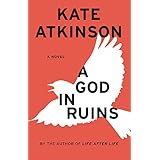
BOOK REVIEW: A GOD IN RUINS, by Kate Atkinson


     Very close to the end of this book, which is built on the framework of the Second World War, Atkinson gets into the numbers.  "Fifty-five thousand, five hundred and seventy-three dead from [presumably only British] Bomber Command."  By that point, having not quite emerged from the long, ordinary, astonishing fictional life of one Edward Beresford Todd, the reader understands the significance of the number.  Those were 55,573 similar stories never told, similar lives never lived.
     You don't need to have read Atkinson's TIME AFTER TIME (here's my review) to appreciate this beautiful new companion novel.  In fact, not having read it might spare you some confusion, because didn't that book end (and also begin) with Ursula Todd, Teddy's sister, killing Hitler in front of a roomful of his hangers-on just as his political star was starting to rise?  Her lifespan from that point on could only have been counted in seconds, and very few of those.  But now, in A GOD IN RUINS, don't we see Ursula surviving the War and dying in late middle age following a stroke?  And wait - if Hitler had been killed in the early 1930's, would there even have been a War? 
     But you would not have been confused for long, because you would have known before even cracking the cover of A GOD that Time, as we know it, does not bind Atkinson; it's her plaything, not her prison.  Which is not to say that Teddy, Ursula's beloved younger brother and their mother's favorite child, is not slowly and inexorably being crushed - ruined - under its weight, just as the rest of us are.  And he lacks Ursula's handy-dandy knack (see TIME AFTER TIME) of repeatedly dying and then popping back up again in what start out, at least, as the exact same circumstances as before.  But Atkinson doesn't need the flashy gimmicks to prove to us that Teddy will come back again.  All she needs is a few lowkey mentions of the Buddha, and the song of a skylark.
     The pre-War Teddy Todd is an amiable, bright-enough young man of no particular talent or ambition who seems destined to remain in a despised career in banking because he can't think of anything better to do.  When the War arrives, he hits rather haphazardly on the idea of training to be a bomber pilot.  Then he goes off to serve his country.  Years later, when his plane is shot down over Germany, he is taken prisoner.  After the War ends, he marries the literal girl next door, the one he's loved since the age of three.  Teddy stumbles into a job as a columnist ("Nature Notes") for his local newspaper, which eventually becomes the editorship, which eventually becomes his career.  He and Nancy have a daughter.  Some nine years later, Nancy develops a brain tumor, and dies not long after.  Teddy raises Viola by himself.  She grows up to be a one-woman horror show.  When she abandons her own two children, Teddy raises them by himself too.  He gardens.  He cooks.  He does not travel, or fall in love again, or develop meaningful friendships, or have epiphanies about the meaning of life.  Time passes.  Teddy retires from the newspaper; quietly grows old, then very old;  misses all those he has loved and lost; dies.  An uncomplicated story about an uncomplicated man.  Neither of which is even possible.
     Teddy's is a life lived with decency, and Atkinson shows us, step by step, how it's done.  Teddy has fulfilled his duty to Bomber Command after 30 runs, but he knows he's a good, steady pilot who inspires confidence in his crews, so he signs up again.  And then again.  By the time he's captured, he has completed 72 bombing runs. Rained death and destruction on the Germans; done much more than his part to crush the German was machine. The postwar Teddy is well aware of the cost of his bargain with the devil, although in hindsight he would have made the same choices, and  Atkinson includes those numbers too, lest we forget: 7 million German dead, including 500,000 killed by Allied bombers. 

 
                                            Hamburg (one of the cities Teddy's crew bombed)

Five hundred thousand, including, perhaps, a white-haired, mechanically-inclined orphan boy whose song Anthony Doerr sings to us in ALL THE LIGHT WE CANNOT SEE. Who's to say that fictional people don't exist in the same dimension as each other, especially during the chaos and displacement of wartime?
     Before her mind has been ravaged by the tumor, Nancy asks Teddy to help her die when the time comes.  Although he cannot bring himself to make the promise, he does bring himself to keep it.  Of course, this act of heroism is not without consequences either: unbeknownst to Teddy, Viola is a silent witness of the scene. Could it be part of the reason she becomes such an inhuman adult?  Why she eventually becomes so relentless in her efforts to move Teddy along the old-age conveyor belt toward his demise? 
     Without drama, without expecting anything in return, Teddy saves the lives of his grandchildren, Sunny and Bertie, with his patient, quotidian love for them.  But this good deed somehow goes unpunished: unlike Viola, they love him in return, each in his or her own way.
     The lesser joys of reading a Kate Atkinson novel are too many to list.  Bertie's hilarious parenthetical commentary on her mother is the voice in our ear of the snarky best friend we wish we had. Teddy, much to his chagrin, is the involuntary subject of his flamboyant, childless Aunt Izzie's  hugely successful series of boys' books, THE ADVENTURES OF AUGUSTUS ( "What makes you you?  What do you like doing?  Who are your friends?  Do you have a thingamajig, you know -" she said, struggling for alien vocabulary, "David and Goliath - a slingshot thingy?")  And then, as if Augustus were not enough of a cross to bear, Viola becomes a novelist, specializing in thinly-veiled revisionist history, and he becomes her antihero ("He also failed (apparently) to understand that the book - young girl, brilliant and precocious, troubled relationship with her single-parent father, etcetera - was about them.  Surely he knew that?  Why didn't he say something?")  Ah.  Point well taken, Kate Atkinson.  Not all literary incarnations are rewards for a life well lived.
     "A man is a god in ruins," wrote Ralph Waldo Emerson in Nature.  Atkinson has the heart and wisdom  to celebrate both aspects of the dialectic.  Thanks to her, Teddy's song lives on.  Happy Father's Day, Edward Beresford Todd.

Sunday, May 31, 2015

THE HUNGRY, HUNGRY BLOG (and blogger)

Please help.  My blog is starving and I have nothing to feed it.


     I'm stricken with pity and guilt by my blog's plight, but pity and guilt don't help it any more than they would help this tiny scrap of avian life to survive, to grow, to someday unfold its new wings, to launch itself into the infinite nest of the air.  My blog needs nourishment, and I have none to give.
     Unfortunately, the USB ports on my laptop don't accept worms and grubs.  If they did, I could probably manage to find some good specimens in the back yard.  But the food I need to produce for the blog has to be manufactured in my brain, and my brain seems to have closed up the creativity shop.  The only thing it seems able to produce these last few weeks is anxiety, and as we all know, the only thing anxiety can feed is more anxiety.


     It's embarrassing to reveal what I'm so anxious about, but I will, in the hope that if I spill a little of my own blood between the keys, the blog will at least be temporarily mollified.  I'm anxious because in 13 days I'll find myself in attendance at the New Jersey Society of Book Writers and Illustrators (a.k.a. "NJSCBWI") annual Conference.  I've attended this Conference for many years, and for every one of at least the last five, I've gotten my heart broken.  I've submitted the first 15 pages of a book manuscript for one-on-one critiques by editors  and/or agents, and I've been told by at least one such critiquer that she (it's always been a she) loves what I've written, loves the way I write, and wants to see more, more, more.  So I've duly sent more, more, more, only to (occasionally) be told never mind, or (more frequently) never hear so much as a syllable in response.  This happens every.  Single.  Year.  And yet I keep making my annual pilgrimage to this Conference, because where else will I find the opportunity to receive real critiques from real industry professionals?  It's truly an amazing perk that NJSCBWI offers, and I keep taking advantage of it, and I keep getting my hopes up, only to eventually be spat out once again upon the slush-pile shore.
     But here's the thing: my writing keeps getting better.  I know this to be true beyond all doubt.  So of course, each year I can't help believing that THIS TIME will be the charm.  And each year, I do inch closer and closer, but - at least so far - never close enough.  Which is why for the past week I haven't been able to draw a full breath - not like that's annoying, right? - and I'm not expecting any relief from this condition until I'm back home post-Conference.
     Truth be told, writing all this is not only embarrassing; it's mortifying.  What's wrong with me??  Do I not have one of the most fortunate of lives?  I have a good, wise, supportive husband.  I have two healthy, smart, talented, funny, kind children.  I live with the two best dogs in the world.  I have a career that I find challenging and rewarding, and that also pays decent money.  I have a handful of friendships that go bone-deep.  In sum, I have everything I have any right to want, and more.  So why can't I just be grateful and STFU????
     I'll tell you why.  Because, much like my blog and a certain caterpillar, I'm hungry, hungry too.

Wednesday, May 20, 2015

PERSONALLY...

     In April I only wrote about other people - specifically, people who lived and died 500 years ago.  So far in May, I've barely written about anything at all.  So maybe it's time for me to write about myself and my family and our little jaunt over the past weekend to Washington, D.C. TO ATTEND MY SON'S LAW SCHOOL GRADUATION!!
     But honestly, it's been such a crazy couple of weeks that I'm not sure I have enough brain power remaining to write anything coherent, let alone halfway intelligent.  So we'll compromise.  I'll just post pictures.

there's the grad
 
(is it just me, or is there something distinctly 16th-century about that cap and gown Nathan's wearing??)


                                  and there he is with his sister (left) and his girlfriend (right)

                                                         and here's the whole fam!!

So much happiness and pride I almost exploded... and still might, if I ever have enough energy!

Wednesday, May 6, 2015

WRAPPING IT UP

     I don't know about you, but for me April ended just in the nick of time.  In the week that followed, this is almost literally the first opportunity I've had to rub two minutes together.  In other words, it's time for me to attempt an A to Z Challenge Wrap-Up post.
     I'll start by saying that I LOVED doing the Challenge in this, my second year.  I sort of stumbled my way to what proved to be the perfect topic for me: 16th-century people who lived exceptional lives in one way or another, but whose names are, for the most part, unfamiliar to people of the 21st century except for historical scholars.  Not being a historical scholar myself, I had never heard of almost any of the 26 people I ended up posting about, and trying to round up and organize information about their lives was a constant source of delight for me.
     I also discovered a whole bunch of wonderful blogs and bloggers that I would probably never have found otherwise.  I can't mention all the names here, but I will list my absolute top three (in no particular order):

     Kern Windwraith, The Odd Particle Review.  Quirky, hilarious, thought-provoking observations, 
deeply generous in spirit.

     Nilanjana Bose,  Madly-in-Verse.  Gorgeous poetry that had me thinking, almost every                   day: "So why is it exactly that this writer isn't famous yet?"

     Zalka Csenge Virag, The Multicolored Diary.  Fascinating summaries by a professional storyteller of epic tales from around the world, retold with panache, expertise, and irreverent humor.

     I volunteered to be a Minion this year, and then when I found out what that entailed, I thought about backing out.  Did I really want to be a Blog Cop, searching out and reporting to my Overlord bloggers who had dropped out along the way or who were still participating but not following the rules?  YUCK!  It took me a little while, but then I caught on to the purpose behind all this.  A lot of Challenge participants diligently hop around the list, visiting ten or twenty or even more new blogs each day, and it can be a real bummer to put in that kind of time and effort, only to find that you keep hitting on blogs that aren't really part of the Challenge after all.  So the goal is to eliminate the debris and make blog-hopping a more pleasant experience for the people who actually are participating.  Makes sense, right?
     I don't have any brilliant suggestions about ways to improve the Challenge for next year.  I enjoy the democratic flavor of it all - we're all in it together as long as we're willing to put in the work.  Since I'm unlikely to ever run a marathon, this may be the closest I get to that kind of experience!  And I don't even have to be seen in public in running shorts!  I'd call that a win-win.
     Congratulations to all my fellow Challenge survivors!  If we didn't meet this year, I hope we will next April.
   

Thursday, April 30, 2015

Z IS FOR ABRAHAM ZACUTO


     Abraham Zacuto was born c. 1452 and died sometime between 1510 and 1520, so it might be a bit of a stretch to call him a 16th-century personage, but I've gotten all the way up to Z in this Challenge, barely cheating along the way, so you're just going to have to cut me some slack with this.  Thank you.  He was a very interesting man, and well worth bending the rules for.  The story of his life reads like a well-plotted novel: every good turn of events is followed by a bad one, and vice versa.
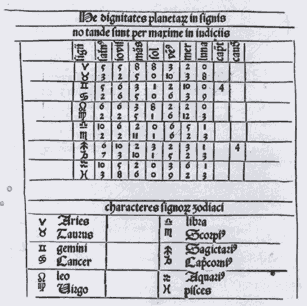
     Zacuto was born in Salamanca, Spain, into a family of that city's Jewish nobility, and was given an outstanding religious and secular education.  As an adult he became a mathematician and astronomer, served as the rabbi of his community, and taught astronomy at several prestigious Spanish universities, becoming quite well-known in academic circles.  Unlike Copernicus, whom we discussed for the letter C, Zacuto apparently specialized in applied, rather than theoretical, astronomy.  From what little we know, it sounds like the first 40 years of his life were satisfying ones.  In 1478 he published, in Hebrew, a "Great Book" of 65 very detailed astronomical tables that corrected a navigational problem no one had been able to overcome before, and was thus of great practical use to seafarers.  The book, soon translated into Spanish and Latin versions, became a huge success, and no 16th-century European maritime explorers embarked without a copy of it. 


     Then all the Jews who refused to convert to Catholicism were expelled from Spain by Ferdinand and Isabella in August 1492, beginning one day before Christopher Columbus embarked on his voyage to the New World with Zacuto's charts on board for guidance (a copy of the charts with Columbus's own handwritten notations is preserved in Seville).  Rather than undergo forced conversion (as some historians believe Columbus did, having possibly been born a Jew), Zacuto fled to Portugal, along with tens of thousands of other Jewish refugees.  His academic reputation had preceded him and allowed him to land on his feet.  He was soon appointed as the Royal Astronomer and Historian to Portugal's King John II. 
     For most Jewish immigrants to Portugal, their respite (bought from King John with cash) was only temporary; less than a year after granting them asylum, King John ordered that all remaining Jews in the country who refused forced conversions be enslaved.  Of course, exceptions were made for valuable citizens like Zacuto, who remained at court in Lisbon.  King John died in 1495 and was succeeded by Manuel I, who for a time maintained Zacuto in his royal position and consulted with him as to whether Vasco da Gama's proposed voyage to find a sea route to India would be feasible.  Zacuto supported the plan, and he personally trained da Gama and his crew before they departed on their voyage in 1496, bearing with them Zacuto's navigation charts as well as the new, more portable kind of astrolabe he had invented to be used at sea to determine latitude.
     But in 1497, bowing to political pressures (he wanted to marry the daughter of Ferdinand and Isabella of Spain, whose views on harboring Jews we all know), King Manuel ordered that the Jews in Portugal must either convert to Christianity or be deported without their children.  Zacuto and his son Samuel were among the few who managed to escape the country in safety. They fled first to Tunis, where in 1504 Zacuto wrote a history of the Jewish people from the time of the Creation to the year 1500, which was repeatedly reprinted for centuries afterward.  From Tunis, under the increasing threat of Spanish invasion, he moved on to elsewhere in the Middle East - possibly Turkey, possibly Damascus.  Exactly where he spent the rest of his life is unknown, but it is said that he was buried in Jerusalem. 
     The moon crater Zagut is named after Abraham Zacuto.

    In THE DISCOVERERS, Daniel Boorstin (my go-to awesome quotemeister) was writing about Jewish cartographers, but I think what he wrote was equally applicable to astronomers like Zacuto, who mapped the skies rather than the Earth: "It was no accident that Jews played a leading role in the liberation of Europeans from the slavery of Christian geography.  Driven from place to place, they helped make cartography, still the special preserve of princes and high bureaucrats, into an international science, offering facts equally valid in lands of all faiths.  Marginal both to Christians and to Muslims, the Jews became teachers and emissaries bringing Arab learning into the Christian world."

                                                      Vermeer: The Astronomer

                     *              *             *              *              *              *               *             *

     And thus ends my 2015 A to Z Challenge.  It's been an incredible journey for me.  I've learned so much, I've made some new cyberfriends, and I feel like I've been part of something meaningful.  I'd like to thank the Academy - oops, wrong speech.  But I truly would like to thank every blogger who stopped by here during April, even if it was only once, regardless of whether they had time to leave a comment.  I started doing this Challenge last year thanks to Yvonne Ventresca, who told me about it.  And this year I had the extra satisfaction of being a Minion, which made me feel like I was doing a little bit to give back, even though I didn't have as much time as I would have liked to visit other blogs.  There was a comment left on my yesterday's post about how one person can change history, and indeed, that is true.  Well, one person, Arlee Bird, thought up this Challenge a few years ago, and look at the amazing thing he's wrought!  Bloggers from all around the world come together for one month to share a common goal.  The alphabet is, of course, secondary, but it does add a layer of structure and an added element of challenge.  Well done, all of us!  And that includes everyone who successfully finished as well as everyone who tried but didn't quite make it this time.  There's always next year!  I hope to see everyone back again in 2016!  And until then, here's an Irish blessing that may well date back before my beloved 16th century:

May the road rise to meet you.
May the wind be always at your back;
May the sun shine warm upon your face;
And, until we meet again, may God hold you in the palm of his[/her] hand.


Wednesday, April 29, 2015

Y IS FOR YI SUN-SHIN

                                                                    (1545 - 1598)

     Yi Sun-Shin (or Sun-Sin) was a Korean admiral who is remembered as a national hero for turning back a relentless eight-year invasion by Japan.
     Yi was born into a noble family in Seoul but was raised in Asan, near his mother's family.  He passed the government examinations to become a military officer in 1576 (after failing them on his first try because he fell off his horse and broke his leg).  Yi first made his mark as a strategist on land, defending border territories from Jurchen marauders from Manchuria, China.  In 1583, he lured the Jurchen into battle and captured their chief.  Soon after that, he became a naval officer.  Although at the time he had no naval experience at all, he proved adept and soon rose through the ranks. 
     The Korean government and military were rife with corruption and backstabbing.  Other officers were jealous of Yi's rapid rise, and spread false accusations about him which led to his discharge from officer rank.  He was imprisoned and tortured, and when he was released he was demoted to a common soldier.  Soon, though,  he was assigned to run a military training center in northern Korea, which he did very well.
     Within the span of a few months in 1590, Yi received four different promotions, culminating in his appointment as commander of the naval forces in Left Cholla Province. While in that post, he resurrected and developed the famous kobukson, "Turtle Ship," considered the first ironclad battleship in history.  Cannons and guns could be fired from every side of these ships, and the dragon's heads on the bows could not only fire cannon, but also discharge smoke screens to conceal the ship's position from enemies.  The decks were covered with armored plates which were studded with spikes and knives to prevent boarding by hostile forces (the Japanese ships were taller than the Korean ones, and leaping onto the decks of the vessels they wanted to capture was a Japanese m.o.).


      In 1592 Japan invaded Korea as a first step in its plan to conquer China.  Because Yi was one of the very few who had foreseen that the invasion was inevitable, he and his troops were well-supplied and well-prepared, despite the lack of cooperation he received from the government.  Japan increased the size of its fleet to 1,700 ships, hoping to defeat the Korean navy through sheer numbers.  But the Korean ships were structurally stronger than the Japanese ones, and Yi proved to be an exceptionally able strategist and leader.  His forces defeated the Japanese invaders again and again, although they were greatly outnumbered.  They fought four major operations against the Japanese during 1592,  consisting of at least 15 battles, and Yi's forces decisively won every battle.  While the Japanese invading land forces were very successful against Korea, their navies kept suffering humiliating defeats.  In 1593, Yi was appointed the joint naval commander of the three southern provinces.
      In 1597, a Japanese double agent convinced the useless Korean king that the Japanese were about to launch a massive attack and insisted that Yi and his forces be sent to set an ambush.  Knowing how treacherous the area was for ships, and probably smelling a rat, Yi refused the king's orders.  As a result, Yi was once again arrested, imprisoned and tortured.  Upon his release, he was demoted to the rank of a common soldier.  But his replacement as commander was disastrously inept, and under his watch the Japanese virtually destroyed the entire Korean fleet.  Yi was quickly reinstated in his old post, but the Japanese wasted no time in attacking his greatly reduced navy, trying to finish it off for good this time.   Miraculously, helped in part by a shift in the tides, Yi's 13 remaining ships defeated the Japanese force of 333 ships at the Battle of Myeongnyang, while suffering almost no casualties and losing none of their own tiny fleet.  This resounding naval victory is credited with turning the course of the war against Japan and eventually leading to that country's retreat after eight years of continuous war.  Unfortunately, Yi was not alive to see the final victory.
     In December 1598, during the Battle of Noryang, Yi's forces once again defeated the Japanese and were pursuing them as they fled, but Yi himself was struck by a stray bullet.  Aware of his imminent death, he famously said to his son and nephew, "The war is at its height. Wear my armor and beat my war drums.  Do not announce my death."  They obeyed his commands and kept the troops fighting until victory was achieved.  Thus, even after his death, Yi and his forces remained undefeated in every battle they fought with the Japanese.
     Yi's noble deeds in protecting his country have been commemorated with statues scattered throughout Korea.