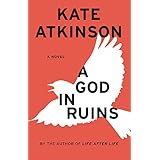
Very close to the end of this book, which is built on the framework of the Second World War, Atkinson gets into the numbers. "Fifty-five thousand, five hundred and seventy-three dead from [presumably only British] Bomber Command." By that point, having not quite emerged from the long, ordinary, astonishing fictional life of one Edward Beresford Todd, the reader understands the significance of the number. Those were 55,573 similar stories never told, similar lives never lived.
You don't need to have read Atkinson's TIME AFTER TIME (here's my review) to appreciate this beautiful new companion novel. In fact, not having read it might spare you some confusion, because didn't that book end (and also begin) with Ursula Todd, Teddy's sister, killing Hitler in front of a roomful of his hangers-on just as his political star was starting to rise? Her lifespan from that point on could only have been counted in seconds, and very few of those. But now, in A GOD IN RUINS, don't we see Ursula surviving the War and dying in late middle age following a stroke? And wait - if Hitler had been killed in the early 1930's, would there even have been a War?
But you would not have been confused for long, because you would have known before even cracking the cover of A GOD that Time, as we know it, does not bind Atkinson; it's her plaything, not her prison. Which is not to say that Teddy, Ursula's beloved younger brother and their mother's favorite child, is not slowly and inexorably being crushed - ruined - under its weight, just as the rest of us are. And he lacks Ursula's handy-dandy knack (see TIME AFTER TIME) of repeatedly dying and then popping back up again in what start out, at least, as the exact same circumstances as before. But Atkinson doesn't need the flashy gimmicks to prove to us that Teddy will come back again. All she needs is a few lowkey mentions of the Buddha, and the song of a skylark.
The pre-War Teddy Todd is an amiable, bright-enough young man of no particular talent or ambition who seems destined to remain in a despised career in banking because he can't think of anything better to do. When the War arrives, he hits rather haphazardly on the idea of training to be a bomber pilot. Then he goes off to serve his country. Years later, when his plane is shot down over Germany, he is taken prisoner. After the War ends, he marries the literal girl next door, the one he's loved since the age of three. Teddy stumbles into a job as a columnist ("Nature Notes") for his local newspaper, which eventually becomes the editorship, which eventually becomes his career. He and Nancy have a daughter. Some nine years later, Nancy develops a brain tumor, and dies not long after. Teddy raises Viola by himself. She grows up to be a one-woman horror show. When she abandons her own two children, Teddy raises them by himself too. He gardens. He cooks. He does not travel, or fall in love again, or develop meaningful friendships, or have epiphanies about the meaning of life. Time passes. Teddy retires from the newspaper; quietly grows old, then very old; misses all those he has loved and lost; dies. An uncomplicated story about an uncomplicated man. Neither of which is even possible.
Teddy's is a life lived with decency, and Atkinson shows us, step by step, how it's done. Teddy has fulfilled his duty to Bomber Command after 30 runs, but he knows he's a good, steady pilot who inspires confidence in his crews, so he signs up again. And then again. By the time he's captured, he has completed 72 bombing runs. Rained death and destruction on the Germans; done much more than his part to crush the German was machine. The postwar Teddy is well aware of the cost of his bargain with the devil, although in hindsight he would have made the same choices, and Atkinson includes those numbers too, lest we forget: 7 million German dead, including 500,000 killed by Allied bombers.
Five hundred thousand, including, perhaps, a white-haired, mechanically-inclined orphan boy whose song Anthony Doerr sings to us in ALL THE LIGHT WE CANNOT SEE. Who's to say that fictional people don't exist in the same dimension as each other, especially during the chaos and displacement of wartime?
Before her mind has been ravaged by the tumor, Nancy asks Teddy to help her die when the time comes. Although he cannot bring himself to make the promise, he does bring himself to keep it. Of course, this act of heroism is not without consequences either: unbeknownst to Teddy, Viola is a silent witness of the scene. Could it be part of the reason she becomes such an inhuman adult? Why she eventually becomes so relentless in her efforts to move Teddy along the old-age conveyor belt toward his demise?
Without drama, without expecting anything in return, Teddy saves the lives of his grandchildren, Sunny and Bertie, with his patient, quotidian love for them. But this good deed somehow goes unpunished: unlike Viola, they love him in return, each in his or her own way.
The lesser joys of reading a Kate Atkinson novel are too many to list. Bertie's hilarious parenthetical commentary on her mother is the voice in our ear of the snarky best friend we wish we had. Teddy, much to his chagrin, is the involuntary subject of his flamboyant, childless Aunt Izzie's hugely successful series of boys' books, THE ADVENTURES OF AUGUSTUS ( "What makes you you? What do you like doing? Who are your friends? Do you have a thingamajig, you know -" she said, struggling for alien vocabulary, "David and Goliath - a slingshot thingy?") And then, as if Augustus were not enough of a cross to bear, Viola becomes a novelist, specializing in thinly-veiled revisionist history, and he becomes her antihero ("He also failed (apparently) to understand that the book - young girl, brilliant and precocious, troubled relationship with her single-parent father, etcetera - was about them. Surely he knew that? Why didn't he say something?") Ah. Point well taken, Kate Atkinson. Not all literary incarnations are rewards for a life well lived.
"A man is a god in ruins," wrote Ralph Waldo Emerson in Nature. Atkinson has the heart and wisdom to celebrate both aspects of the dialectic. Thanks to her, Teddy's song lives on. Happy Father's Day, Edward Beresford Todd.