Friday, April 22, 2016

S IS FOR STANDUP COMEDY


     Who needs comedy clubs when you can have your own personal jester(s) on call 24/7?  If the jester is a member of your household, you don't ever have to worry about the show being sold out before you've had a chance to score tickets. 


     The jester could have many talents - singing, dancing, juggling, acrobatics, magic tricks - but primarily, his job  was to make people laugh, with his jokes or with his physical comedy or both.  Not only royals, but also wealthy aristocrats, kept jesters as household members.  Recruitment was apparently a pretty casual process, as shown in this 1662 account of the recruitment of a man named Tarlton to be a jester for Queen Elizabeth I:

          Here he was in the field, keeping his father's swine, when a servant of
          Robert Earl of Leicester... was so highly pleased with his happy/
          unhappy answers, that he brought him to Court, where he became
          the most famous jester to Queen Elizabeth.

     To quote from Beatrice K. Otto's FOOLS ARE EVERYWHERE: THE COURT JESTER AROUND THE WORLD (University of Chicago Press, 2001), an online excerpt of which has provided me with much of the information I share in this post:

                        An individual court jester in Europe could emerge from a
                        wide range of backgrounds; an erudite but nonconformist
                        university dropout, a monk thrown out of a priory for
                        nun frolics, a jongleur [juggler] with exceptional verbal
                        or physical dexterity, or the apprentice of a village
                        blacksmith whose fooling amused a passing nobleman.
                        Just as a modern-day television stand-up comedian might
                        begin his career on the pub and club circuit, so a would-be
                         jester could make it big time in court if he was lucky
                         enough to be spotted.

     Some jesters were witty and well-educated.  Some were just naturally funny people, the smartasses of their era.  Unfortunately, others were chosen from among the ranks of the physically or mentally handicapped.  Dwarves abounded in the profession..  


      There were also a fair share of "naturals," people with intellectual limitations who were, on the one hand, mocked and infantilized, but on the other hand, were treated with a measure of awe because they were thought to be divinely inspired.
     Otto contends that "the court jester is a universal phenomenon," and cites to historical records from China, India, Japan, Russia and Africa.   But fortunately for 16th-century European jesters, the long tradition of their profession was given a boost by the 1511 publication of a short book by the philosopher Desiderius Erasmus called IN PRAISE OF FOLLY:

                         We have all seen how an appropriate and well-timed joke
                          can sometimes influence even grim tyrants... The most
                          violent tyrants put up with their clowns and fools, though
                          these often made them the butt of open insults.

     According to Otto, "the fortunes of the European court jesters rose and fell with the tsunami-scale wave of medieval and Renaissance fool mania that engulfed the continent."  Thanks to Erasmus, folly became a hot topic in Europe, and professional "fools" became hugely popular for their illustration of the concept as well as for their entertainment value.


traditional jester's hat sporting three points, each ending in a jingle bell

older-style jester's costume, featuring hat with ass's ears
 
     But there was a second aspect of jesterdom that Otto says was also universal: "jesters everywhere were allowed and encouraged to offer counsel and to influence the whims and policies of kings."  Instead of being expected to fawn over and flatter their masters like everyone else, jesters were given unique liberty to speak their minds and to offer criticisms that might have gotten anyone else thrown into a dungeon, as the above quote from Erasmus demonstrates.  This situation led to the paradox of the "wise fool," a societal outcast who sees and says things more clearly and truthfully than anyone else.  A prime example is the Fool in Shakespeare's King Lear, who repeatedly (and with impunity) chastised the old king for his poor judgment and egotistical shortsightedness.  On the other hand, once Lear was dethroned by his conniving daughters and had become a demented, friendless, homeless old man, the Fool was the only person who loyally stayed by his side in his wanderings.


     In short, a jester's master might have had the jester at his beck and call, but in exchange, he would have to put up with whatever verbal abuse the jester felt like dishing out.  So it really was like stand-up comedy in a way; the Fool would get heckled, but he would heckle the audience right back.


Wednesday, April 20, 2016

U IS FOR UPS (AND UBER!)

      The sixteenth century was the dividing line between the Dark Ages - haunted by the Black Plague, governed by superstition - and the Renaissance, when the world was reborn at what must have felt like lightning speed.  Science began to replace myth; the advent of printing spread new knowledge around the globe; the Protestant Reformation loosened the Catholic Church's iron grip on European society.  But transportation of people and goods remained virtually unchanged.  Horses, mules and ships provided the only ways to get from one place to another without having to walk.  Both land and sea routes were fraught with danger from thieves and pirates, who flourished pretty much unchallenged by law enforcement, and sea routes were also beset by storms, rocks, and other natural causes of shipwreck.  In short, things were a mess.
     Enter Francesco de Tasso of Lombardy (1459-1517), also known in Germany as Franz von Taxis and in France as Francois de Tassis.


     Members of the de Tasso family had been operating courier services in some of the Italian city-states since the very end of the 13th century, but things didn't really take off until 1490, when the German king (later Emperor) Maximilian commissioned Francesco, along with his brother and his nephew, to build postal and courier lines throughout the Holy Roman Empire.  They responded by setting up the first relay-style postal system (think Pony Express) with stations along the route for the couriers to change horses.  By 1505, de Tasso's system was operating in France and Spain as well.  He obtained a monopoly on carrying both government and private mail, thus creating the very first mail service to which the public could have access for a fee.  De Tasso employed as many of his own relatives as he could, and apparently they shared his work ethic, because the business flourished and was constantly expanding into new locations.  In 1512, Maximilian, now an emperor, granted the family a patent of nobility (hence the name VON Taxis).  They acquired a fancy coat of arms:


     Franz died in 1517, but as international trade increased throughout the 16th century, a dependable postal service became even more indispensable in almost every aspect of life.  Well into the 19th century branches of the von Taxis family continued to run both national and local postal services in Spain, Germany, Austria, Italy, Hungary, Belgium and the Netherlands, eventually employing up to 20,000 messengers at a time.


     The family also became incredibly wealthy along the way, as you might be able to tell from some glimpses of their humble homestead.


     No, these aren't photos of Buckingham Palace, although you could be forgiven for thinking so.  Not too shabby for a family of mailmen, am I right?

     And as to the Uber reference in my post title: the de Tasso/von Taxis family never did get involved in transporting passengers from place to place, but did you ever wonder where the word "taxi" came from?   Well, wonder no more!
  

Q IS FOR QUEER CULTURE


     This is going to be different from my other A to Z posts.  While all the other ones are designed to illustrate that there is nothing new under the sun, this post is going to be about an area in which significant progress HAS been made - not so much because we're so awesome, but because 16th century conditions were so horrifying.
       Throughout history, some cultures have tolerated (or even endorsed) homosexuality to varying degrees, but Judeo-Christian culture has never been one of them.   Both the Old and New Testaments strongly condemn homosexual practice, and those proscriptions were taken seriously throughout Europe.  Thomas Aquinas, who lived during the 13th century, ranked sodomy as second only to murder among all sins.  But as a practical matter, during the Middle Ages the general policy was often "don't ask, don't tell."  There were no police forces, after all, and presumably not many cities wanted to waste their scarce judicial resources on victimless crimes.
     All of that changed dramatically during the Renaissance.  Ironically, the historical period famous for major artistic, intellectual and scientific advances was also the period when most of Europe, led largely by the Catholic Church, enacted brutal crackdowns on gay people.  Part of the hysteria seems to have stemmed from the fact that the practice of sodomy was widely believed to contribute to the spread of both the Black Plague and syphilis.  In short, if there was a queer culture in 16th century Europe, it had to remain deeply hidden, or its members would risk being executed.

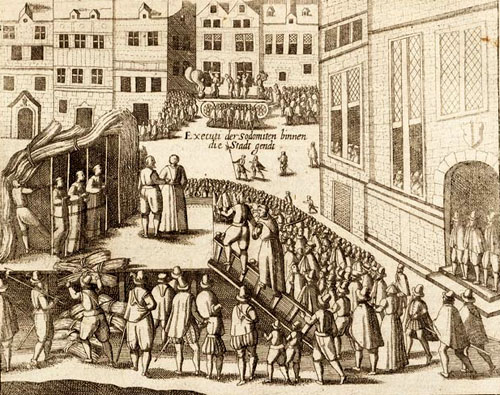
Execution of homosexual monks in Ghent

     In Spain and all its colonies, the Spanish Inquisition began in 1478, and it was not formally abolished until 1834.  At least 500 people were prosecuted as sodomites (a term often used interchangeably with homosexuals, although it also had broader meanings) in Spain during the Inquisition, and the first sentence of burning (to death) was carried out in 1572.  Everything is relative; it's been noted that the Inquisition executed relatively few consenting adults for sodomy, focusing instead on rapists and child abusers.  In 1532, the Holy Roman Empire enacted a law making sodomy punishable by death.   In France, first-time offenders were castrated; second-time offenders were punished by some form of dismemberment; third-time offenders were burned.  Lesbians received punishments of similar severity.


     In 1533, Henry VIII of England and his pal Thomas Cromwell passed the Buggery (a.k.a. sodomy) Act,  which provided that all acts of male-male sexuality were punishable by hanging, followed by confiscation by the government of all one's property.  Even priests, monks and nuns, who could not be prosecuted for murder, could be convicted and hanged as sodomites.  Conveniently enough for the King, this would lead to the confiscation of monastery lands.  Perhaps this was why the Catholic Queen Mary abolished the Act when she assumed the throne in 1553, and why her younger sister, the Protestant Queen Elizabeth I, reinstated it when she succeeded Mary ten years later.
     The city of Florence was well-known in the 15th century as one place that did have a fairly open and widespread homosexual culture.  In 1432 the city established a troop of Officers of the Night, whose job it was to root out sodomy.  From then until 1502, more than 17,000 men were charged with sodomy in Florence, and 3,000 were convicted.
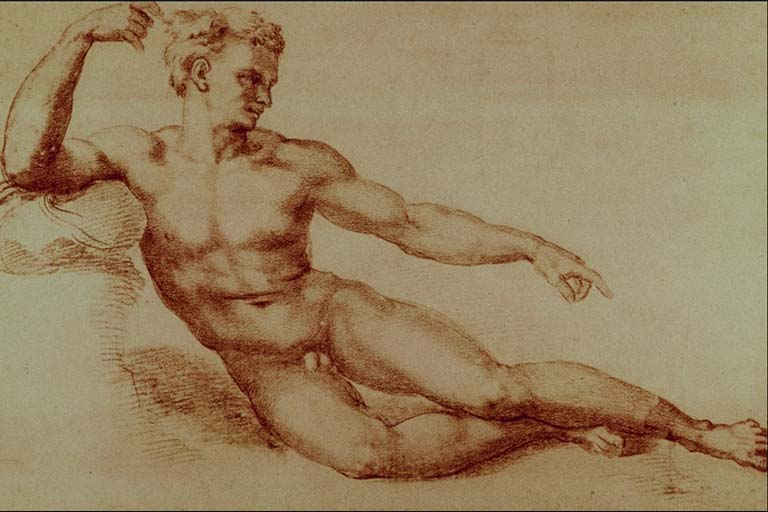
     Michelangelo, arguably the greatest artist of the Renaissance, was widely believed by his contemporaries to be homosexual.  The debate as to whether or not he actually was still rages, but the fact is that he was never prosecuted for sodomy (unlike Leonardo DaVinci, who actually seems to have been asexual, but was charged - probably falsely - with sodomy by a rival painter and was jailed for a few weeks).  But then again, Michelangelo was Michelangelo.  His genius was undisputed, and it's reasonable to believe that he was considered above the law.

Michelangelo drawing
     The persecution of homosexuals gradually became somewhat less intense during the 17th and 18th centuries, but once again, everything is relative.  The first western European country to decriminalize homosexual acts between consenting adults was revolutionary France, in 1791.


Tuesday, April 19, 2016

P IS FOR PAPARAZZI

     16th century Europe didn't have rock stars, movie stars, or star athletes.  On the other hand, they had all of the above rolled into one: royals.  People gathered in droves when they heard that kings and queens would be on public display.

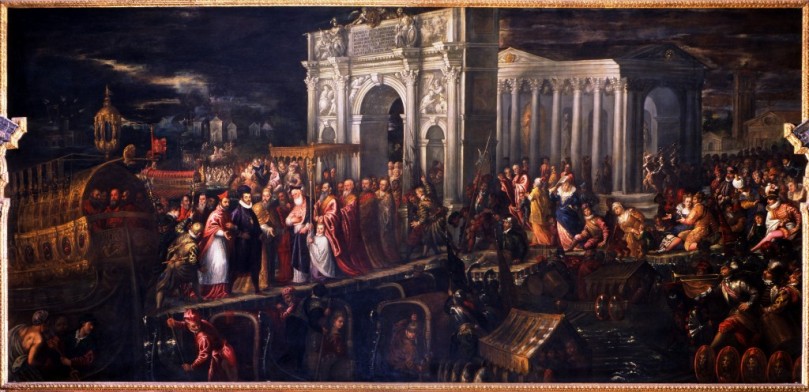
     In July of 1574, Henri III, the new successor to the French throne, was on his way with an enormous entourage from Poland, where he had been living in exile, to Paris, to claim his kingdom.  He decided to stop in Venice along the way.  Venice was a proud republic, and had been so for many years, but that didn't mean that its citizens weren't as gaga over royalty as anyone else, if not even more so. 


     The first (unpublished, of course) book I ever wrote was a middle-grade novel set in the year 1574 in Murano, a tiny island off the coast of Venice that was the traditional home of the city's glassblowers.  Because this A to Z post is the only way any of GLASS ISLAND will ever see the light of day (see title of blog above), I'm going to offer an excerpt of the scene in which I describe (based on research into contemporary accounts) the crowd of spectators gathered near the water in Murano to watch Henri's arrival in Venice, as seen from the viewpoint of young Tommaso, the main character.


On the evening of July 16th, more than thirty thousand people, all mad with excitement, stood jostling and pushing at the Murano pier. Tommaso's family had been stationed there since midafternoon.  Papa, Uncle Luigi, Marco and Tommaso all stood, legs braced, arms around each other's shoulders, creating a small semicircle of space into which Mama, Aunt Rosanna, and the younger children were all packed. The boys were under strict orders not to move, no matter what happened. But Marco, who was still not speaking to Tommaso, found many opportunities to pinch and shove him when the adults weren't looking. 
As the sun began to drop into the sea, the woman standing directly behind Marco suddenly stopped scolding her children, gave a gasp and fainted in the heat, almost knocking Marco over, but he stood his ground like a soldier. 
A gondola carrying a group of Turkish merchants drew up at the waterside. Their appearance drew angry mutterings from the crowd. One red-faced man, who had been drinking wine at least since Tommaso had been there, refused to move over to make room for them. "You don't belong in Venice!" he shouted, shoving aside a portly Turk with a long gray beard."Walking around as free as the rest of us, and you're probably all spies for your heathen government! Go back to your own filthy country!"
A shriveled little man with no teeth took up the chant.  "They ought to be kept in pens if they have to be here. Gathered up in one place so they can't do no harm to the rest of us." 
Fortunately, the Turks either didn't understand Venetian dialect, or were wise enough to pretend that they didn't. They squeezed themselves humbly into the smallest possible space, and silently waited for the King. Since the red-faced man and his toothless friend couldn't draw any response from them, they soon gave up and sank back into a bleary-eyed silence.


Just as twilight turned to dark, a new commotion began less than ten yards from where Tommaso and his family stood. 
"Move over, swine!" 
"I was here first, son of a dog!" 
"Aargh!  You spit on me!"
"I didn't!"
"Liar!  Here's what I have for you!"
Screams and shouts filled the air. Tommaso couldn't see what was going on, but he could hear excited voices. "My God! He's got a knife!" "Stop him!" "He's bleeding!" "Give him room! Room!  The man's been stabbed!"
All was unimaginable chaos. Eventually, the man with the knife was wrestled to the ground, and the injured man, moaning in pain, was lifted over the heads of the crowd and carried off into the nearest house to have his wounds bandaged. To Tommaso's great relief, word came back that he would live.

An hour after the torches were lit, the King finally did arrive, accompanied by a


fleet of more than two thousand gondolas. The mass hysteria reached new heights,

but none of the people crammed together at the dock actually got to see him.

Surrounded by hundreds of his entourage, including armed guards, Henry was rushed

under a canopy through the crowds to the palace of Bartolomeo Capello, where he

was to spend the next two nights.  The disappointed mob seemed almost ready to

storm the palace walls.

Henri III arrives in Venice
 
 
     Of course, everywhere the royals went in Europe, people lined up along the roads to watch them pass by, but for most of them the sight of a royal entourage was at least an occasional occurrence.  For the Venetians, who had no royalty of their own (they always had a doge, a chief magistrate, who made very fancy public appearances from time to time, but he was just a well-connected Venetian politician so it wasn't quite the same), that July day in 1574 was a once-in-a-lifetime experience.

Monday, April 18, 2016

WE BRIEFLY INTERRUPT THIS A TO Z CHALLENGE...

to bring you this important photo of Leo, my newest family member!


     Leo is an approximately 7-year-old cockapoo who was found so neglected, his coat so hopelessly matted, that the shelter had to shave him down to the skin.  His hair is still growing back, as you can see, and he still needs to put on some weight, but what a handsome little boy he'll be!  He and Finney (partially seen to the right) got along just fine during our meet-and-greet, after an initial warning growl or two.  Leo is friendly, gentle and affectionate, and his temperament will remind us every day of our beloved Murphy, whom we lost to cancer in February.
     Leo isn't home with us yet because we're going to Washington next weekend to visit our adult son, but we're picking up our new baby on our way back on Sunday.  And now we know what to do when he arrives home, thanks to the video posted on Saturday by Giulie Castillo, fellow A to Z blogger and dog rescuer extraordinaire, at Life in Dogs!  Thanks, Giulie!  Thanks, Animal Alliance of Lambertville, New Jersey!  And thanks to whatever higher powers have brought little Leo into our lives!

O IS FOR ORANGE IS THE NEW BLACK

     In age-old European tradition, jails were used as holding facilities for people charged with crimes but not yet sentenced.  That's still how jails are used in the 21st century, although now prisoners are segregated by gender and by an age of majority.  Back then, everyone was just jammed together in one disgusting common area.  But nowadays, there are also prisons - places to which people get sentenced as punishment for their crimes.   Before the 16th century, that concept didn't exist.  Punishment for petty crimes usually consisted of some form of humiliation, like public flogging or being exhibited in the stocks (also called the pillory).

   
     For more serious crimes, the punishment was usually execution in one grisly form or another.   I won't go into detail about these methods because some people might inexplicably find it unpleasant to read about, but if you do have a perfectly understandable curiosity about practices such as drawing and quartering, you can just look it all up yourself.  Sorry, but I'm here to talk about prisons.
     In the 15th and 16th centuries, crime rates soared throughout Europe as populations increased, economies suffered, and rural residents fled to the cities to try to make a living.  If they couldn't succeed there in feeding themselves and their families by legal means, many turned to illegal ones.   The traditional penal systems started becoming unmanageable, and it was apparent that something was going to have to change.
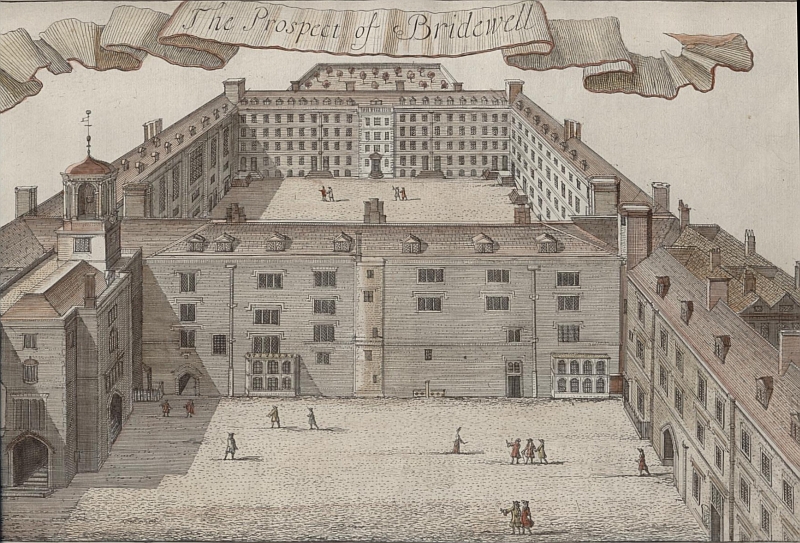
     That change started in London in 1553.  In that year, Bridewell Palace, originally built for King Henry VIII in 1515, was donated by Edward VI to the city, which revamped it into a prison facility for petty criminals.  That category included "vagrants," i.e., homeless people.  Instead of being subjected to brief public humiliation, the prisoners - all of them poor - would instead be both punished and (so it was thought) reformed through a period of enforced hard work, for which they would be paid a small wage.  More than half of the prisoners were also beaten.  And yes, the opening of Bridewell Prison was indeed considered a reform; after all, it gave the benevolent state the opportunity to help the poor to help themselves! 
     One actually beneficial innovation at Bridewell was providing services to homeless children.  Operating as the prison's charitable component, which was called a "hospital," Bridewell provided to its apprentices a rudimentary education and a course of training under masters in useful trades. 


     But of course, it was the "reformist" system of managing indigent populations through incarceration, and not necessarily the "hospital" idea, that soon spread throughout England and the rest of Europe, along with the name "Bridewells."  I'll put in my own two cents here by saying that the system still sounds shockingly familiar to me as a 21st-century American. 
     And then things got even worse in the prisons when the Black Plague swept through Europe in the mid-1500s.  Aware that the terrible sanitation conditions (see my B for Bathrooms post) and cramped living quarters conditions among the poorer classes quickened the spread of the outbreak,  the Powers that Be hit upon the novel idea of sending debtors to prison in vast numbers.  After all, the more poor people who were locked up, the fewer there were still out on the streets to spread disease, possibly even (OMG) to the upper classes.  In the prisons, the reasoning went, the only people they could infect was each other, so...  really, how much of a loss could that be?
     The Plague eventually died out, carrying with it about a third of Europe's population.  But the practice of debtors' prisons persisted into the 19th century, when it ensnared the father of the young Charles Dickens, among countless others.

"Debtors Prison," by William Hogarth


Saturday, April 16, 2016

N IS FOR NOSE JOBS

     There was no shortage of fashionistas in the 16th century,


but cosmetic surgery was unheard of  - with one exception.  Physicians performed rhinoplasties - otherwise known as nose jobs - although I'm using that term in a misleading way.  We're talking about full nasal reconstruction procedures, not small tweaks.  Men of that era tended to have a nasty habit of lopping each others' noses off during duels and swordfights.  In fact, that's what happened to Tycho Brahe (1546-1601), the renowned Danish astronomer, who lost most of his nose in a duel and for the rest of his life wore a metal (some say silver) prosthesis over it.  And diseases like cancerous tumors and syphilis did their fair share of nasal damage too.
     But the history of cutting off someone's nose to punish or humiliate them goes back much farther than the medieval era.  An article by plastic surgeon Larry Nichter, M.D., provides the following information:

     Examples abound in Asian and European literature. In the ninth
     century the Danes slit the noses of Irishmen who could not pay
     the annual levied tax of one ounce of gold. Sixtus Quintus of
     Rome (1521–1590) ordered nasal amputation of thieves and
     other rogues. In 1769–1770 Pritivi Narayan, the Ghoorka King
     of India, ordered the amputation of nose and lips of all 865 male
     inhabitants in the recently captured city of Kirtipoor, Nepal. Only
     musi­cians who played wind instruments were ex­cluded. Adding
     insult to injury, he changed the city’s name to Naskatapoor, which
     means “city without noses.”15 In recent times, too, the Da­coits of
     Northern India plundered a village and punished resistance by
     amputating the noses of their enemies.

Nichter also says that in India, mutilation of the nose was practiced "on women suspected of infidelity, on sexual offenders, and as a prime means of 'mortal revenge.'"  Because nasal mutilation was not uncommon in that country, it's thought that the practice of nasal reconstruction originated in India.  The first detailed description of nasal replacement is found in a classical Indian text written in about 600 B.C.  The method employed was removal of a flap of skin from the patient's cheek, attaching it to the bridge of the nose to maintain a blood supply, sewing it in place over the nose area, and binding it all together with bandages until healing was complete.  At some later point, the "Indian method" of nasal reconstruction came to involve the use of a flap of skin from the middle of the patient's forehead, rather than from his cheek.


     Gradually, Indian medical knowledge spread to the West.  In 15th-century Italy, the Branca family of Sicily - whose members were NOT physicians - developed a new and innovative technique for nasal reconstruction using a flap of tissue taken from the upper arm.  This knowledge was apparently transmitted to an Italian surgeon, Gaspare Tagliacozzi (1545-1599), a professor at the University of Bologna, who went on to popularize the procedure as the "Italian method," and to discuss it in detail in his 1597 treatise, De Curlorum Chirurgia per Insitionem, the first text in any language to discuss plastic surgery exclusively.
     What made the Italian method unique was that it involved only partially removing the skin flap from the arm.  One end would remain attached so as to continue the blood flow, and the free end would be shaped into a nose and grafted onto the patient's face.  How?  Like this:


     The arm would be held immobilized in that position for weeks while the graft firmly attached itself, after which the flap would be cut from the arm and the new nose would be molded into shape.  The bottom line, I would say, was that nobody in his or her right mind would undergo this kind of torturous procedure just to remove a bump or two.  The intent was to give noses to the noseless.  In Tagliacozzi's words:

          We restore, rebuild, and make whole those parts which nature hath given, but
          which fortune has taken away. Not so much that it may delight the eye, but that
          it might buoy up the spirit, and help the mind of the afflicted.
    
     Healing the wounded body and the wounded spirit at the same time.  It sounds like good medicine to me.