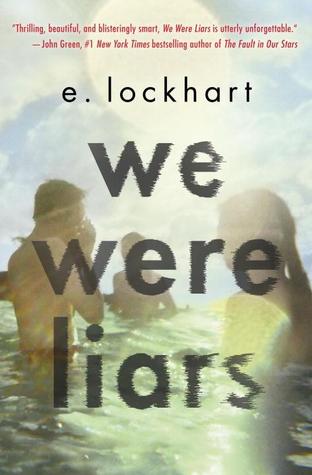
I love the way E. Lockhart writes, and I was breathlessly awaiting my preordered delivery of this book (Delacorte Press, 2014) for months. When it arrived last week I devoured it in two sittings. It's taken me a while to figure out how to blog about it, because I'm left with mixed feelings. The novel is beautiful and mysterious and emotionally gripping. Ultimately, though, I couldn't get past its logical inconsistencies, despite the fact that Lockhart makes it clear throughout that the story is a fable, a fairy tale, not to be taken literally. I'm literal-minded. Sometimes this is a blessing, sometimes a curse, but it's not something I know how to turn off, and it affects my experience with a book.
Problem: Lockhart
pretty much demands that no one reveal the plot twists. I actually don't think that's a fair demand to make of readers; once the book is out in the public domain, I believe that anyone is entitled to comment on it. On the other hand, I want to run a giveaway contest with my copy of the novel as the prize, and I don't want to spoil the ending for anyone who wants to read it, but doesn't want to know any secrets. So I decided to divide this post into three parts: 1. A partial review, without spoilers; 2. A giveaway contest; 3. For people who don't care whether some of the top-secret plot twists are revealed, a fuller review ***WITH SPOILERS*** so that I can say everything I think. Okay, got that? Ready?
PART I. Cady Sinclair Easton is almost eighteen years old, and she tells us right up front about her blinding migraines and partial amnesia. Both of these conditions began the summer she was fifteen, although Cady cannot remember why. All she knows is that something very bad happened to her that summer but no one will talk to her about it. Cady had spent that summer, as she had every summer before that, on the private Cape Cod island owned by her extremely wealthy maternal grandparents. The island's summer residents are the senior Sinclairs; their three daughters, who are Cady's mother and aunts; and the families of these three women, in all of their various permutations. Oh yes - and the staff, of course.
Each of the three sisters has a separate house on the island. Although during Summer Fifteen none of them has a husband, all of them have children. In fact, the oldest children of each of the sisters were all born within a couple of months of each other: Cady, Johnny and Mirren. Cady tells us that although these three cousins all live in different places and have virtually no contact with each other during the school year, they are inseparable during their summers on the island. Oh yes - and there's a fourth member of their cohort. Ever since Summer Eight, when Johnny didn't like to play with girls, his mother and her longterm boyfriend have brought along with them the boyfriend's nephew, Gat, who is Johnny's age and therefore also the girls' age. It is these four who spend every waking minute of their summers together, and who have collectively become known by the adults as The Liars.
As the story unfolds, Cady is back on the island for the first time in two years, having been taken by her father on a seemingly mandatory trip to Europe for the entirety of Summer Sixteen. Some things seem exactly the same: she spends almost all of her time hanging out with the other Liars and falling even deeper in love with Gat. But other things are puzzlingly different. For example, her grandfather has torn down his grand old Victorian mansion, stuffed with valuable antiques and collectibles, and built in its place a spare, modern glass-and-concrete box of a house. And the other three Liars seem unable to account for how they'd spent the previous summer on the island, when Cady wasn't with them. But their presence is so familiar and so comforting to her that very slowly, shard by shard of memory, Cady begins to piece together what really happened on the island during Summer Fifteen.
PART II. I'm going to give away my virtually pristine hardcover copy of WE WERE LIARS to one lucky winner. The rules will be very simple. Leave a comment on this post related to any of the themes I've talked about above. At the end of the contest, I'll choose the post I like best, based on my own entirely subjective criteria. Make it interesting. Surprise me. The contest will end next Sunday, May 25th, at midnight Eastern time. I'll send the book out to the winner, regardless of where he or she lives. Good luck! And may the odds be ever in your favor!
PART III. SPOILERS! SPOILERS! Okay. This one isn't really a spoiler, but I thought I should save it for here nonetheless. Despite the title, Cady never gives any real indication of why she, Johhny, Mirren and Gat are known as The Liars. To the contrary, they all seem remarkably truthful, at least with each other, and there's no real indication that they act differently with anyone else. In fact, the only one who's seen telling a lie is Mirren, and that lie is so painfully transparent that it only seems to demonstrate her lack of experience with lying in general.
The only other lies are the Summer Seventeen attempts by the other three to convince Cady that everything is normal, but in this regard they're acting no differently than any of the other Sinclairs; by common agreement, no one is to discuss Summer Fifteen with Cady, because the doctors have advised that she must either remember what happened on her own, or not at all. So to me, the whole "We Were Liars" premise is one prominent plot hole, a device that wasn't fully thought through.
Which brings me to my main issue with the book. HERE'S THE SPOILER! In Summer Seventeen, Johnny, Mirren and Gat are ghosts. All of them died in a tragic accident during Summer Fifteen, and Cady was partly responsible, which is why she's so traumatized that she suffers from selective amnesia. But Lockhart asks us to believe both that Cady's mother is so worried about her that she obsessively watches her when she's sleeping and keeps lists of what she eats and drinks, yet has no problem with Cady's spending all her time on the island isolated in a house that one of her aunts has essentially abandoned to move into the main house. Cady, the unreliable narrator, describes in detail how she spends all her time with the other Liars, returning to her mother's house only to sleep at night, but in the end, we learn that she's been alone. The mother never once asks Cady where she's going, what she's doing, why she spends almost no time interacting with the rest of the family. And Cady never casually mentions anything about Johnny, Mirren or Gat to her mother, for an entire month. But why wouldn't she, since she believes that they're alive and real? Are we really to believe that for a whole month, everyone on the island, including the two ten-year-old boy cousins, enforces the Code of Silence about the accident so rigorously that not one word is ever let slip? There's no explanation given for any of this, and ultimately I find it all so farfetched that it interferes with my ability to wholeheartedly recommend this book. As I said, Lockhart intersperses the story with accounts of fairy tales about kings with three beautiful daughters, as well as with the tale of King Lear. The grandfather, we and Cady learn, is underneath all his surface benevolence a despot who pits his daughters against each other in competition to inherit his wealth. He creates monsters, and then has to live to see the tragic results. As I said, the story contains many deep emotional truths, but is marred by problems with its execution.
THAT'S IT, FOLKS! I'm looking forward to reading your comments and to sending this book winging its way to a lucky winner!!!
.jpg)