Wednesday, April 6, 2016

E IS FOR ELECTRIC SLIDE


     You don't have to be so literal about it!  Maybe there was no electric slide, per se, in the 16th century, but those guys killed it when it came to line dances!
     The peasants had line dances


as well as Morris dances, which sometimes involved costumes and mumming (play-acting).


And the merchant classes had some simple circle dances,


but of course, at royal courts, everything got much more elaborate.


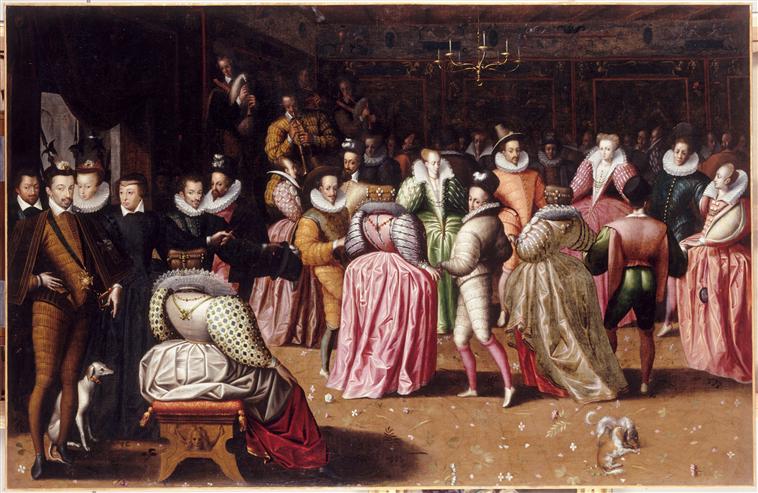
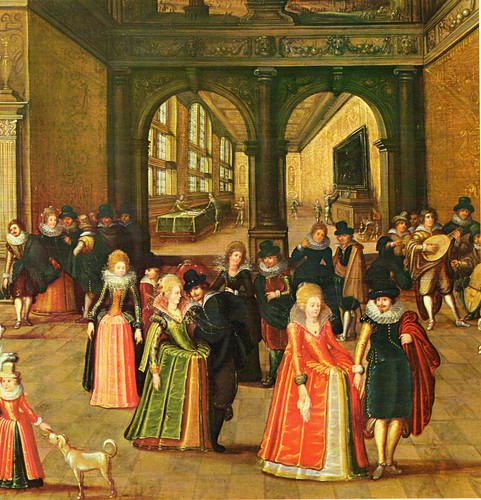
And the royals had line dances too.  The Pavane, for example, was a slow, stately, processional dance for couple, like so:


     and like so.


Yep, here too, with a smaller crowd.


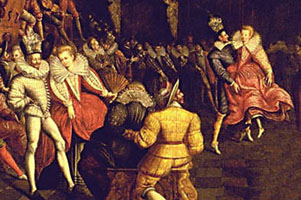
     But listen: you can't just Pavane, Pavane, Pavane all the time, am I right?  Bor-ing.  Sometimes you have to kick up your heels!  And that's just what these 16th-century folks are doing, in a lively dance called la Volta:


     Some people claim that's Queen Elizabeth I herself in the upper right, cutting a rug with her "favorite," Robert Dudley, and showing an indecent expanse of leg.  And OMG, where is her partner's hand???  But I don't buy that, and neither do a lot of people more knowledgeable than me.  Sure, Elizabeth had her wild side (and I bet there were plenty of coughing fits among the courtiers any time someone called her "The Virgin Queen,") but she was careful about her image, and she didn't go around making a spectacle of herself just for fun.  This is just a gathering of some other partying aristocrats, whoever they may be.
     So there were some pretty sprightly dances, considering how many pounds of clothing all the dancers were wearing.  La Branle was a 16th-century French style of chain dance which traditionally kicked off the dancing portion of banquets. The coupled-off dancers moved mainly from side to side either in a circle or a line.  It might not sound that thrilling, but there must be reasons why the name of that dance gave rise to the English word brawl
     Take that, Electric Slide!!


Tuesday, April 5, 2016

D IS FOR DRUGGING


     No one knows who first discovered that opium poppies had several valuable medicinal uses.  But what we do know is that Sumerians in Mesopotamia were cultivating the plants about 5,500 years ago, and that cultivation continued throughout the Middle East for the next several millennia.  The enterprising Phoenicians were the first to bring Egyptian opium on their long-distance trading voyages and to introduce it to Greece, Carthage and Europe.  Much later, between 400 and 1200 A.D., Arab traders introduced opium to China.  In 1527, the physician Paracelsus returned to the West from his travels through Arabia with "stones of immortality," derived from opium, hidden in the pommel of his sword, and as a professor at the University of Basel, he widely touted its use.  Through experimentation, he found that opium was far more soluble in alcohol than in water, and he discovered a particular tincture of opium in brandy (to which he added crushed pearls, musk, and amber, among other things) which he found to be very useful in controlling pain.  He named it laudanum, and it soon became a wildly popular component of all different kinds of medicines - for ailments from menstrual cramps to fretful babies -  and remained in wide use (unnamed on product labels and unregulated by governments) throughout the West until the use of opioids first began to be regulated in the early 20th century.
     But I'm getting centuries ahead of myself now.  Back to the 1500's.  Up to this point, opium appears to have been used by various cultures either in religious/spiritual rituals or as a surgical anesthetic.  But the 16th century seems to represent the dawn of a new era.  The practice of recreational drug use was born.
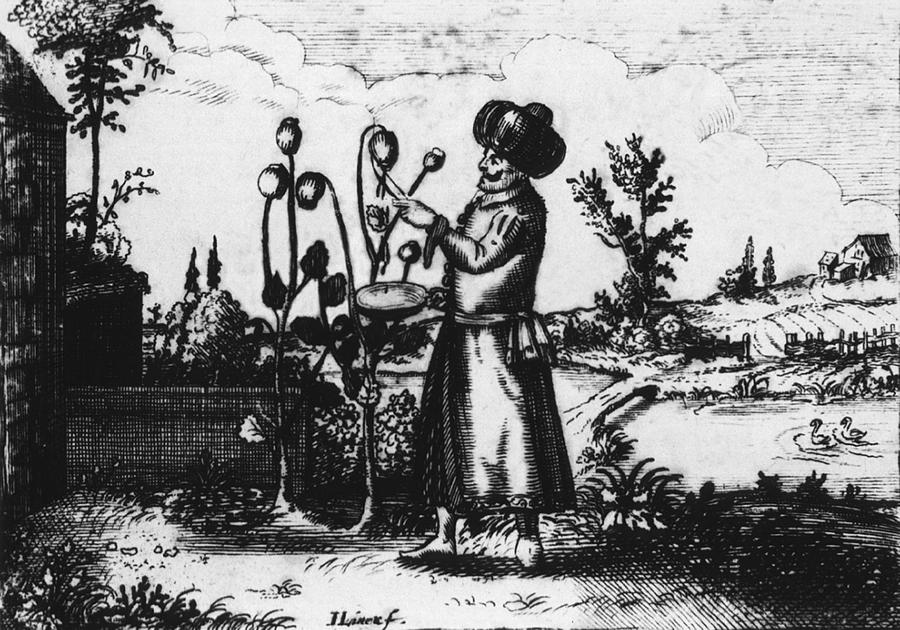
     Poppy cultivation and opium-eating were observed in Iran at this time, and India developed a valuable export trade in opium. Nonmedicinal use became fairly prevalent in Turkey, particularly in Constantinople.  A 1573 Venetian visitor to that city wrote that many of the natives he observed "regularly drank a certain black water made with opium" to which they became so addicted that if they tried to stop consuming it, they would "quickly die." 

                                                 Turk cultivating opium poppies

     But opium abuse hit China particularly hard.  Initially, Chinese people claimed that the poppy extract was an aphrodisiac.  One commentator wrote in 1483 that it was "mainly used to aid masculinity, strengthen sperm and regain vigor."  He described an expedition sent by the Ming emperor that same year to obtain opium "for a price equal to that of gold."  A Chinese medical textbook published in 1578 listed the medicinal uses of opium, but also noted that "lay people use it for the art of sex."  
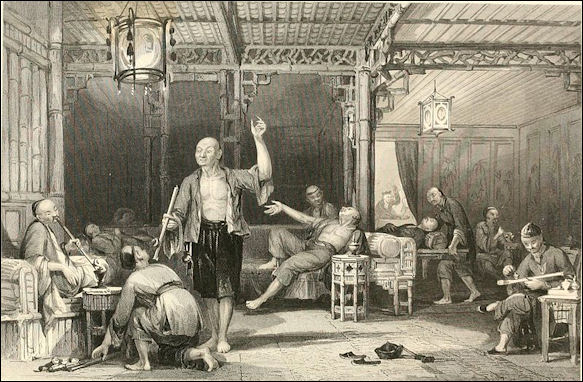
     But of course, regardless of the reasons why individuals in China began using opium, they quickly became addicted.  Opium dens, eerily similar to present-day crack houses, abounded.


      In short, when it came to doping in Europe and Asia in the 16th century, opium was the only game in town, but it was more than enough.  On top of the addiction problem, in a couple of hundred years, conflicts surrounding its international trade would lead to the Opium Wars between Britain and China (and, indirectly, to Britain's acquisition of Hong Kong).  But there I go getting ahead of myself again!   

Monday, April 4, 2016

C IS FOR CELEBRITY CHEFS


       Did you think that foodies didn't exist until the 21st century?  If that's what you thought, you were very much mistaken.  For the 16th-century upper classes, the food that came out of their kitchens had to not only taste delicious; just as importantly, it had to showcase their family's wealth and social status.  There were almost always a lot of guests at the table, and it was essential that they give rave reviews about the host's cuisine to everyone they met after they left.  Cooking was very much a competitive sport.  To give just one example: especially in royal households, meals often ended with what were called "subtleties:" incredibly elaborate sculptures made of sugar or marzipan representing people, animals, or sometimes replicas of buildings.  Some of these were edible.  Some were not, and in those cases, after all the guests had finished admiring the chef's artistry, they would join in enthusiastically pouncing on the subtlety and destroying it.


     The upscale medieval kitchen was a complex place, requiring well-thought-out divisions of labor, much like a modern-day restaurant.  Producing three fabulous meals a day, every day, for a family and its associates demanded coordinated efforts from all workers, and the head cook had to have excellent managerial as well as culinary skills.  Just to give you an idea, Maria Dembinska's FOOD AND DRINK IN MEDIEVAL POLAND (1963)  reports that in the household of the King and Queen of Poland during that era, "the royal entourage normally consisted of forty to sixty people on a daily basis."  In addition to the small army of ordinary cooks in their kitchens, "[t]he king and queen also had their own personal cooks.  These cooks were accorded very high honor, and as magister coquina (master chefs), they often presented opinions on economic and social matters related to the State."


     I'll grant you that in the 1500's there was no Cooking Channel, but that doesn't mean that there weren't at least a few famous chefs.  But it wasn't their cooking alone that brought them widespread fame.  To achieve that goal, they had to write and publish cookbooks.  The most famous European chef of the century was an Italian, Bartolomeo Scappi (c. 1500 - 1577).  Little is known of his early life, but by 1536 he was employed by one cardinal, and he went on to work for several others.  Then he rose to the top: he moved to the Vatican kitchens where he served two popes, Pius IV and then Pius V.  In 1570 he published his life's work: a monumental book called Opera dell'arte del cucinare (something like "culinary works of art"), listing about 1,000 contemporary recipes and describing and illustrating techniques and tools for following them.  The first known picture of a fork appears in his pages.


     Scappi's cookbook was an instant success, and reprints of it continued to be published for the next 75 years.  It was also partially translated into Spanish in 1599 and into Dutch in 1612.  When he died, he was buried in the church of Saints Vincenzo and Anastasio alla Regola, which was dedicated to cooks and bakers.
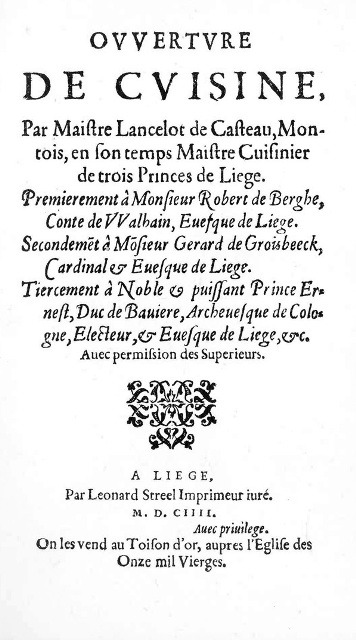
     Lancelot de Casteau was a Belgian master-chef who served three prince-bishops of Liege.  The first known record of him dates to 1557, when he organized a banquet for the Joyous Entry of Robert of Berghes, the first of his three royal patrons.  De Casteau's cooking made him a rich burgher and real-estate owner, but for some reason, the prince-bishops stopped employing him in 1601 and he had to go live with his daughter and son-in-law, who supported him financially.  Apparently he began occupying himself with writing a cookbook.  His Overture de cuisine, published in 1604, was the first cookbook published in French in the Low Countries, and it served to illustrate the food of the intermediate period between 16th-century cuisine and the haute cuisine of the 17th century.  Again, it was the cookbook, and not the cooking per se, that brought De Casteau fame (but not fortune).


     Similarly, almost nothing is known of the Englishman Thomas Dawson except that he published several cookbooks during his lifetime, including The Good Huswifes Jewell (1585).  The Jewell included not only recipes, but also a catalogue of "approved medicines for sundry diseases," including one for "a tart to provoke courage in either man or woman" which included the brains of male sparrows, and one for a paste of crushed worms to be laid on torn sinews to heal them.  (All right, that last part was mildly disgusting, but nothing compared to my "B" post!)
     The only contemporary famous female chef I could find was Sabina Welserin, who published the first German-language cookbook in 1553.  Almost nothing is known about her except the facts that can be gleaned from her book.  Because many of her recipes call for large quantities of spices and sugar, which were hugely expensive and only affordable by the wealthy classes; because some recipes were clearly intended for fancy banquets; and because she mentions that the cook for the Count of Leuchtenberg taught her a method for cooking fish, it's apparent that she was a professional cook and worked for a very wealthy household.  I don't know the name of her cookbook, but here is one of her recipes in case you're looking for something to make for dinner tonight:

To make stuffed birds

           Prepare them in the following manner: Take small wild birds, hold
             them with a finger and stuff them with eggs. Put some ground anise
                      and juniper berries into them to avoid a gamy smell. Leave the feet
                        and heads on the birds, stick them on a spit and roast them, but not too
                                            dry, and in a bowl make a sweet sauce with Reinfal for the birds. In this
manner one can stuff other birds.

     Meanwhile, of course, let's not forget that while all this fine dining was going on among the upper classes, the diet of most of the European population consisted almost entirely of coarse bread and pottage (a kind of grain-and-vegetable stew).  Often the iron pot containing the pottage would hang over the fire continuously for days.  The family would eat from it at mealtimes, and the mother would keep replenishing it with new grains and vegetables.  Of course you know this rhyme:
   
    Pease porridge hot, pease porridge cold,
    Pease porridge in the pot, nine days old.

     It represented reality.


Saturday, April 2, 2016

B IS FOR BATHROOMS

     Yes, I know that nobody in the 21st century believes that we invented bathrooms.  But I'm begging for a little leeway here, because bathrooms are such a fabulously gross topic that I feel I have no choice but to include them.  Not to mention that bungee-jumping really hadn't become a thing yet in the 1500's, so my "B" choices were limited. 
     No 16th-century houses contained what you or I might recognize as "bathrooms" - places to get yourself cleaned up as well as cleaned out (sorry).  But unless you were royalty (and sometimes not even then), cleanliness wasn't exactly a top priority for people.  In fact, most people were convinced that bathing was actually bad for one's health, in that it opened the pores and thus allowed all the nasty stuff floating in the air to gain entry into one's body.  You've heard the term "the great unwashed?"  Commoners who washed their hands and faces on a fairly regular basis, but bathed once or twice a year, felt pretty righteous about their personal hygiene.  For the most part, royals bathed more frequently, but they didn't need a special room for that purpose.  Anything that kings or queens, or other very rich people, wanted while anywhere in their homes, including bathtubs, turned out to be amazingly portable.  But some royals didn't take advantage of this perk.  James VI of Scotland was notorious for his filth, and for not changing his clothes for months on end.


     The question arises: if most people hardly ever washed, didn't they stink?  Duh.  Of course they did.  Everyone in the Middle Ages was just used to it.  Wealthy people sometimes doused themselves in perfumes to try to mask their natural odors, but it's probably debatable how much of an improvement that represented.  You know the word "nosegay," which nowadays just denotes a small bouquet of flowers?  Back in the day, members of the upper classes would carry nosegays around with them wherever they went so they could bury their noses in them when the ambient body odors got too overwhelming.  That was how they kept their nose gay (in the sense of happy).  Get it?
     But no doubt there were those who, through no fault of their own, just stank more than others.  This seems to have been the case with poor Anne of Cleves.  Henry VIII of England chose her as Wife #4 based just on a photograph, and was terribly dismayed when she arrived from Germany to meet him in person.  He could reportedly never bring himself to consummate their marriage, which ended in divorce six months later.  Luckily for her, he apparently didn't consider body odor, no matter how extreme, to be a capital offense, and she spent the rest of her life in comfort, choosing never to return from England to Germany.
     Unlike bathing, excretion - the other reason to have bathrooms - is unavoidable, and so some kind of arrangements had to be made. Actually, on the subject of excretion, the poorest classes had the biggest bathrooms, otherwise known as the great outdoors.  But this convenience did not usually equate to comfort, especially in the winter.  Nonetheless, indoor bathrooms wouldn't become commonplace in Europe for several hundred more years.  (I'm focusing on Europe in this post out of necessity.  I could find very little information about toilet habits in other cultures.)
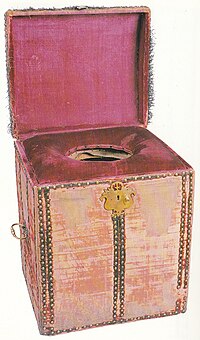
     For centuries preceding the 16th, middle-class people had used chamber pots in their homes so they wouldn't have to go outside to relieve themselves.  They would either just crouch directly over the pots, or (in a slightly fancier version) sit on a piece of furniture known as a close stool - designed to look like an ordinary chair, but with a top seat that lifted up to reveal a hole in the middle of a second seat, positioned over a concealed chamber pot.  So classy. 


     But either way, the chamber pots had to be frequently emptied by servants, and where were the contents dumped?  Directly into the streets and gutters, of course!   I'll spare you further details about this practice, other than to say that by the 1400s, walking in the streets of any European city was a very hazardous and noxious exercise, to say the least.
     To address this increasingly horrifying public health problem, in the 16th century city home-owners began hiring workmen to dig cesspools near their houses so that at least the waste could be stored away from the streets.  Chamber pots began to be replaced by crude indoor toilets known as jakes or garderobes (basically a slab of wood with a hole in the middle, positioned over a pit), which were connected to the cesspools by a series of pipes.


      I regret to inform you, though, that in castles the pipes frequently emptied directly into the surrounding moats.  At least the cesspools got shoveled out from time to time.  The moats, not so much.
     Some garderobes didn't bother with pipes.  They simply jutted out from the exterior side of a wall, like so:


     Um, that's a gaping hole on the bottom.  Yep.  Exactly.  Look out below.
     Of course, the royals had their close stools brought to them whenever and wherever they felt like, and they had servants wipe their butts for them with sponges attached to the end of a stick.  Do you think I'm lying about all this?  Go look it up!  "Groom of the King's Close Stool" was a coveted position at court, involving carrying the extremely fancy stool around all day for whenever the need arose, and then standing by while it was being used.


     You might think this job was considered demeaning.  Shows how much you know about monarchies!  No, only well-born gentlemen got the assignment of the Groom of the Stool.  Seems that it was the proximity to the monarch, not the actual tasks performed, that mattered.
     And if all of this brings you a newfound appreciation of indoor plumbing, my work here is done.


Friday, April 1, 2016

A IS FOR A.I.


      If you define artificial intelligence as a device which can be programmed to run without direct human intervention, then the robots of today are so, so yesterday.  Automatons have been around for an extremely long time, and their invention flourished in the 16th century.  Think of it: centuries, even millennia, before electronics were even dreamed of, people were using wires and springs and gears and levers and pulleys to create inanimate copies of animals and people which, once set in motion, could run on their own and perform incredible feats.
     Reports of ingenious automatons date back to the Old Testament empire of King Solomon, who reportedly designed his own throne so that one golden animal on either side of each step would reach out to help support him as he climbed, and once he had seated himself, an eagle would place a crown on his head and a dove would bring him a Torah scroll. 
     In a much later and somewhat more credible account from the year 949 A.D., ambassador Liutprand of Cremona described the palace of the Emperor Theophilos in Constantinople, including "lions, made either of bronze or wood covered with gold, which struck the ground with their tails and roared with open mouth and quivering tongue... a tree of gilded bronze, its branches filled with birds, likewise made of bronze gilded over, and these emitted cries appropriate to their species," and the emperor's throne, which "was made in such a cunning manner that at one moment it was down on the ground, while at another it rose higher and was to be seen up in the air."
     Okay, one more before we get to the 16th century.  Ismail al-Jazari (1136-1206) was a genius: a gifted and creative mechanical engineer who liked to tinker with inventions on the side.  His Book of Knowledge of Ingenious Mechanical Devices described 100 whimsical objects he had constructed himself, including:
  • A tank which would be filled with some sort of drink, dripping gradually into a bucket and then periodically into a cup.  When the cup was full, a mechanical "waitress" would appear to guests out of an automatic door and serve the drink.
  • A peacock fountain connected to a hand-washing basin.  The user would pull a plug on the peacock's tail to release water from its beak, and wash his or her hands in the basin.  As dirty water from the basin fills the hollow base, a float rises and makes a humanoid servant figure emerge from a door under the peacock to offer soap.  When more water is used, a second, higher float rises and produces a second servant figure offering a towel.
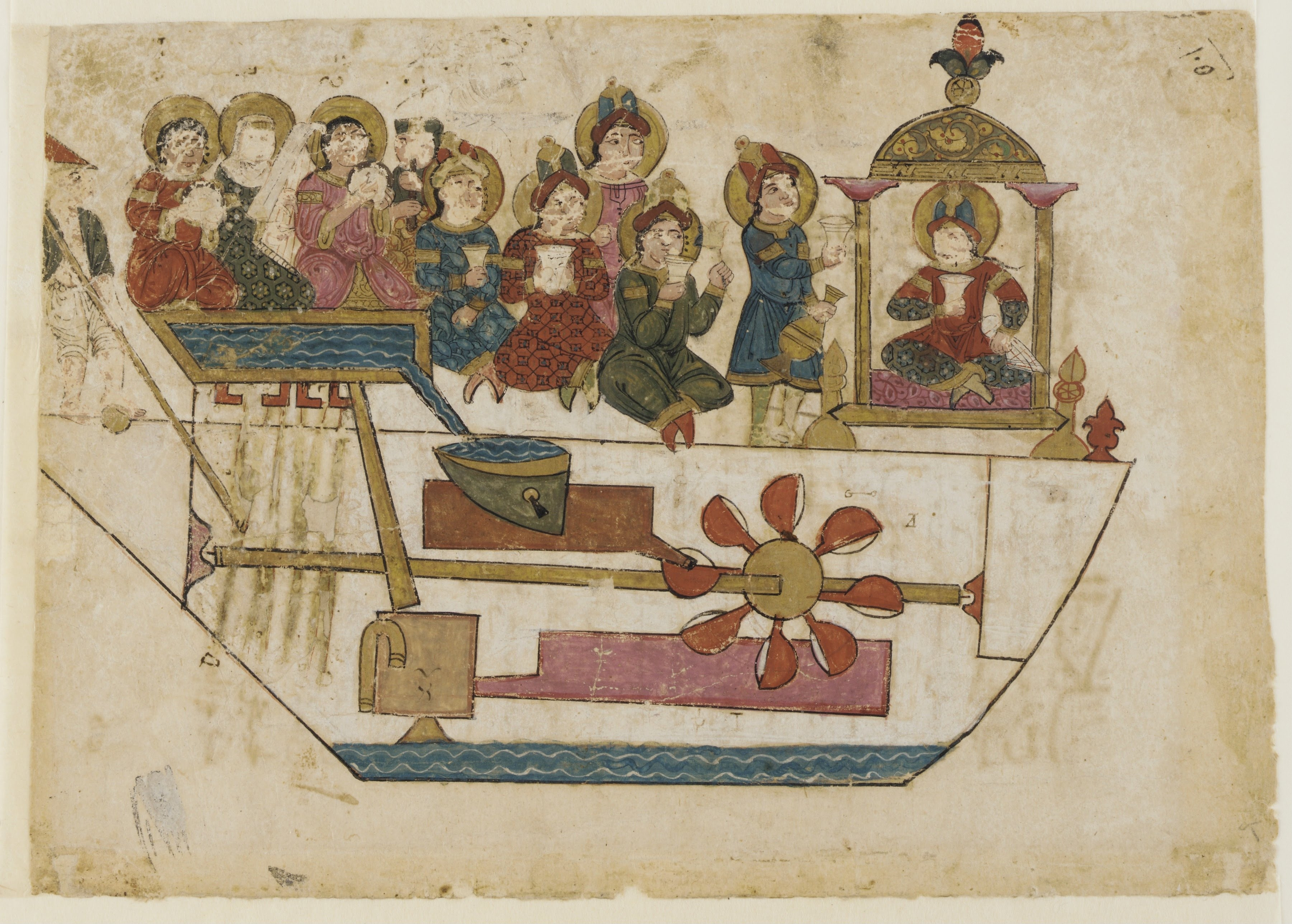
  • A boat containing four automatic musicians which floated on a lake to entertain guests.  The drummer had a drum machine which could be programmed to produce different rhythms.

     And now, on to our (my) century of choice!  The invention of automatons seems to have ebbed somewhat in the Middle Ages, but picked up again the 1500's when clockwork mechanisms had become perfected enough to be used for this purpose.  One extremely rare automaton, built in the 1560's, still exists, still works perfectly, and can be seen in the Smithsonian in Washington, D.C.  It comes with a backstory.  Legend has it that when the son and heir of King Philip II of Spain suffered a serious head injury, the distraught king promised God a miracle in exchange for the miracle of healing the boy.  The son recovered, and Philip kept his promise.  He commissioned a clockmaker and inventor named Juanelo Turriano to build a lifelike recreation of a beloved Franciscan friar, Diego al Alcala (later canonized as San Diego).  The 15-inch tall automaton is operated by a wound spring; it "walks," nods its head, mouths devotional prayers, raises and lowers a rosary and cross, and periodically beats its chest.  Watch it here:


     I'm aware that this little monk wouldn't meet everyone's definition of an A.I.  He can't think.  He doesn't play chess.  But what makes him such a marvel that watching him perform can fill a 21st century person with awe is that he's not only a mechanical device, but an exquisite work of art.  Five hundred years from now, Watson will be just a clump of metal and wires.  I'll take the little monk.
     

Monday, March 28, 2016

ON THE SUBJECT OF A TO Z...

     I've already revealed my theme: 16th-century analogues of 21st-century memes.  What I thought I should add here before the Challenge actually launches is that, despite my best intentions, my posts are going to be almost entirely Eurocentric.  Regrettably, I've found information in English about 16th-century Europe to be much more easily accessible than information about other continents.  (Of course, this fact says a lot in and of itself.)  Please don't take this to mean that I find only European cultures to be interesting or worthy of examination!  It's just that I have a limited amount of time to do research for each post, and so I've gone with what was easiest.  If I do the Challenge again in future years, I'll try to remedy this problem.  But for this upcoming April, our time machine will (with rare exception) be planted in European soil.

Tuesday, March 22, 2016

H IS FOR HUNGER GAMES


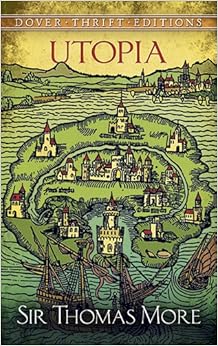
     The Hunger Games novels represent a long historical tradition of dystopian literature.  But that tradition would never have come into existence if it hadn't been preceded by its flip side: utopian literature.  And utopian literature had its start in the 16th century, with the 1516 publication of Sir Thomas More's groundbreaking novel,


     Wait, you say.  That Thomas More?  The one whom Henry VIII ordered executed for refusing to acknowledge the validity of Henry's newly-invented, purpose-driven Church of England?  Yes, friends, that very same dude coined the word "utopia" and published the first literary work about an imaginary perfect society.
     But who was this guy?  I'm glad you asked.  He was born in London in 1477 and was elected to Parliament in 1504.  During his studies to become a lawyer, More decided to enter a monastery, and tried to pursue both careers simultaneously.  After several years he gave up studying for the priesthood, but remained a pious believer (and, secretly, a wearer of a hair shirt) for the rest of his life, even though he married (twice) and had children.
     As a capable and respected undersheriff in London,  More caught the attention of Cardinal Wolsey, who brought him into the service of the young King Henry VIII.  More rose quickly, soon becoming the king's personal secretary and advisor.   In 1523 he was elected as speaker of the House of Commons.  All went well for him until Henry, in order to be able to divorce his first wife, Katherine of Aragon, created the fiction that the 20-year-long marriage must be annulled and that Henry himself was now the supreme leader of the English church. 
     More's conscience did not allow him to go along with this, marking the beginning of his end.  He was imprisoned in the Tower of London in 1534, indicted for high treason in 1535, and beheaded on Henry's orders not long after.
     But long before More's fall from the king's favor - in fact, shortly before he gained the king's favor in the first place - he wrote and published "Utopia," a name he created from the Latin words for "no place."  The novel is written in two parts: the first contains criticisms of then-existing English society, and the second describes an island society, situated in some unspecified location in the New World, in which all aspects of life are governed by reason rather than self-interest.
     Some of the more unique features of Utopian society include:
  • No private property.  All goods are stored in warehouses, and people request what they need.
  • Private space does not exist.  No doors can be locked.  The communal households all consist of 30 people, and everyone is under constant observation by everyone else.

  • Discussion of politics outside of the appropriate forum is punishable by death.
  • Euthanasia is practiced.
  • So is pacifism, if at all possible.
  • Houses, which are all built more or less alike, are rotated among citizens every ten years.
  • Every household is issued two slaves (who are either foreigners or criminals).  One of the ways a Utopian becomes a slave is by being caught traveling around the island a second time without your internal passport.
  • There are judges, but no lawyers.
  • Although premarital sex is punished by a lifetime of enforced celibacy, before marriage the proposed bride and groom are displayed to each other naked (to avoid surprises).  Penalties for adultery: 1st offense, slavery; second offense, death.

  • Divorce, married priests, and female priests are permitted.  There are a number of religions on the island, mostly pagan, all tolerant of each other.
  • Every citizen must spend occasional two-year stints on farms doing agricultural work.
     There are a number of features of More's Utopia that have caused commentators to wonder whether, in fact, the work was intended satirically, and More was actually describing his idea of a dystopian society.  For one thing, More was a staunch Catholic all his life, and as Lord Chancellor, he persecuted Protestants.  So did he really believe that a perfect society would be one which practiced religious tolerance, divorce, euthanasia, and noncelibacy among priests?  And as the highest-ranking lawyer in England, did he really believe that a perfect society would have no lawyers, because "they [the Utopians] consider them as a sort of people whose profession it is to disguise matters?"  And if he did believe all these things, why did he give his fictional traveler and guide to Utopia the surname Hythlodaeus, which in Greek means "spouter of nonsense?"
     Of course, no one will ever know the answer to any of these questions.  But what we do know is an old adage that probably dates back before the 16th century: one man's meat is another man's poison.  Some of the laws of Utopia sound like they were borrowed from the Taliban, if you ask me.  Maybe Utopia and Dystopia are not that far apart after all.

     All right, stay with me here.  Without Thomas More, there would be no utopian literature.  Without utopian literature, there would be no dystopian literature.  And without dystopian literature, there would be no Hunger Games.  Thus, Thomas More is the great-great-great-great-etc.-grandfather of Katniss Everdeen.
     Don't believe me?  Look closely.  There's Katniss, up at the top.  And here's Tom.


Boom.  Is your head exploding yet?  How did people ever miss the resemblance???

p.s. For a great essay about dystopian novels, go to Heather Jackson's http://writeonsisters.com/writing-craft/masterplots-theater-d-is-for-dystopia/.  All her other A to Z posts about literary genres are terrific too!