If you define artificial intelligence as a device which can be programmed to run without direct human intervention, then the robots of today are so, so yesterday. Automatons have been around for an extremely long time, and their invention flourished in the 16th century. Think of it: centuries, even millennia, before electronics were even dreamed of, people were using wires and springs and gears and levers and pulleys to create inanimate copies of animals and people which, once set in motion, could run on their own and perform incredible feats.
Reports of ingenious automatons date back to the Old Testament empire of King Solomon, who reportedly designed his own throne so that one golden animal on either side of each step would reach out to help support him as he climbed, and once he had seated himself, an eagle would place a crown on his head and a dove would bring him a Torah scroll.
In a much later and somewhat more credible account from the year 949 A.D., ambassador Liutprand of Cremona described the palace of the Emperor Theophilos in Constantinople, including "lions, made either of bronze or wood covered with gold, which struck the ground with their tails and roared with open mouth and quivering tongue... a tree of gilded bronze, its branches filled with birds, likewise made of bronze gilded over, and these emitted cries appropriate to their species," and the emperor's throne, which "was made in such a cunning manner that at one moment it was down on the ground, while at another it rose higher and was to be seen up in the air."
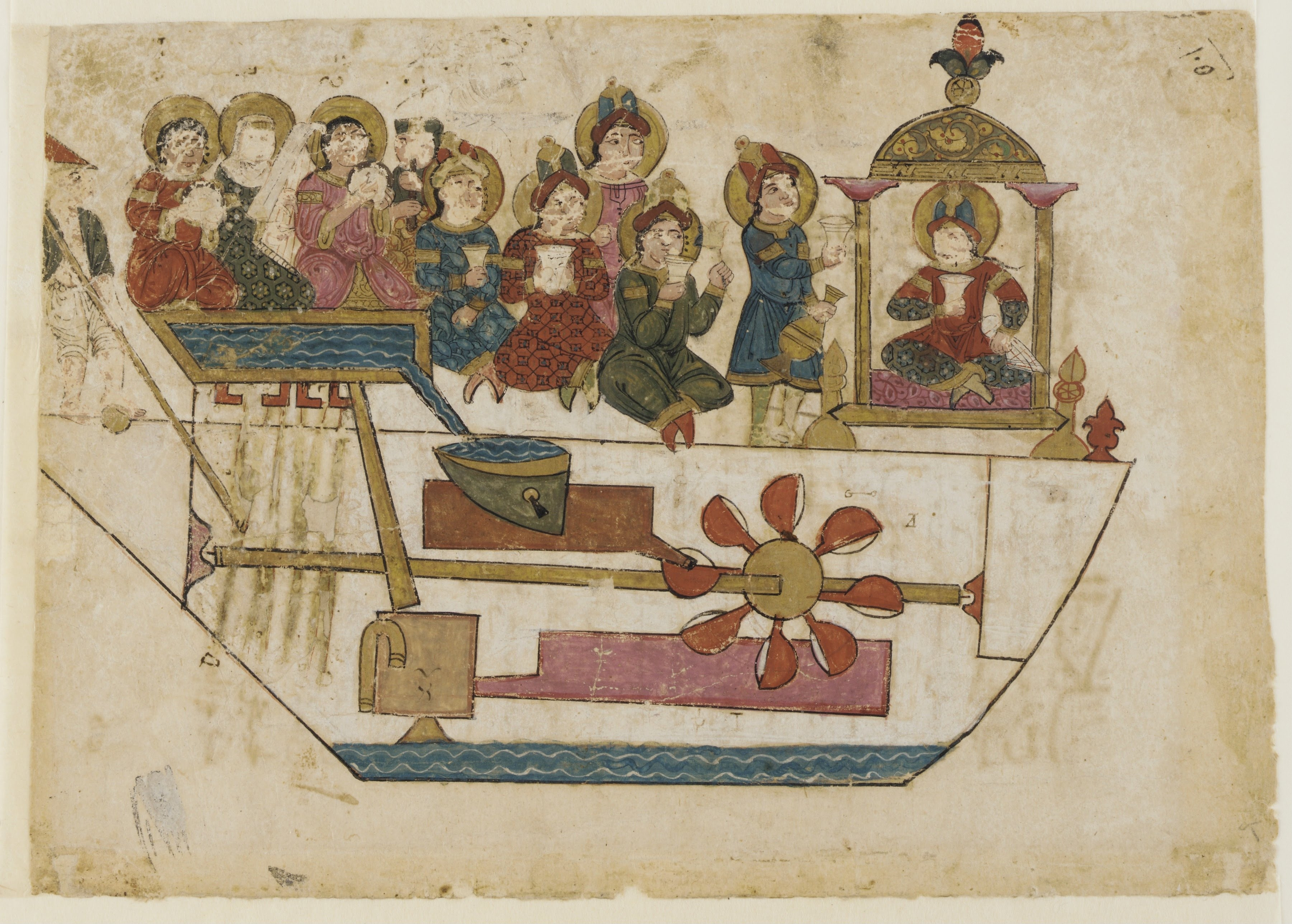
Okay, one more before we get to the 16th century. Ismail al-Jazari (1136-1206) was a genius: a gifted and creative mechanical engineer who liked to tinker with inventions on the side. His Book of Knowledge of Ingenious Mechanical Devices described 100 whimsical objects he had constructed himself, including:
- A tank which would be filled with some sort of drink, dripping gradually into a bucket and then periodically into a cup. When the cup was full, a mechanical "waitress" would appear to guests out of an automatic door and serve the drink.
- A peacock fountain connected to a hand-washing basin. The user would pull a plug on the peacock's tail to release water from its beak, and wash his or her hands in the basin. As dirty water from the basin fills the hollow base, a float rises and makes a humanoid servant figure emerge from a door under the peacock to offer soap. When more water is used, a second, higher float rises and produces a second servant figure offering a towel.
- A boat containing four automatic musicians which floated on a lake to entertain guests. The drummer had a drum machine which could be programmed to produce different rhythms.
And now, on to our (my) century of choice! The invention of automatons seems to have ebbed somewhat in the Middle Ages, but picked up again the 1500's when clockwork mechanisms had become perfected enough to be used for this purpose. One extremely rare automaton, built in the 1560's, still exists, still works perfectly, and can be seen in the Smithsonian in Washington, D.C. It comes with a backstory. Legend has it that when the son and heir of King Philip II of Spain suffered a serious head injury, the distraught king promised God a miracle in exchange for the miracle of healing the boy. The son recovered, and Philip kept his promise. He commissioned a clockmaker and inventor named Juanelo Turriano to build a lifelike recreation of a beloved Franciscan friar, Diego al Alcala (later canonized as San Diego). The 15-inch tall automaton is operated by a wound spring; it "walks," nods its head, mouths devotional prayers, raises and lowers a rosary and cross, and periodically beats its chest. Watch it here:
I'm aware that this little monk wouldn't meet everyone's definition of an A.I. He can't think. He doesn't play chess. But what makes him such a marvel that watching him perform can fill a 21st century person with awe is that he's not only a mechanical device, but an exquisite work of art. Five hundred years from now, Watson will be just a clump of metal and wires. I'll take the little monk.
