(1516 - 1565)
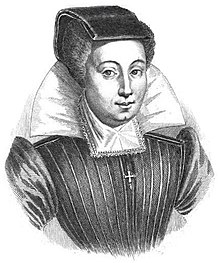
Honestly, I'm not at all sure how to categorize Gesner. Some of the people I've been posting about make it easy: painter, midwife, astronomer. Gesner is not one of those people. He's often referred to as a naturalist, but if I had to categorize him, it might actually be as a categorizer! Essentially, he created exhaustive databases compiled through laborious research, which he conducted both hands-on and through information received from his huge number of correspondents located around the world. Had he lived in our century, he would have invented the first Internet search engine. Living as he did in the 16th century, he did the very best he could with the tools available to him, and his very best was nothing short of astounding.
For a thumbnail sketch of this man, I couldn't hope to do better than Daniel Boorstin, former Librarian of Congress and ongoing Knower of Everything, so I'm just going to quote this paragraph from p. 427 of his book, THE DISCOVERERS:
These opportunities (voyages to the New World) inspired a new generation
of encyclopedists of nature. The most remarkable of them, Konrad Gesner,
had a genius for grafting the new onto the old. Prodigiously learned in
several languages, Gesner was torn between what he had read and what he
saw. He was born into a poor Zurich family in 1516, educated himself as
a vagrant scholar, and, when he was only twenty, wrote a Greek-Latin
dictionary. In the next thirty years he turned out seventy volumes on
every conceivable subject. His monumental Bibliotheca Universalis (4
vols., 1545-1555) aimed to provide a catalogue of all writings that had
ever existed in Latin, Greek and Hebrew. Gesner listed eighteen hundred
authors and titles of their works in manuscript and in print, with summaries
of their content. Thus he earned his title as the Father of Bibliography.
What cartography was to explorers on land and sea, bibliography would
be to libraries.
If by any chance your mind is not yet blown, I'll now go on to tell you about his five-volume Historia Animalium, which, in Boorstin's words, "supplied everything known, speculated, imagined, or reported about all known animals." Gesner divided the animal kingdom into quadrupeds, amphibians, birds, fishes and snakes. Because he was being as inclusive as he could with this catalogue, it featured some animals with which you or I might not be particularly familiar:
But truly - the last thing I want to do is mock Gesner. If he didn't know for a fact that a particular creature didn't exist, he included it just in case it did. (Fun fact: the Historia Amimalium made it onto the Church's list of Banned Books. Was it, perhaps, because he included mermaids, unicorns and basilisks? Nah. It was because he was Protestant!) Gesner's approach to every academic subject was far beyond thorough. Which reminds me - Did I mention that he was primarily a botanist? And, oh yeah - also a physician. And a mountain climber. If he wasn't the guy for whom the term "Renaissance man" was coined, he gets my vote for the title.
Gesner's education wasn't quite as haphazard as Boorstin suggests; his intelligence was so apparent to all his teachers that at an early age he acquired some important sponsors who supported him financially and put him through top universities. At the age of 21 Gesner became a professor of Greek at the Academy of Lausanne. The steady income enabled him to devote time to studying botany. After teaching at Lausanne for three years, he left to attend medical school at the world-renowned University of Montpelier in France. He received his degree in 1541, when he was 25, and relocated to Zurich to practice medicine and to teach physics at the Collegium Carolinum, the precursor to the University of Zurich. In 1554 he became the city physician, and he remained in Zurich for the rest of his life. It was during this settled period that he began his writings in earnest.
In addition to his other interests, he was also a linguist, and in 1555 published a book describing about 130 known languages. He was always collecting samples of plants and having his farflung friends send him even more samples. Although only two of his botanical books were published during his lifetime, his extensive notes and woodcuts of plants were circulated and used by other authors for hundreds of years.
Gesner climbed mountains not only to collect botanical samples, but also for the sheer joy of it. He wrote a letter to a friend in 1541 declaring his intention to climb at least one mountain every year for the rest of his life. He authored what might well be the first written account of climbing.
When he was only 49, Gesner contracted the plague. Legend has it that when he knew he was about to die, he asked to be brought to his library where he could be surrounded by his beloved books. At his death, he left behind 18 unpublished manuscripts in addition to the veritable mountain of his published works.
Wednesday, April 8, 2015
Tuesday, April 7, 2015
F IS FOR LAVINIA FONTANA
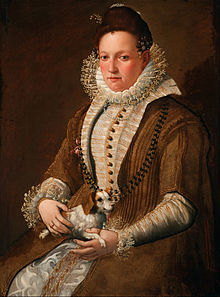
Lavinia Fontana (1552-1614) is widely considered the first female artist of the modern world to have worked as an equal alongside her male counterparts. Born in Bologna, she was taught to paint in the then-popular Mannerist style by her father, a fairly minor artist. Fortunately for Lavinia, Bologna was a relatively open-minded city; it had admitted women to its university since it opened in 1158. Even for Bologna, though, Lavinia's marital arrangements must have stood out. In 1577 she married another painter, Gian Paolo Zappi, who was a rather ordinary artist but must have been a very unusual man for his time. He willingly subjugated his career to hers, becoming her assistant and agent as well as taking care of many household matters. Meanwhile, Lavinia supported the family. As far as I know, Gian Paolo was the first documented househusband in history, and I can only imagine how well that situation must have been received down at the bocce court. It was because of his generosity that Lavinia, who gave birth to eleven children (although, sadly, only three of them survived her), managed to continue to devote herself to her career.
By the late 1570s Lavinia had achieved a local reputation for fine portraiture, depicting upper-class members of Bolognese society.
Apparently female painters weren't unheard of at the time, but they were basically relegated to the "mommy track" of painting: portraiture. Most of her portraits were of wealthy people who could afford to pay commissions, but here's one more intimate one that I particularly like:
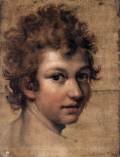
(Could this have been one of her children? I like to think so.)
What was different about Lavinia, though, was that she expanded her reach beyond portrait-painting into different genres. She began with small devotional works painted on copper, which were popular as gifts, and moved on to large-scale works on religious and mythological subjects.
Minerva Dressing
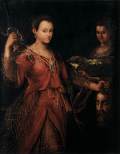
Judith With the Head of Holofernes
She was also commissioned to make many large altarpieces for the churches of Bologna. In 1603, at the invitation of Pope Clement VIII, Lavinia and her family moved to Rome, where she continued to succeed at her work and the family of Pope Gregory XIII became her patrons. Pope Paul V sat for a portrait by her. She received many honors for her work, and was elected to the Accademia di San Luca, a Roman artists' guild. All told, she painted 135 documented works, although only 32 signed and dated ones survive. One of her paintings, "Jesus Appears to Mary Magdalen," now hangs in the Uffizi Gallery:
Lavinia Fontana died in Rome in 1614. Her prolific body of work outlives her.
Monday, April 6, 2015
E IS FOR DESIDERIUS ERASMUS
(1466 - 1536)
Born in Rotterdam, Erasmus was raised, and was provided an excellent education which included the study of Greek, by his parents (unmarried - his father was a Catholic priest), who both died of the plague in 1483. His guardians then insisted on his entering a Dutch monastery, where he spent the next six years and was ordained a priest at about the age of 25. Erasmus had already achieved a reputation as a brilliant scholar, and this was his ticket out of the canonical life: he was offered a post as secretary to the Bishop of Cambrai, France, whom he served for several years. In 1495, with the Bishop's approval, he moved to Paris, where he studied at the University and became acquainted with the scholarly new wave of Renaissance humanism, and supported himself by teaching until 1498. He moved to England for a short time after that, but was back in France by 1500 and remained there for the next six years. From 1506 to 1509 he was at Turin University in Italy. Another stint at Queens College in Cambridge, England as a professor of Divinity followed, and then a residency at Leuven, the Netherlands. After 1514 he lived alternately between England and Basel, Switzerland. He didn't seem to ever be able to select any one place as a home base. Throughout his life, he was offered many permanent and prestigious academic posts, and he turned all of them down. Rightly or wrongly, he believed that getting himself enmeshed with any one institution would hamper his intellectual freedom. Instead, he chose to wander from place to place, chronically short of money and always asking his friends for loans. Am I the only one reminded here of another great philosopher, Janis Joplin? "Freedom's just another word for nothin' left to lose..." (Yes, I know Joplin didn't write "Me and Bobby McGee," but she embodied it.)
In 1512 Erasmus embarked on a massive project, which he completed and published in 1516: a translation of the entire New Testament into both Latin and Greek (which also constituted the first published Greek translation). He produced a second edition in 1519, a third in 1522, a fourth in 1527, and a fifth and final one in 1535, the year before his death. While these were his most widely distributed works, Erasmus wrote numerous other books, many of them bitingly sarcastic criticisms of all classes of society, but in particular of abuses he perceived within the Church.
Meanwhile, in 1517, Martin Luther had published his Ninety-FiveTheses, thus officially kicking off the Protestant Reformation. Luther and his followers were delighted with Erasmus's harsh words about the Church and tried to persuade him to join their cause, but (no surprise, perhaps, knowing what we know about his stubborn independence) he refused to break with the Church and attempted to walk an impossible line by supporting both the Church and the Reformation; as he said, "I detest dissention because it goes both against the teachings of Christ and against a secret inclination of nature. I doubt that either side in the dispute can be suppressed without grave loss." Needless to say, this studied neutrality did not go over well with either party, both of which adopted the view that if Erasmus wasn't with them, he must be against them. Finally, in 1524, Erasmus directly attacked Luther (or at least, Luther's views about the nonexistence of free will) in his writings, and Luther enthusiastically returned the favor. The split between them was never healed. Nonetheless, until the end of his life, Erasmus was deeply distrusted by the Church and suspected of being a heretic.
Long before the phrase came into existence, Erasmus was the classic polarizing figure. He had multitudes of intellectual friends from all over Europe, and corresponded with more than 500 of them. But his public reputation was extremely mixed until the Enlightenment of the seventeenth century, when he rose again in the world's estimation. Not everyone saw him in a positive light even then, however. And the current Catholic Encyclopedia says both that Erasmus was "the most brilliant and most important leader of German humanism," and that "his vanity and egotism were boundless, and to gratify them he was ready to pursue former friends with defamation and invective.... His was an absolutely unspeculative brain, and he lacked entirely all power of acute philosophical definition." They weren't holding back, were they? The Church, at least, remains unwilling to forgive and forget; it still blames Erasmus for the Reformation. On the other hand, can you guess after whom the modern-day European Union student exchange program is named? A profoundly gifted writer, a fierce proponent of education, a theologian, a humanist philosopher... Erasmus was all these things, and more.
I'll end this post with a few quotes from this most quotable of Renaissance thinkers (he would have aced Twitter):
- It is the chiefest point of happiness that a man is willing to be what he is.
- In the kingdom of the blind, the one-eyed man is king.
- When I have a little money, I buy books; and if I have any left, I buy food and clothes.
And, finally:
Born in Rotterdam, Erasmus was raised, and was provided an excellent education which included the study of Greek, by his parents (unmarried - his father was a Catholic priest), who both died of the plague in 1483. His guardians then insisted on his entering a Dutch monastery, where he spent the next six years and was ordained a priest at about the age of 25. Erasmus had already achieved a reputation as a brilliant scholar, and this was his ticket out of the canonical life: he was offered a post as secretary to the Bishop of Cambrai, France, whom he served for several years. In 1495, with the Bishop's approval, he moved to Paris, where he studied at the University and became acquainted with the scholarly new wave of Renaissance humanism, and supported himself by teaching until 1498. He moved to England for a short time after that, but was back in France by 1500 and remained there for the next six years. From 1506 to 1509 he was at Turin University in Italy. Another stint at Queens College in Cambridge, England as a professor of Divinity followed, and then a residency at Leuven, the Netherlands. After 1514 he lived alternately between England and Basel, Switzerland. He didn't seem to ever be able to select any one place as a home base. Throughout his life, he was offered many permanent and prestigious academic posts, and he turned all of them down. Rightly or wrongly, he believed that getting himself enmeshed with any one institution would hamper his intellectual freedom. Instead, he chose to wander from place to place, chronically short of money and always asking his friends for loans. Am I the only one reminded here of another great philosopher, Janis Joplin? "Freedom's just another word for nothin' left to lose..." (Yes, I know Joplin didn't write "Me and Bobby McGee," but she embodied it.)
In 1512 Erasmus embarked on a massive project, which he completed and published in 1516: a translation of the entire New Testament into both Latin and Greek (which also constituted the first published Greek translation). He produced a second edition in 1519, a third in 1522, a fourth in 1527, and a fifth and final one in 1535, the year before his death. While these were his most widely distributed works, Erasmus wrote numerous other books, many of them bitingly sarcastic criticisms of all classes of society, but in particular of abuses he perceived within the Church.
Meanwhile, in 1517, Martin Luther had published his Ninety-FiveTheses, thus officially kicking off the Protestant Reformation. Luther and his followers were delighted with Erasmus's harsh words about the Church and tried to persuade him to join their cause, but (no surprise, perhaps, knowing what we know about his stubborn independence) he refused to break with the Church and attempted to walk an impossible line by supporting both the Church and the Reformation; as he said, "I detest dissention because it goes both against the teachings of Christ and against a secret inclination of nature. I doubt that either side in the dispute can be suppressed without grave loss." Needless to say, this studied neutrality did not go over well with either party, both of which adopted the view that if Erasmus wasn't with them, he must be against them. Finally, in 1524, Erasmus directly attacked Luther (or at least, Luther's views about the nonexistence of free will) in his writings, and Luther enthusiastically returned the favor. The split between them was never healed. Nonetheless, until the end of his life, Erasmus was deeply distrusted by the Church and suspected of being a heretic.
Long before the phrase came into existence, Erasmus was the classic polarizing figure. He had multitudes of intellectual friends from all over Europe, and corresponded with more than 500 of them. But his public reputation was extremely mixed until the Enlightenment of the seventeenth century, when he rose again in the world's estimation. Not everyone saw him in a positive light even then, however. And the current Catholic Encyclopedia says both that Erasmus was "the most brilliant and most important leader of German humanism," and that "his vanity and egotism were boundless, and to gratify them he was ready to pursue former friends with defamation and invective.... His was an absolutely unspeculative brain, and he lacked entirely all power of acute philosophical definition." They weren't holding back, were they? The Church, at least, remains unwilling to forgive and forget; it still blames Erasmus for the Reformation. On the other hand, can you guess after whom the modern-day European Union student exchange program is named? A profoundly gifted writer, a fierce proponent of education, a theologian, a humanist philosopher... Erasmus was all these things, and more.
I'll end this post with a few quotes from this most quotable of Renaissance thinkers (he would have aced Twitter):
- It is the chiefest point of happiness that a man is willing to be what he is.
- In the kingdom of the blind, the one-eyed man is king.
- When I have a little money, I buy books; and if I have any left, I buy food and clothes.
And, finally:
Saturday, April 4, 2015
D IS FOR RANI DURGAVATI MARAVI
(1524 - 1564)
Durgavati Marati was born in what is now Utter Pradesh, India, into the Chandel dynasty of Emperor Keerat Rai. At the age of 18 she was married to Dalpat Shah of the Gond dynasty, thus forming a strategic alliance between the two powerful families.
When her husband Dalpat Shah died in about 1550, their only child, a son named Vir Narayan, was only seven years old. Because he was too young to assume leadership, Durgavati took control of the Gond Kingdom, assuming the title Rani (Queen). Her effectiveness in this role was tested in 1556 when her kingdom was attacked by Baz Bahadur from the neighboring Malwa region. The Gond armies repelled the attack and inflicted heavy losses on the enemy. But in 1562, Bahadur was defeated by the very powerful Mughal sultanate, and as a result, Rani Durgavati's kingdom now shared a border with the famously fierce Mughals. Asaf Khan, a Mughal general, wasted no time in invading Gond territory.
Rani Durgavati engaged Asaf Khan's forces in battle and, although her soldiers were greatly outnumbered by the better-trained and better-armed Mughal forces, and her top general was killed, Durgavati herself took over the battle and was able to temporarily disperse the Mughal forces.
Durgavati wanted to attack the Mughals again that night, but her lieutenants refused to carry out this plan. As a result, the Mughals were able to receive reinforcements during the night. The following morning, June 24, 1564, Durgavati, riding her war elephant Sarman, personally led her troops into battle. Although her soldiers forced the Mughals to retreat three times, the tide turned when Durgavati's son was wounded and had to be removed from the battlefield. Then Durgavati's neck was pierced by an arrow and she lost consciousness. When she awoke and realized that defeat was imminent, she killed herself with her dagger rather than surrender to the enemy.
Rani Durgavati Marati is still renowned in India for her great courage and leadership. In 1983, Jabalpur University was renamed Rani Durgavati Vishwavidyalaya, and the present-day train between Jabalpur and Jammutawi is known as the Durgavati Express. And Durgavati lives on, astride her elephant, as a noble statue in Jabalpur
and on a 1988 postage stamp, where she resembles an Amazon warrior.
p.s. I hope you like this post, Archana! It's for you!
Durgavati Marati was born in what is now Utter Pradesh, India, into the Chandel dynasty of Emperor Keerat Rai. At the age of 18 she was married to Dalpat Shah of the Gond dynasty, thus forming a strategic alliance between the two powerful families.
When her husband Dalpat Shah died in about 1550, their only child, a son named Vir Narayan, was only seven years old. Because he was too young to assume leadership, Durgavati took control of the Gond Kingdom, assuming the title Rani (Queen). Her effectiveness in this role was tested in 1556 when her kingdom was attacked by Baz Bahadur from the neighboring Malwa region. The Gond armies repelled the attack and inflicted heavy losses on the enemy. But in 1562, Bahadur was defeated by the very powerful Mughal sultanate, and as a result, Rani Durgavati's kingdom now shared a border with the famously fierce Mughals. Asaf Khan, a Mughal general, wasted no time in invading Gond territory.
Rani Durgavati engaged Asaf Khan's forces in battle and, although her soldiers were greatly outnumbered by the better-trained and better-armed Mughal forces, and her top general was killed, Durgavati herself took over the battle and was able to temporarily disperse the Mughal forces.
Durgavati wanted to attack the Mughals again that night, but her lieutenants refused to carry out this plan. As a result, the Mughals were able to receive reinforcements during the night. The following morning, June 24, 1564, Durgavati, riding her war elephant Sarman, personally led her troops into battle. Although her soldiers forced the Mughals to retreat three times, the tide turned when Durgavati's son was wounded and had to be removed from the battlefield. Then Durgavati's neck was pierced by an arrow and she lost consciousness. When she awoke and realized that defeat was imminent, she killed herself with her dagger rather than surrender to the enemy.
Rani Durgavati Marati is still renowned in India for her great courage and leadership. In 1983, Jabalpur University was renamed Rani Durgavati Vishwavidyalaya, and the present-day train between Jabalpur and Jammutawi is known as the Durgavati Express. And Durgavati lives on, astride her elephant, as a noble statue in Jabalpur
and on a 1988 postage stamp, where she resembles an Amazon warrior.
p.s. I hope you like this post, Archana! It's for you!
Friday, April 3, 2015
C IS FOR NICOLAUS COPERNICUS
(1473 - 1543)
If there was one scientific fact that was perfectly obvious to everyone in the 15th century, it was that the Earth was the center of the universe. After all, hadn't God fashioned it and separated it from the sky on the first day of the Creation? And wasn't it home to every living creature? And didn't the sun and the moon and the stars perform their dance across its sky each day and night while, as Ptolemy had written almost 1,000 years earlier, the Earth stood absolutely still and watched the show? Case closed.
EARTH IN THE CENTER OF EVERYTHING
In 1473, Nicolaus Copernicus - or rather, Mikolaj Kopernik - was born in Poland into a family of wealthy merchants. His father died when Mikolaj was 10, and his maternal uncle, a Catholic bishop, became the boy's guardian and oversaw his education. At 18 Mikolaj enrolled in the University of Krakow, where he studied astronomy, mathematics, philosophy, and the sciences. Four years later, he had completed his course of study but not obtained a degree (as I've been learning while writing these posts, wealthy young European gentlemen of that era were not usually expected to obtain degrees; it was considered a rather middle-class thing to do, suggesting as it did that one might need to someday make a living). Mikolaj was then sent by his uncle to the University of Bologna to study canon law, with the goal of becoming a Church official. Mikolaj - who by now had Latinized his name to Nicolaus Copernicus - spent three years in Bologna pretty much ignoring the study of canon law and devoting himself instead to his true passions: mathematics and astronomy. He also learned Greek, because many of the foremost astronomical treatises still being used, included Ptolemy's, had been written by ancient Greeks (yes, really) and were not available in translation. If Nicolaus had been trying to subvert his uncle's plans for him, however, he failed. His uncle pulled enough strings to have him appointed a canon in the Polish Church, although Nicolaus was still living in Italy! Nicolaus's feelings about having been done this "favor" are not recorded.
In 1501, Copernicus returned to his uncle's home in Poland, where of course he was expected to jump right into his canonical duties, but instead he managed to wheedle two more years in Italy out of his uncle, this time ostensibly to study medicine. At the University of Padua, he focused on his studies of astronomy - no surprise there - but amazingly, also managed to successfully complete courses of study in medicine and law, all simultaneously. When Copernicus returned to Poland at the age of 30, it was as a physician, a canon, a lawyer, and an astronomer. His travels abroad were over; he lived for another 40 years, and never left Poland again. Ah, but in his mind, he waltzed among the stars.
From 1503 until 1510, Copernicus lived in the castle of his uncle the bishop, serving as his physician and personal secretary and accompanying him to parliamentary meetings throughout Poland. At about the time of his uncle's death in 1512, Copernicus moved to the town of Frombork, where he settled permanently (he never married or had children). He lived the life of an important and respected citizen, taking on many political and administrative duties over the years as well as serving as physician to the series of bishops who succeeded to his uncle's post.
But all this time, as busy as he was with other professional and civic obligations, Copernicus was living a second, semi-secret life as a mathematician and astronomer. Other astronomers already knew that there were some serious problems with Ptolemy's geocentric (Earth-centered) view of the universe; for example, it did not account for the fact that Mars would occasionally be seen to travel backward across the sky, a phenomenon known as "retrograde motion." If all the planets revolved around the Earth, as Ptolemy said they did, this wouldn't happen. Rather than applying this information to assess whether Ptolemy had been right or wrong, however, astronomers instead came up with tortured explanations of how he could have been right despite retrograde motion. But even while his uncle was still alive, Copernicus had begun to quietly question whether Ptolemy had been infallible after all.
In 1514, Copernicus circulated to his friends his own handwritten book setting forth his theories. The cornerstone of his thoughts was that the sun, not the Earth, lay near (but not at) the center of the planets, and that Earth, like the other planets, revolved around it. Earth also rotated on its axis, causing the rising and setting of the sun, the movement of the stars, and the changing of the seasons.
The only way to observe the sky at that time was with the naked eye. Telescopes did not exist until the late 1500's, and no one trained one on the sky until Galileo did in the early 1600's. But by 1532, having combined his own observations of the sky with the field of applied mathematics, Copernicus had completed the first draft of what would prove to be his life's work: a book entitled The Revolutions of the Celestial Spheres. He showed it only to his circle of close friends, but it was so groundbreaking that soon word of it began to spread. Everyone was curious, including the Pope, but Copernicus showed no inclination to satisfy their curiosity. His book remained unpublished.
In 16th-century Catholic countries, saying or doing anything that the Church might interpret as heresy tended to greatly reduce one's life expectancy, and Copernicus (a prudent man) had every reason to be wary about how his book might be received by religious authorities. But things changed for him in 1539 when Georg Joachim Rheticus, a German mathematician, came to Frombork to spend two years learning everything he could from Copernicus. And what Rheticus learned convinced him that Copernicus was a genius and that his book must be published.
Eventually, Copernicus agreed to release a sort of trial balloon: he allowed Rheticus to publish a short summary of Copernicus's theories. There was no reaction from the Church. Copernicus had made the excellent tactical move of dedicating his book to the Pope, but that's probably not what saved him; it's much more likely that the book created no stir because it was so esoteric that almost no one understood it. And so, Copernicus finally entrusted his precious manuscript to Rheticus, to have it published in Germany. The Revolutions of the Celestial Spheres rolled off the presses in 1643, shortly before its author's death; the legend is that the proofs were brought to Copernicus as he lay on his deathbed, after which he closed his eyes and was able to die in peace.
Copernicus's theories were not perfect; like Ptolemy, he made mistakes, which others who came after him were able to correct through the use of improved technology (like telescopes). But Copernicus was one of the giants on whose shoulders Galileo and Kepler later stood when they reached past him even deeper into the heavens.
p.s. The reason for retrograde motion is that Earth is revolving around the sun on one circuit, and Mars is revolving on another, and occasionally Earth overtakes and passes Mars.
Thursday, April 2, 2015
B IS FOR LOUISE BOURGEOIS BOURSIER
She must have very quickly developed an outstanding reputation, because only three years later, in 1601, Bourgeois was chosen to be the royal midwife to Queen Maria de Medicis, wife of that same Henri IV (apparently Bourgeois was willing to let bygones be bygones), and between then and 1610 she successfully delivered all of the Queen's six children. In the meantime, she managed to write and publish a book entitled (in English translation) Various Observations on Sterility, Miscarriage, Ability to Conceive, Childbirth, Female Illnesses, and Infants. So, clearly, she wasn't just in the business of delivering babies; she was a full-service ob/gyn. In the book, she described herself as "the first woman practicing my art to take up the pen." First published in 1609, this book was updated and republished multiple times over the next 40 years, was translated from the French into four other European languages, and it became the classic text on the subjects it covered.
Bourgeois continued to write and publish, as well as to work as a sought-after midwife to noblewomen, until 1627, when she served as midwife to Marie de Bourbon Montpensier, the Duchess of Orleans, who died of fever shortly after giving birth. The (male) physicians who performed Montpensier's autopsy determined that Bourgeois had been negligent, and her professional reputation suffered as a result.
Bourgeois did not let this setback put a stop to her career. She had a lifetime's worth of practical knowledge to impart to other women. Think about it: consider all the complications that can still arise in pregnancy and childbirth, and subtract 500 years' worth of scientific knowledge. This was not a profession for the faint of heart. Already 67 years old, when anyone else might have considered retirement, Bourgeois continued writing and publishing books until just before her death in 1636. Her last book, the Book of Secrets of Louise Bourgeois Boursier, published in 1635, was a compilation of recipes to treat female medical ailments such as skin eruptions and painful menstruation.
As an educated woman, married to a surgeon, practicing midwifery, Bourgeois aroused the distrust both of midwives from lower social classes (for being too book-smart) and of male medical practitioners (for not knowing her place). To quote from Collette H. Winn in ENCYCLOPEDIA OF WOMEN IN THE RENAISSANCE: "In a time of growing suspicion over women's capacities to handle child delivery, Louise Boursier understood the need for formal training and collaboration with male physicians and surgeons. She saw herself as the founder of a new generation of midwives, more knowledgeable and better trained. In her efforts to educate those who would follow her, she published Instruction a ma Fille (Notes for my Daughter), the first treatise in French on the art of midwifery. She recorded her theories on maternity care and her experiences in Parisian society in her Recit Veritable (True Account). This important work provides a unique source of information about midwifery practices in the early modern period as well as insights into the challenges women faced as they entered the professional world."
In other words: five hundred years before Sheryl Sandberg, Bourgeois was one of the first known proponents of leaning in!
Wednesday, April 1, 2015
A IS FOR ARCIMBOLDO
Ah, the unrivaled genius of Europe's sixteenth-century painters: Leonardo. Michelangelo. Raphael. Arcimboldo. WHO???
What? You never heard of Giuseppe Arcimboldo (1526-1593)? That's weird. He was a genius too. Here's a self-portrait:
A Serious Man
Born in Milan, he began his painting career in the way that was the norm at that time: focusing on religious subjects, for which he received his first paid commissions.
stained glass, 1549
tapestry, 1558
In 1562, he assumed the prestigious post of court portraitist for the Hapsburg emperor Ferdinand I in Vienna. In 1565 he relocated to Prague to become the official portraitist to the Holy Roman Emperor Maximilian II and his family,
Maximilian II, his wife and three children
Archduchess Anna, Maximilian's daughter
and then, after he came to the throne in 1576, Maximilian's son Rudolf II.
Arcimboldo remained a court portraitist until his retirement in 1587 at age 61. And he did the things one would expect for his royal patrons, who had way more money than they knew what to do with. In addition to painting portraits, he designed fanciful sleighs
and costumes for pageants (because he was also the royal Party Planner).
But somewhere along the way, his work started getting a little... unusual. No, a lot unusual. Take, for example, his portraits of some people who weren't members of the royal family:
The Librarian
The Cook
The Admiral
And then there were other paintings that seemed to be portraits...
until you turned them upside down...
Like so:
Startling composites featuring aspects of nature were Arcimboldo's speciality. For example, he spent a lot of time meticulously sketching animals.
And this eventually led to his composite portraits of the Elements: Water, Earth, Fire and Air. Here's Earth (the animals that walk on land):
But you haven't even seen his best-known works yet: a series known as The Four Seasons.
SUMMER
AUTUMN
WINTER
SPRING
So what did everyone make of this weird royal portrait-painter? Did they think he was just nuts? Well, in 1592, the year before Arcimboldo's death, Emperor Rudolf made him a Count, so that probably tells you something. They LOVED him at the palace. The European one-percenters of the sixteenth century, in their constant pursuit of novelty (sound like any one-percenters you know?), became fascinated with the idea of the bizarre, the grotesque, or simply the unusual (no court was complete without its complement of dwarves), and Arcimboldo's more inventive work fit the bill, and then some.
And what is Arcimboldo's legacy in the 21st century? Well, many experts consider him to be the forerunner of 20th-century Surrealism - the spiritual father of Salvador Dali and Rene Magritte.
All in all, not bad for a man who didn't just march to his own drummer - he created his own one-man orchestra.
Subscribe to:
Posts (Atom)