
Lavinia Fontana (1552-1614) is widely considered the first female artist of the modern world to have worked as an equal alongside her male counterparts. Born in Bologna, she was taught to paint in the then-popular Mannerist style by her father, a fairly minor artist. Fortunately for Lavinia, Bologna was a relatively open-minded city; it had admitted women to its university since it opened in 1158. Even for Bologna, though, Lavinia's marital arrangements must have stood out. In 1577 she married another painter, Gian Paolo Zappi, who was a rather ordinary artist but must have been a very unusual man for his time. He willingly subjugated his career to hers, becoming her assistant and agent as well as taking care of many household matters. Meanwhile, Lavinia supported the family. As far as I know, Gian Paolo was the first documented househusband in history, and I can only imagine how well that situation must have been received down at the bocce court. It was because of his generosity that Lavinia, who gave birth to eleven children (although, sadly, only three of them survived her), managed to continue to devote herself to her career.
By the late 1570s Lavinia had achieved a local reputation for fine portraiture, depicting upper-class members of Bolognese society.
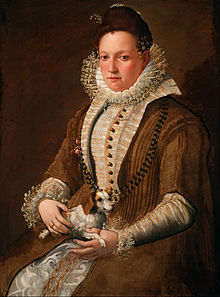
Apparently female painters weren't unheard of at the time, but they were basically relegated to the "mommy track" of painting: portraiture. Most of her portraits were of wealthy people who could afford to pay commissions, but here's one more intimate one that I particularly like:
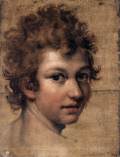
(Could this have been one of her children? I like to think so.)
What was different about Lavinia, though, was that she expanded her reach beyond portrait-painting into different genres. She began with small devotional works painted on copper, which were popular as gifts, and moved on to large-scale works on religious and mythological subjects.

Minerva Dressing
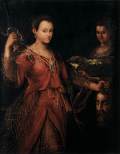
Judith With the Head of Holofernes
She was also commissioned to make many large altarpieces for the churches of Bologna. In 1603, at the invitation of Pope Clement VIII, Lavinia and her family moved to Rome, where she continued to succeed at her work and the family of Pope Gregory XIII became her patrons. Pope Paul V sat for a portrait by her. She received many honors for her work, and was elected to the Accademia di San Luca, a Roman artists' guild. All told, she painted 135 documented works, although only 32 signed and dated ones survive. One of her paintings, "Jesus Appears to Mary Magdalen," now hangs in the Uffizi Gallery:

Lavinia Fontana died in Rome in 1614. Her prolific body of work outlives her.
