Vacation was great.
We were in Vancouver and then Seattle. I don't take a lot of photos on vacation so you can't see us in Whistler, a ski resort 2 hours north of Vancouver, ziplining between two mountains. Yeah we did!! Nor can you see us attending a Saturday night Bard on the Beach production of Shakespeare's Love's Labor Lost, set in the 1920's with all kinds of Jazz Age choreographed musical numbers thrown in. It was a hoot! But here are a few Vancouver shots my husband took:
(outside our hotel with some serious eye-rolling by my daughter)
(Shannon Waterfall, just off the road to Whistler)
(some new friends)
(ditto)
(double ditto)
Nor do I have photos to display of our Underground Seattle Tour (which seemed to focus heavily on the city's history of sewage disposal) or of our Locked Room Challenge (which was cool, except that I discovered to my deep shame that I'm useless at locked room challenges. Everyone else in my family did really well though). I did force my daughter to pose for me at the wonderful Elliot Bay Bookstore
and my husband caught this lovely shot of me and my son at the aquarium gift shop:
But the only time I really pulled my phone out and started snapping pics is when we got to the Chihuly Garden and Museum, because it was absolutely incredible. First off, I should note that Dale Chihuly, one of the world's foremost glassmakers and a native of Tacoma, is a genius (I think that's beyond question) but is also completely whacked. This museum/exhibit space of his in Seattle has a café, where we ate lunch, but before you enter the café you walk past two enormous wall-hung exhibit cases displaying a tiny fraction of his collection of bottle openers. Two cases of bottle openers also hang in each of the nearby bathrooms. So you start to get a sense of why it might be called the Collections Café, but you don't really get it until you're seated in the restaurant and you look up to the ceiling and see this:
Those are accordions. Eighty-two of them on the ceiling, our helpful waiter told us. Less than a fifth of Chihuly's full accordion collection, which he stores at various warehouses. But if you thought that Chihuly only collects accordions and bottle openers, you were gravely mistaken. He has MANY other collections, including but not limited to: shaving brushes; pre-WWII string dispensers; mid-20th-century wooden dollhouse furniture; vintage radios; and a category called chalkware, which is so supremely creepy that I had to take two pictures of the huge display cases:
Okay, so there you have Dale Chihuly the Lunatic Collector. But there is also Dale Chihuly, the man who single-handedly revolutionized the art of glassmaking, and on this subject, I will just let the photos speak for themselves.
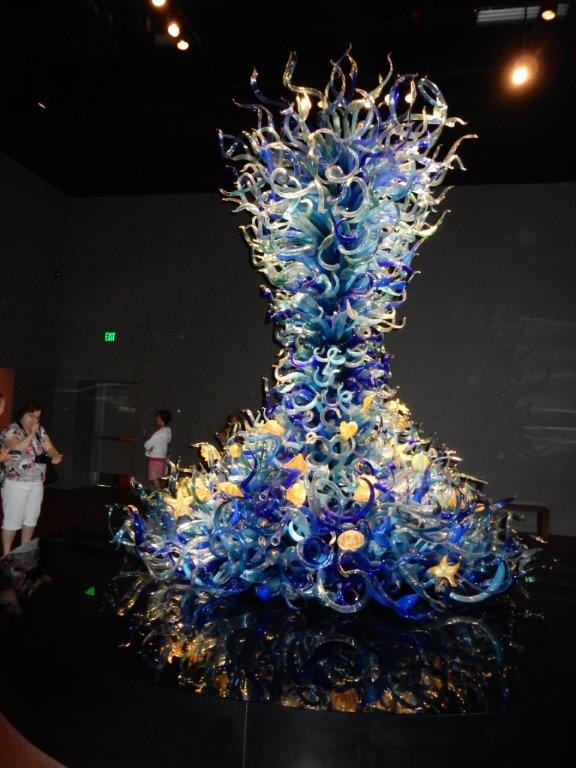
If you ask me, we could have done nothing else on vacation but seen the Chihuly exhibits, and it would still have been worth the trip.
Tuesday, August 25, 2015
Monday, August 17, 2015
STOPPING TIME
Best Things About Returning From a Family Vacation
1. My own home; bed; pillow.
2. Reuniting with the dogs.
Worst Things About Returning From a Family Vacation
1. Cooking! Washing dishes!
2. Having a zillion tasks that were shelved until after vacation.
3. Thinking I see my son everywhere I go and then remembering it can't be him.
Absolute Worst Thing About Returning From a Family Vacation
The very worst thing, bar none, is having to confront the reality that none of us can stop time. For a week or so, I can live inside the illusion that my husband and kids and I are still a four-person unit, and that status will never change. Of course, it's already changed. My son is a grown man with a job waiting for him to start in September and a new apartment he shares with his girlfriend. My daughter is in college and even though she's still a work in progress, more and more often I see glimmers of the woman she's becoming. But when the four of us go on vacations together, it's like we enter an unspoken pact to pretend that they're still The Kids and my husband and I are still The Parents. No one tells The Kids they have to act that way, so I have to think that they derive some measure of comfort from this arrangement too. Because of course all of us know that time has changed us and will keep changing us even more. The four of us will drift apart and then, if we're fortunate, back together, but in new configurations. They'll both start their own families, and those will become primary to them. My husband and I will retire from our jobs at some point, and we'll have to figure out where our next steps will lead us. The future is exciting, scary, inevitable. So once in a while, for a short and finite time, it's restful to stop moving forward into whatever comes next. It feels good for all of us to climb back into the nest together, and just be the way we used to be, even though we all know it's artificial. And then our little idyll ends.
Vacation photos to follow soon.
p.s. This afternoon I came across a poem by Nilanjana Bose, a gifted poet whom I e-met during the A to Z Challenge, that perfectly fit my elegiac mood, so I thought I'd share it here.
SHELLS
1. My own home; bed; pillow.
2. Reuniting with the dogs.
Worst Things About Returning From a Family Vacation
1. Cooking! Washing dishes!
2. Having a zillion tasks that were shelved until after vacation.
3. Thinking I see my son everywhere I go and then remembering it can't be him.
Absolute Worst Thing About Returning From a Family Vacation
The very worst thing, bar none, is having to confront the reality that none of us can stop time. For a week or so, I can live inside the illusion that my husband and kids and I are still a four-person unit, and that status will never change. Of course, it's already changed. My son is a grown man with a job waiting for him to start in September and a new apartment he shares with his girlfriend. My daughter is in college and even though she's still a work in progress, more and more often I see glimmers of the woman she's becoming. But when the four of us go on vacations together, it's like we enter an unspoken pact to pretend that they're still The Kids and my husband and I are still The Parents. No one tells The Kids they have to act that way, so I have to think that they derive some measure of comfort from this arrangement too. Because of course all of us know that time has changed us and will keep changing us even more. The four of us will drift apart and then, if we're fortunate, back together, but in new configurations. They'll both start their own families, and those will become primary to them. My husband and I will retire from our jobs at some point, and we'll have to figure out where our next steps will lead us. The future is exciting, scary, inevitable. So once in a while, for a short and finite time, it's restful to stop moving forward into whatever comes next. It feels good for all of us to climb back into the nest together, and just be the way we used to be, even though we all know it's artificial. And then our little idyll ends.
Vacation photos to follow soon.
p.s. This afternoon I came across a poem by Nilanjana Bose, a gifted poet whom I e-met during the A to Z Challenge, that perfectly fit my elegiac mood, so I thought I'd share it here.
SHELLS
The laughter’s gone from this heart.
the lamplight’s gone from this home;
the threshold, the corners are dark,
the ones who’d lit it up depart
for cities from where no letters come;
for cities that no one returns from.
The water’s as tall as the crops -
the river’s too full of herself,
ear by ear the grain starts to rot,
the young scatter in search of jobs,
the old watch unable to help;
the lamp stands unlit on its shelf.
The fathers can keep their eyes dry
and keep their words clipped and brief;
but they pause far too much, they sigh,
and their lips suddenly pull awry;
the mothers are too bowed to weep
gone to places even beyond grief.
The water stands as high as the rice
the harvest has stopped in its tracks;
the lamp flickers once before it dies -
the light lays its head on the thighs
of the dark and the young men pack
for cities, and they don’t come back.
We’re become the shell of a house.
We’re become the shell of a loving.
See how our garments fall loose.
See how our proud heads are bowed.
Once here the bulbul used to sing,
she’s now fallen quiet, there’s nothing.
* * * *
My feelings at the moment aren't quite as extreme as those Nila is expressing here - and I'd like to think I'm more than just an empty shell - but her poetry is always lovely, and always worth the read. You can find more of it on her blog, http://nilabose.blogspot.com.
Wednesday, July 29, 2015
BOOK REVIEW: ABOVE THE EAST CHINA SEA
I do love me some Sarah Bird. By which I mean that I love her novels, but I also mean that I have a very strong sense that if I were ever to actually meet her, I would want so badly to be her BFF. Her books glow with wacky humor and deep compassion. Her sharp intelligence enlivens all of her intricate plotlines and their satisfying conclusions. She's one of the handful of authors whose names I periodically Google to see if they've published any new novels, and if they have, I scoop them up. That's how I found out about Bird's ninth novel, ABOVE THE EAST CHINA SEA (Vintage Press, April 2015).
Unlike her other novels, this one didn't draw me in at first. Writers are always told to begin a story with a hook, and I have to admit that a first chapter consisting of a conversation in stylized language between a dead fetus and his dead teenaged mother missed the sweet spot for me by a wide margin. But this was Sarah Bird, so I persevered. I'm glad I did.
We don't learn the name of Tamiko, the pregnant 15-year-old, who lived on Okinawa and died during World War II, until much later in the book, but we do learn a lot about her life before the War. Her two parents exemplify opposite ends of the social spectrum at the time: her mother comes from a long line of pragmatic, rough-mannered Okinawan peasant farmers, while her father's family has long followed white-collar pursuits - mathematics and calligraphy - and considers itself refined and elegant, superior in every way to those who toil in the fields. Tamiko is ashamed of her mother, and ashamed that she takes after her physically: dark skin, round face, broad feet. Her older sister Hatsuko, on the other hand, seems to have inherited more of her father's genes, and is everything Tamiko longs to be: beautiful, graceful, sophisticated. Of course, Hatsuko was selected last year to be one of the Princess Lily girls - the chosen few from the entire island who will be invited to attend the one and only girls' high school. Tamiko is up for the selection process this year, but she has almost no hope for her own prospects and is more or less resigned to her fate - a lifetime of farm work - in advance. But when the war suddenly arrives on Okinawan shores in the form of invading American ships, the old social order is instantly upended.
Switch gears to the book's other story, also set on Okinawa but 70 years after Tamiko's. Luz James is a tough-talking, rule-breaking 17-year-old military brat who pulls off looking like she has her shit together, but secretly contemplatesending it all by jumping off one of the island's high black cliffs. For Luz, Okinawa is just one more in the endless series of her mother's interchangeable short-term postings. At first her mother pumps her up about the prospect of meeting their Okinawan relatives - Luz's maternal grandmother was from the island - but that idea is shut down totally after her mother receives a mysterious letter she refuses to discuss with Luz. So now, the only difference between Okinawa and anyplace else, as far as Luz is concerned, is that this is the first time she's started over in a new place as an only child. When Luz's older sister stunned her by enlisting right out of high school and then promptly getting herself killed on her first deployment, Luz lost the only person who made her feel like she mattered. All she's doing now is going through the motions of hanging out with yet another band of base-kid stoners while trying to decide whether it's even worth the effort. But that begins to change when Luz finds herself trapped in a cave and follows the sound of whimpering until she comes upon a starving, wounded young Okinawan girl who wordlessly begs Luz for help - not for herself, but for her tiny newborn baby. And it changes even more when she leads Jake, the handsome Okinawan boy who follows Luz to the cave because he's worried about her, back to where she saw the girl and her baby. But now, only minutes later, there's nothing there but a pile of bones.
But what's even crazier is how matter-of-factly Jake reacts when Luz can finally bring herself to tell him about the disappearing girl in the cave. "This is Okinawa," he tells her. "This is how it is: We live with the dead and the dead live with us. It's not spooky or creepy or woo-woo; it's just how it is." But what Jake fails to mention at that point is how much more true all of this becomes during the three-day festival of Odon, when the line between the living and the dead becomes so thin that it requires almost no effort to slip across it - in either direction.
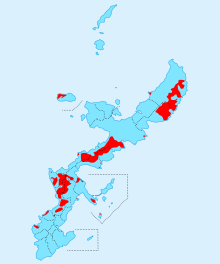
I don't know about you, but my knowledge of Okinawa has, until now, begun and ended with Mr. Miaggi. Wax on, wax off. I didn't know that Japan had used Okinawa as a pawn in World War II, putting it in harm's way and then not even making a pretense of defending it. I didn't know that, despite the fact that Okinawa had no stake in the outcome of the War, something like a third of its population was killed by the end of it. And I didn't know that afterward, part of Japan's peace treaty with the Allied forces was its agreement to cede about one-fifth of Okinawa (which was given no say in the matter) to be used for American military operations.
Or that it didn't matter to the Americans what they were plowing under - fertile fields, ancient burial grounds - in order to build their bases and airstrips. I didn't know that the tiny island of Okinawa has been shamelessly screwed over by more powerful forces, time after time after time.
I was bothered by one gaping plot hole. There's a ton of backstory for all the major players, and a huge emphasis on family, but Luz's absent father barely even gets a mention. Still, to me this omission is heavily outweighed by the sheer pleasure of reading this lovely novel and following its clues until, at the end, the reader fully understands how and why - as the Okinawans say - "life is the treasure."
Unlike her other novels, this one didn't draw me in at first. Writers are always told to begin a story with a hook, and I have to admit that a first chapter consisting of a conversation in stylized language between a dead fetus and his dead teenaged mother missed the sweet spot for me by a wide margin. But this was Sarah Bird, so I persevered. I'm glad I did.
We don't learn the name of Tamiko, the pregnant 15-year-old, who lived on Okinawa and died during World War II, until much later in the book, but we do learn a lot about her life before the War. Her two parents exemplify opposite ends of the social spectrum at the time: her mother comes from a long line of pragmatic, rough-mannered Okinawan peasant farmers, while her father's family has long followed white-collar pursuits - mathematics and calligraphy - and considers itself refined and elegant, superior in every way to those who toil in the fields. Tamiko is ashamed of her mother, and ashamed that she takes after her physically: dark skin, round face, broad feet. Her older sister Hatsuko, on the other hand, seems to have inherited more of her father's genes, and is everything Tamiko longs to be: beautiful, graceful, sophisticated. Of course, Hatsuko was selected last year to be one of the Princess Lily girls - the chosen few from the entire island who will be invited to attend the one and only girls' high school. Tamiko is up for the selection process this year, but she has almost no hope for her own prospects and is more or less resigned to her fate - a lifetime of farm work - in advance. But when the war suddenly arrives on Okinawan shores in the form of invading American ships, the old social order is instantly upended.
Switch gears to the book's other story, also set on Okinawa but 70 years after Tamiko's. Luz James is a tough-talking, rule-breaking 17-year-old military brat who pulls off looking like she has her shit together, but secretly contemplatesending it all by jumping off one of the island's high black cliffs. For Luz, Okinawa is just one more in the endless series of her mother's interchangeable short-term postings. At first her mother pumps her up about the prospect of meeting their Okinawan relatives - Luz's maternal grandmother was from the island - but that idea is shut down totally after her mother receives a mysterious letter she refuses to discuss with Luz. So now, the only difference between Okinawa and anyplace else, as far as Luz is concerned, is that this is the first time she's started over in a new place as an only child. When Luz's older sister stunned her by enlisting right out of high school and then promptly getting herself killed on her first deployment, Luz lost the only person who made her feel like she mattered. All she's doing now is going through the motions of hanging out with yet another band of base-kid stoners while trying to decide whether it's even worth the effort. But that begins to change when Luz finds herself trapped in a cave and follows the sound of whimpering until she comes upon a starving, wounded young Okinawan girl who wordlessly begs Luz for help - not for herself, but for her tiny newborn baby. And it changes even more when she leads Jake, the handsome Okinawan boy who follows Luz to the cave because he's worried about her, back to where she saw the girl and her baby. But now, only minutes later, there's nothing there but a pile of bones.
But what's even crazier is how matter-of-factly Jake reacts when Luz can finally bring herself to tell him about the disappearing girl in the cave. "This is Okinawa," he tells her. "This is how it is: We live with the dead and the dead live with us. It's not spooky or creepy or woo-woo; it's just how it is." But what Jake fails to mention at that point is how much more true all of this becomes during the three-day festival of Odon, when the line between the living and the dead becomes so thin that it requires almost no effort to slip across it - in either direction.
I don't know about you, but my knowledge of Okinawa has, until now, begun and ended with Mr. Miaggi. Wax on, wax off. I didn't know that Japan had used Okinawa as a pawn in World War II, putting it in harm's way and then not even making a pretense of defending it. I didn't know that, despite the fact that Okinawa had no stake in the outcome of the War, something like a third of its population was killed by the end of it. And I didn't know that afterward, part of Japan's peace treaty with the Allied forces was its agreement to cede about one-fifth of Okinawa (which was given no say in the matter) to be used for American military operations.
Or that it didn't matter to the Americans what they were plowing under - fertile fields, ancient burial grounds - in order to build their bases and airstrips. I didn't know that the tiny island of Okinawa has been shamelessly screwed over by more powerful forces, time after time after time.
I was bothered by one gaping plot hole. There's a ton of backstory for all the major players, and a huge emphasis on family, but Luz's absent father barely even gets a mention. Still, to me this omission is heavily outweighed by the sheer pleasure of reading this lovely novel and following its clues until, at the end, the reader fully understands how and why - as the Okinawans say - "life is the treasure."
Sunday, July 26, 2015
NEVER THOUGHT I'D GET THE CHANCE...
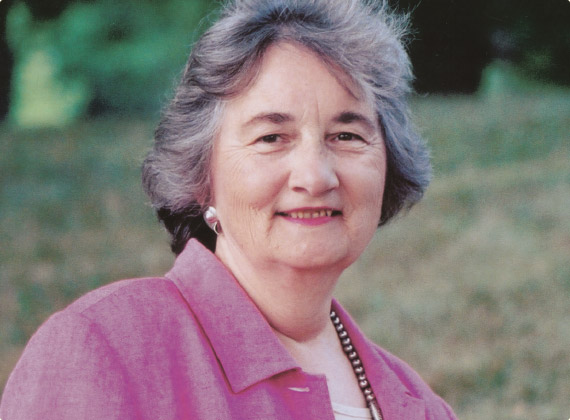
...to meet my #1 Kidlit Writing Hero, but barring something unforeseen, it's going to happen. I'M GOING TO HAVE TEA AT HER HOUSE, you all!! Okay, first let's see if you can guess who it is. This person:
- was born in China between the two World Wars;
- was a teacher in Japan;
- has won (among many other awards) two Newbery Medals and two National Book Awards;
- was recently a U.S. National Ambassador for Children's Literature; and
- is (I just discovered) active on Facebook!
It's Katherine Paterson, and here's how this came about. In June I saw on someone's website that the MFA program of the Vermont College of Fine Arts was going to be hosting an auction. Just out of curiosity, I looked to see what the prizes were, and saw to my amazement that one of them - the only one, as far as I was concerned - was Tea with Katherine Paterson (who's on the VCFA Board of Trustees) at her house. I mean, how many world-famous writers do you know who would open up their homes to complete strangers and serve them tea?? So I pledged an absolutely insane amount of money, because talk about a once-in-a-lifetime opportunity! And I won the auction, because luckily for me, no one else seemed to be willing to spend quite so much of his/her children's inheritance as I was. Sorry, kids. Someday maybe you'll understand.
Katherine Paterson is who I want to be when I grow up. She's been publishing books since the 1970s, and they've been delighting and inspiring me for twenty years or more. And I heard her deliver a keynote address years ago at some conference or other, and she was exactly as awesome as I expected her to be, which is an extremely high bar to meet. She signed books afterward, and when it was my turn to get her autograph and I asked her if I could give her a hug (yes, yes, I'm mortified that I did this, okay?), she didn't bat an eye, just smiled, stood up, came out from behind the desk, and hugged me back.
Paterson has written picture books, a memoir, some essays and other nonfiction, and 16 novels for young people covering an enormous variety of subjects, both historical and contemporary. The common thread between almost all of the novels is that her protagonists are outsiders and sometimes outcasts. They're displaced persons, uncomfortable in their surroundings and, often, in their own skins. Paterson understands them all so deeply that she makes the reader love them even though they don't (yet) know how to love themselves. Paterson's background is intensely Christian (her parents were missionaries, her husband was a minister, she has an advanced degree in Christian education). She doesn't ever use her books to shove her faith at you, but what she does do, over and over, is beautifully, credibly illustrate both the pain of isolation and the power of redemption. Her books have brought solace to kids all over the world, and are very close to my heart.
And in September I'm going to meet this woman and spend a few hours in her company and bask in her glow. And then I'm going to come back home and write about every last detail. So stay tuned. And follow her on Facebook! Because, as if all her other accomplishments weren't enough, apparently she's tech-savvy too!
p.s. No, I'm sorry, you can't have tea with Katherine Paterson, because (as I might have mentioned) I WON THAT, but maybe if you're lucky (and also cool with hijacking your family's financial security), you can have lunch with A.S. King: https://www.facebook.com/as.king.author/photos/a.286927082468.144637.45802717468/10153025337017469/?type=1&theater. I guess writers eating meals with their slavering fans is a thing now! Go for it!
- was born in China between the two World Wars;
- was a teacher in Japan;
- has won (among many other awards) two Newbery Medals and two National Book Awards;
- was recently a U.S. National Ambassador for Children's Literature; and
- is (I just discovered) active on Facebook!
It's Katherine Paterson, and here's how this came about. In June I saw on someone's website that the MFA program of the Vermont College of Fine Arts was going to be hosting an auction. Just out of curiosity, I looked to see what the prizes were, and saw to my amazement that one of them - the only one, as far as I was concerned - was Tea with Katherine Paterson (who's on the VCFA Board of Trustees) at her house. I mean, how many world-famous writers do you know who would open up their homes to complete strangers and serve them tea?? So I pledged an absolutely insane amount of money, because talk about a once-in-a-lifetime opportunity! And I won the auction, because luckily for me, no one else seemed to be willing to spend quite so much of his/her children's inheritance as I was. Sorry, kids. Someday maybe you'll understand.
Katherine Paterson is who I want to be when I grow up. She's been publishing books since the 1970s, and they've been delighting and inspiring me for twenty years or more. And I heard her deliver a keynote address years ago at some conference or other, and she was exactly as awesome as I expected her to be, which is an extremely high bar to meet. She signed books afterward, and when it was my turn to get her autograph and I asked her if I could give her a hug (yes, yes, I'm mortified that I did this, okay?), she didn't bat an eye, just smiled, stood up, came out from behind the desk, and hugged me back.
Paterson has written picture books, a memoir, some essays and other nonfiction, and 16 novels for young people covering an enormous variety of subjects, both historical and contemporary. The common thread between almost all of the novels is that her protagonists are outsiders and sometimes outcasts. They're displaced persons, uncomfortable in their surroundings and, often, in their own skins. Paterson understands them all so deeply that she makes the reader love them even though they don't (yet) know how to love themselves. Paterson's background is intensely Christian (her parents were missionaries, her husband was a minister, she has an advanced degree in Christian education). She doesn't ever use her books to shove her faith at you, but what she does do, over and over, is beautifully, credibly illustrate both the pain of isolation and the power of redemption. Her books have brought solace to kids all over the world, and are very close to my heart.
And in September I'm going to meet this woman and spend a few hours in her company and bask in her glow. And then I'm going to come back home and write about every last detail. So stay tuned. And follow her on Facebook! Because, as if all her other accomplishments weren't enough, apparently she's tech-savvy too!
p.s. No, I'm sorry, you can't have tea with Katherine Paterson, because (as I might have mentioned) I WON THAT, but maybe if you're lucky (and also cool with hijacking your family's financial security), you can have lunch with A.S. King: https://www.facebook.com/as.king.author/photos/a.286927082468.144637.45802717468/10153025337017469/?type=1&theater. I guess writers eating meals with their slavering fans is a thing now! Go for it!
Tuesday, July 14, 2015
BREAKING NEWS: ANOTHER HARPER LEE DISCOVERY!!
So have you heard already that there might be yet a third Harper Lee novel lurking in that mysterious vault in Monroeville? Or possibly even a fourth?? That vault seems to have the capacity of Hermione Granger's bottomless bag, doesn't it? But here's an exclusive scoop the media hasn't gotten hold of yet: the vault also contained an fully authenticated Harper Lee graphic novel, carbon-dated to the year 1958, only a few years after the time when GO SET A WATCHMAN took place.
That's right, folks. Harper Lee wrote a graphic novel decades before the genre was thought to have been created. And not only that - although I cannot reveal my sources, I have been given permission to share here an exclusive excerpt from this extremely rare and valuable manuscript. Are you ready? Okay then, here goes:
Don't forget, folks - you saw it here first.
That's right, folks. Harper Lee wrote a graphic novel decades before the genre was thought to have been created. And not only that - although I cannot reveal my sources, I have been given permission to share here an exclusive excerpt from this extremely rare and valuable manuscript. Are you ready? Okay then, here goes:
Don't forget, folks - you saw it here first.
Tuesday, July 7, 2015
ELIZABETH WEIN'S "BLACK DOVE, WHITE RAVEN:" A SAD LITTLE BOOK REVIEW
I love Elizabeth Wein. That's why I drove two hours each way to see her at a book signing last year. I adored ROSE UNDER FIRE and CODE NAME VERITY. The second I learned that she had a new historical YA novel (Hyperion, March 2015) coming out, I preordered it. I've read it now, and I wanted so badly to love it and to write a shamelessly glowing review of it, but I can't. Wein tells a good story - I don't think she could do otherwise if she tried - but I felt distanced from the characters as if I was seeing them through a screen. And I think that's because Wein herself is more in love with Ethiopia, where the heart of the book is set, than with either of her two main characters.
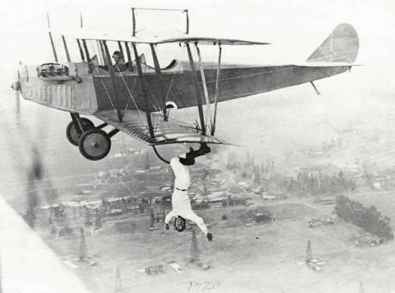
The original Black Dove and White Raven of the tale were, respectively, Delia (African-American) and Rhoda from Blue Rock Farm in Pennsylvania (Caucasian), a pair of Jazz Age, fearless, wing-walking, barnstorming young pilots who traveled around the United States in their little biplane, performing in air shows.
Oh, and each of these Wonder Women had a baby: Rhoda's daughter Emilia (Em) was eight months older than Delia's son Teodros (Teo), and the two solo women were essentially co-parents of both children. Life was wonderful and exciting, but the women chafed against the racism they encountered everywhere they went. Delia proposed a solution: that the four of them move to Ethiopia, the homeland of Teo's conveniently deceased father, a place to which she's never been but which she imagined to be race-blind. Rhoda soon comes to embrace this dream too, and they begin diligently saving money to prepare for the move. But then Delia dies in a terrible airplane encounter with a flock of birds, and Rhoda, now somehow the uncontested guardian of Teo as well as Em (the facts get a little hazy here), retreats to her parents' home where the children are cared for by her family members while she suffers a prolonged and extreme period of depression.
Meanwhile, while Em and Teo's physical needs are being met, they have no one but each other to turn to for emotional support. Together they develop a fantasy world in which the two of them are now Black Dove and White Raven, encountering comic-book-style adventures and perils from which they always emerge victorious. Eventually, Rhoda recovers from her grief to the point where she decides to pursue Delia's dream on her own: she pulls up stakes with the two children and moves to Ethiopia. But unfortunately, there are a lot of things about her newly-adopted country that Rhoda has yet to learn.
It's probably safe to assume that 1930's Ethiopia, a.k.a. Abyssinia, is not a subject about which most modern readers would have an expertise. But Wein wants us to know everything about the country as it was at that moment in time - its history, climate, geography, culture, political situation - because she so passionately wants her readers to love the place as much as she does. And the way she solves this problem is via information dumps. Over and over, people toss into their conversations the kinds of facts that people never toss into conversations, like that Ethiopia was the only African nation never to have been colonized, or that it had just joined the League of Nations, or that a lot of the guns on the street when Teo and Em first arrived in Ethiopia had been picked up at the Battle of Adwa in 1896. Wein creates elaborate backstories to explain how her characters have come to be who they are, but to me, the stories were too elaborate, and by and large unnecessary. After I finished reading the book I went back to the beginning and realized that I had no recollection of most of what I had read there. I didn't care how Rhoda and Delia first met, or how Rhoda met Em's Italian father, Papa Menotti, or how Delia met Teo's father, or how and when Rhoda and Delia had first learned to fly. I just wanted to find out what happened to Em and Teo, and none of the backstory mattered to me so I forgot it as soon as I read it. And I'm an adult, and I'm generally fascinated by history, which to me suggests that a teenage reader with a shorter attention span would forget it all even faster.
It's easy to see from photographs how mesmerizingly beautiful a place Ethiopia is.
You can't possibly fault Wein for having fallen in love with it after she'd been there. Em and Teo have a lot of adventures in Ethiopia, some wonderful, some horrifying. Often their former imaginary identities as White Raven and Black Dove help them to navigate through the worst real-life catastrophes that befall them. They make a great team, and their devotion to each other is lovely to read about. But the real, in-your-face star of this show is Ethiopia itself, not Em and Teo, and I kept finding myself wishing that it were the other way around.
Sunday, June 28, 2015
WELCOME TO MY FONTFAIL
Courier New, anyone? Is there something tragically wrong with Courier New that no one ever bothered me to tell me about? I'm assuming, of course, that you're more font-forward than I am, because let's face it - who isn't? Courier New is the default font I use at work. To me, it's so mild-mannered and inoffensive as to be invisible. I mean, it's not like it features little clowns acting out the letters, is what I'm saying. It's BLAND.
And yet, when I met with an agent for a critique at the NJSCBWI conference I attended two weeks ago, she started off the conversation by telling me, in a seriously aggrieved tone, that I had (Crime #1) sent her my submission in her least favorite font. And if that weren't enough, when she tried to change the font to something more tolerable, everything went "all wonky" because (Crime #2) I had done such a terrible job of formatting. I got the strong impression that, had my crime spree ended with the use of Courier New, she might have courageously gritted her teeth and sailed onward, difficult as it would have been. But by following it up with Crime #2, I had truly drilled the last nail into my own coffin. Oh, the agent also really did not like my manuscript, by the way, but her response to that seemed so much less visceral; she was not remotely interested in the content, but neither was she personally offended.
It's taken me a while to figure out what was going on here, but I've got it now: I was being told that I had demonstrated an appalling lack of taste and judgment by utilizing what I should have known was a clearly inferior font in a submission to a clearly superior person. Or - perhaps even worse - that I knew full well how nightmarish Courier New was, but I simply didn't care. I was utterly indiscriminate (cf. "That's my last duchess painted on the wall"). In short, I was a fontslut.
I realized only today that I had been font shamed, and I was going to post about it when it occurred to me that I might actually not be the first person to come up with that phrase. Enter Google. I now know that font shaming is a concept that has existed for the Internet equivalent of millennia, i.e., at least two years. If you don't believe me, read this and this and this, and then join me in my hatred of people everywhere who will stop at nothing to let you know how much better they are than you.
Look!! It's Little Lord FONTleroy!!! hahahahahahaha
So. Have YOU ever been font shamed? Please let me know. If there are enough of us, maybe we can form a support group!
UPDATE: Today I Googled "font snobbery," and what an education I've gotten! Thank God I didn't send my submission in Comic Sans; if I had, my picture might be up in print shops all around the country under a "MOST WANTED" caption. But I didn't see one mention of Courier New among the lists of Most Reviled Fonts. And besides, the people who seem most offended by certain fonts seem to be mostly graphic designers, who I suppose have a right to care about things like that. But the rest of us? Please. Get a life.
And yet, when I met with an agent for a critique at the NJSCBWI conference I attended two weeks ago, she started off the conversation by telling me, in a seriously aggrieved tone, that I had (Crime #1) sent her my submission in her least favorite font. And if that weren't enough, when she tried to change the font to something more tolerable, everything went "all wonky" because (Crime #2) I had done such a terrible job of formatting. I got the strong impression that, had my crime spree ended with the use of Courier New, she might have courageously gritted her teeth and sailed onward, difficult as it would have been. But by following it up with Crime #2, I had truly drilled the last nail into my own coffin. Oh, the agent also really did not like my manuscript, by the way, but her response to that seemed so much less visceral; she was not remotely interested in the content, but neither was she personally offended.
It's taken me a while to figure out what was going on here, but I've got it now: I was being told that I had demonstrated an appalling lack of taste and judgment by utilizing what I should have known was a clearly inferior font in a submission to a clearly superior person. Or - perhaps even worse - that I knew full well how nightmarish Courier New was, but I simply didn't care. I was utterly indiscriminate (cf. "That's my last duchess painted on the wall"). In short, I was a fontslut.
I realized only today that I had been font shamed, and I was going to post about it when it occurred to me that I might actually not be the first person to come up with that phrase. Enter Google. I now know that font shaming is a concept that has existed for the Internet equivalent of millennia, i.e., at least two years. If you don't believe me, read this and this and this, and then join me in my hatred of people everywhere who will stop at nothing to let you know how much better they are than you.
So. Have YOU ever been font shamed? Please let me know. If there are enough of us, maybe we can form a support group!
UPDATE: Today I Googled "font snobbery," and what an education I've gotten! Thank God I didn't send my submission in Comic Sans; if I had, my picture might be up in print shops all around the country under a "MOST WANTED" caption. But I didn't see one mention of Courier New among the lists of Most Reviled Fonts. And besides, the people who seem most offended by certain fonts seem to be mostly graphic designers, who I suppose have a right to care about things like that. But the rest of us? Please. Get a life.
Subscribe to:
Posts (Atom)