Please help. My blog is starving and I have nothing to feed it.
I'm stricken with pity and guilt by my blog's plight, but pity and guilt don't help it any more than they would help this tiny scrap of avian life to survive, to grow, to someday unfold its new wings, to launch itself into the infinite nest of the air. My blog needs nourishment, and I have none to give.
Unfortunately, the USB ports on my laptop don't accept worms and grubs. If they did, I could probably manage to find some good specimens in the back yard. But the food I need to produce for the blog has to be manufactured in my brain, and my brain seems to have closed up the creativity shop. The only thing it seems able to produce these last few weeks is anxiety, and as we all know, the only thing anxiety can feed is more anxiety.
It's embarrassing to reveal what I'm so anxious about, but I will, in the hope that if I spill a little of my own blood between the keys, the blog will at least be temporarily mollified. I'm anxious because in 13 days I'll find myself in attendance at the New Jersey Society of Book Writers and Illustrators (a.k.a. "NJSCBWI") annual Conference. I've attended this Conference for many years, and for every one of at least the last five, I've gotten my heart broken. I've submitted the first 15 pages of a book manuscript for one-on-one critiques by editors and/or agents, and I've been told by at least one such critiquer that she (it's always been a she) loves what I've written, loves the way I write, and wants to see more, more, more. So I've duly sent more, more, more, only to (occasionally) be told never mind, or (more frequently) never hear so much as a syllable in response. This happens every. Single. Year. And yet I keep making my annual pilgrimage to this Conference, because where else will I find the opportunity to receive real critiques from real industry professionals? It's truly an amazing perk that NJSCBWI offers, and I keep taking advantage of it, and I keep getting my hopes up, only to eventually be spat out once again upon the slush-pile shore.
But here's the thing: my writing keeps getting better. I know this to be true beyond all doubt. So of course, each year I can't help believing that THIS TIME will be the charm. And each year, I do inch closer and closer, but - at least so far - never close enough. Which is why for the past week I haven't been able to draw a full breath - not like that's annoying, right? - and I'm not expecting any relief from this condition until I'm back home post-Conference.
Truth be told, writing all this is not only embarrassing; it's mortifying. What's wrong with me?? Do I not have one of the most fortunate of lives? I have a good, wise, supportive husband. I have two healthy, smart, talented, funny, kind children. I live with the two best dogs in the world. I have a career that I find challenging and rewarding, and that also pays decent money. I have a handful of friendships that go bone-deep. In sum, I have everything I have any right to want, and more. So why can't I just be grateful and STFU????
I'll tell you why. Because, much like my blog and a certain caterpillar, I'm hungry, hungry too.
Sunday, May 31, 2015
Wednesday, May 20, 2015
PERSONALLY...
In April I only wrote about other people - specifically, people who lived and died 500 years ago. So far in May, I've barely written about anything at all. So maybe it's time for me to write about myself and my family and our little jaunt over the past weekend to Washington, D.C. TO ATTEND MY SON'S LAW SCHOOL GRADUATION!!
But honestly, it's been such a crazy couple of weeks that I'm not sure I have enough brain power remaining to write anything coherent, let alone halfway intelligent. So we'll compromise. I'll just post pictures.
(is it just me, or is there something distinctly 16th-century about that cap and gown Nathan's wearing??)
and here's the whole fam!!
So much happiness and pride I almost exploded... and still might, if I ever have enough energy!
But honestly, it's been such a crazy couple of weeks that I'm not sure I have enough brain power remaining to write anything coherent, let alone halfway intelligent. So we'll compromise. I'll just post pictures.
there's the grad
and there he is with his sister (left) and his girlfriend (right)and here's the whole fam!!
So much happiness and pride I almost exploded... and still might, if I ever have enough energy!
Wednesday, May 6, 2015
WRAPPING IT UP
I don't know about you, but for me April ended just in the nick of time. In the week that followed, this is almost literally the first opportunity I've had to rub two minutes together. In other words, it's time for me to attempt an A to Z Challenge Wrap-Up post.
I'll start by saying that I LOVED doing the Challenge in this, my second year. I sort of stumbled my way to what proved to be the perfect topic for me: 16th-century people who lived exceptional lives in one way or another, but whose names are, for the most part, unfamiliar to people of the 21st century except for historical scholars. Not being a historical scholar myself, I had never heard of almost any of the 26 people I ended up posting about, and trying to round up and organize information about their lives was a constant source of delight for me.
I also discovered a whole bunch of wonderful blogs and bloggers that I would probably never have found otherwise. I can't mention all the names here, but I will list my absolute top three (in no particular order):
Kern Windwraith, The Odd Particle Review. Quirky, hilarious, thought-provoking observations,
deeply generous in spirit.
Nilanjana Bose, Madly-in-Verse. Gorgeous poetry that had me thinking, almost every day: "So why is it exactly that this writer isn't famous yet?"
Zalka Csenge Virag, The Multicolored Diary. Fascinating summaries by a professional storyteller of epic tales from around the world, retold with panache, expertise, and irreverent humor.
I volunteered to be a Minion this year, and then when I found out what that entailed, I thought about backing out. Did I really want to be a Blog Cop, searching out and reporting to my Overlord bloggers who had dropped out along the way or who were still participating but not following the rules? YUCK! It took me a little while, but then I caught on to the purpose behind all this. A lot of Challenge participants diligently hop around the list, visiting ten or twenty or even more new blogs each day, and it can be a real bummer to put in that kind of time and effort, only to find that you keep hitting on blogs that aren't really part of the Challenge after all. So the goal is to eliminate the debris and make blog-hopping a more pleasant experience for the people who actually are participating. Makes sense, right?
I don't have any brilliant suggestions about ways to improve the Challenge for next year. I enjoy the democratic flavor of it all - we're all in it together as long as we're willing to put in the work. Since I'm unlikely to ever run a marathon, this may be the closest I get to that kind of experience! And I don't even have to be seen in public in running shorts! I'd call that a win-win.
Congratulations to all my fellow Challenge survivors! If we didn't meet this year, I hope we will next April.
I'll start by saying that I LOVED doing the Challenge in this, my second year. I sort of stumbled my way to what proved to be the perfect topic for me: 16th-century people who lived exceptional lives in one way or another, but whose names are, for the most part, unfamiliar to people of the 21st century except for historical scholars. Not being a historical scholar myself, I had never heard of almost any of the 26 people I ended up posting about, and trying to round up and organize information about their lives was a constant source of delight for me.
I also discovered a whole bunch of wonderful blogs and bloggers that I would probably never have found otherwise. I can't mention all the names here, but I will list my absolute top three (in no particular order):
Kern Windwraith, The Odd Particle Review. Quirky, hilarious, thought-provoking observations,
deeply generous in spirit.
Nilanjana Bose, Madly-in-Verse. Gorgeous poetry that had me thinking, almost every day: "So why is it exactly that this writer isn't famous yet?"
Zalka Csenge Virag, The Multicolored Diary. Fascinating summaries by a professional storyteller of epic tales from around the world, retold with panache, expertise, and irreverent humor.
I volunteered to be a Minion this year, and then when I found out what that entailed, I thought about backing out. Did I really want to be a Blog Cop, searching out and reporting to my Overlord bloggers who had dropped out along the way or who were still participating but not following the rules? YUCK! It took me a little while, but then I caught on to the purpose behind all this. A lot of Challenge participants diligently hop around the list, visiting ten or twenty or even more new blogs each day, and it can be a real bummer to put in that kind of time and effort, only to find that you keep hitting on blogs that aren't really part of the Challenge after all. So the goal is to eliminate the debris and make blog-hopping a more pleasant experience for the people who actually are participating. Makes sense, right?
I don't have any brilliant suggestions about ways to improve the Challenge for next year. I enjoy the democratic flavor of it all - we're all in it together as long as we're willing to put in the work. Since I'm unlikely to ever run a marathon, this may be the closest I get to that kind of experience! And I don't even have to be seen in public in running shorts! I'd call that a win-win.
Congratulations to all my fellow Challenge survivors! If we didn't meet this year, I hope we will next April.
Thursday, April 30, 2015
Z IS FOR ABRAHAM ZACUTO
Abraham Zacuto was born c. 1452 and died sometime between 1510 and 1520, so it might be a bit of a stretch to call him a 16th-century personage, but I've gotten all the way up to Z in this Challenge, barely cheating along the way, so you're just going to have to cut me some slack with this. Thank you. He was a very interesting man, and well worth bending the rules for. The story of his life reads like a well-plotted novel: every good turn of events is followed by a bad one, and vice versa.
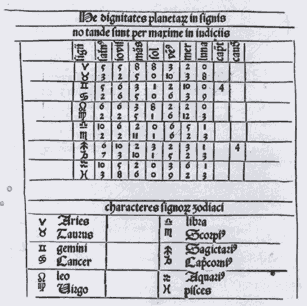
Zacuto was born in Salamanca, Spain, into a family of that city's Jewish nobility, and was given an outstanding religious and secular education. As an adult he became a mathematician and astronomer, served as the rabbi of his community, and taught astronomy at several prestigious Spanish universities, becoming quite well-known in academic circles. Unlike Copernicus, whom we discussed for the letter C, Zacuto apparently specialized in applied, rather than theoretical, astronomy. From what little we know, it sounds like the first 40 years of his life were satisfying ones. In 1478 he published, in Hebrew, a "Great Book" of 65 very detailed astronomical tables that corrected a navigational problem no one had been able to overcome before, and was thus of great practical use to seafarers. The book, soon translated into Spanish and Latin versions, became a huge success, and no 16th-century European maritime explorers embarked without a copy of it.
Then all the Jews who refused to convert to Catholicism were expelled from Spain by Ferdinand and Isabella in August 1492, beginning one day before Christopher Columbus embarked on his voyage to the New World with Zacuto's charts on board for guidance (a copy of the charts with Columbus's own handwritten notations is preserved in Seville). Rather than undergo forced conversion (as some historians believe Columbus did, having possibly been born a Jew), Zacuto fled to Portugal, along with tens of thousands of other Jewish refugees. His academic reputation had preceded him and allowed him to land on his feet. He was soon appointed as the Royal Astronomer and Historian to Portugal's King John II.
For most Jewish immigrants to Portugal, their respite (bought from King John with cash) was only temporary; less than a year after granting them asylum, King John ordered that all remaining Jews in the country who refused forced conversions be enslaved. Of course, exceptions were made for valuable citizens like Zacuto, who remained at court in Lisbon. King John died in 1495 and was succeeded by Manuel I, who for a time maintained Zacuto in his royal position and consulted with him as to whether Vasco da Gama's proposed voyage to find a sea route to India would be feasible. Zacuto supported the plan, and he personally trained da Gama and his crew before they departed on their voyage in 1496, bearing with them Zacuto's navigation charts as well as the new, more portable kind of astrolabe he had invented to be used at sea to determine latitude.
But in 1497, bowing to political pressures (he wanted to marry the daughter of Ferdinand and Isabella of Spain, whose views on harboring Jews we all know), King Manuel ordered that the Jews in Portugal must either convert to Christianity or be deported without their children. Zacuto and his son Samuel were among the few who managed to escape the country in safety. They fled first to Tunis, where in 1504 Zacuto wrote a history of the Jewish people from the time of the Creation to the year 1500, which was repeatedly reprinted for centuries afterward. From Tunis, under the increasing threat of Spanish invasion, he moved on to elsewhere in the Middle East - possibly Turkey, possibly Damascus. Exactly where he spent the rest of his life is unknown, but it is said that he was buried in Jerusalem.
The moon crater Zagut is named after Abraham Zacuto.
In THE DISCOVERERS, Daniel Boorstin (my go-to awesome quotemeister) was writing about Jewish cartographers, but I think what he wrote was equally applicable to astronomers like Zacuto, who mapped the skies rather than the Earth: "It was no accident that Jews played a leading role in the liberation of Europeans from the slavery of Christian geography. Driven from place to place, they helped make cartography, still the special preserve of princes and high bureaucrats, into an international science, offering facts equally valid in lands of all faiths. Marginal both to Christians and to Muslims, the Jews became teachers and emissaries bringing Arab learning into the Christian world."
Vermeer: The Astronomer
* * * * * * * *
And thus ends my 2015 A to Z Challenge. It's been an incredible journey for me. I've learned so much, I've made some new cyberfriends, and I feel like I've been part of something meaningful. I'd like to thank the Academy - oops, wrong speech. But I truly would like to thank every blogger who stopped by here during April, even if it was only once, regardless of whether they had time to leave a comment. I started doing this Challenge last year thanks to Yvonne Ventresca, who told me about it. And this year I had the extra satisfaction of being a Minion, which made me feel like I was doing a little bit to give back, even though I didn't have as much time as I would have liked to visit other blogs. There was a comment left on my yesterday's post about how one person can change history, and indeed, that is true. Well, one person, Arlee Bird, thought up this Challenge a few years ago, and look at the amazing thing he's wrought! Bloggers from all around the world come together for one month to share a common goal. The alphabet is, of course, secondary, but it does add a layer of structure and an added element of challenge. Well done, all of us! And that includes everyone who successfully finished as well as everyone who tried but didn't quite make it this time. There's always next year! I hope to see everyone back again in 2016! And until then, here's an Irish blessing that may well date back before my beloved 16th century:
May the road rise to meet you.
May the wind be always at your back;
May the sun shine warm upon your face;
And, until we meet again, may God hold you in the palm of his[/her] hand.
Wednesday, April 29, 2015
Y IS FOR YI SUN-SHIN
(1545 - 1598)
Yi Sun-Shin (or Sun-Sin) was a Korean admiral who is remembered as a national hero for turning back a relentless eight-year invasion by Japan.
Yi was born into a noble family in Seoul but was raised in Asan, near his mother's family. He passed the government examinations to become a military officer in 1576 (after failing them on his first try because he fell off his horse and broke his leg). Yi first made his mark as a strategist on land, defending border territories from Jurchen marauders from Manchuria, China. In 1583, he lured the Jurchen into battle and captured their chief. Soon after that, he became a naval officer. Although at the time he had no naval experience at all, he proved adept and soon rose through the ranks.
The Korean government and military were rife with corruption and backstabbing. Other officers were jealous of Yi's rapid rise, and spread false accusations about him which led to his discharge from officer rank. He was imprisoned and tortured, and when he was released he was demoted to a common soldier. Soon, though, he was assigned to run a military training center in northern Korea, which he did very well.
Within the span of a few months in 1590, Yi received four different promotions, culminating in his appointment as commander of the naval forces in Left Cholla Province. While in that post, he resurrected and developed the famous kobukson, "Turtle Ship," considered the first ironclad battleship in history. Cannons and guns could be fired from every side of these ships, and the dragon's heads on the bows could not only fire cannon, but also discharge smoke screens to conceal the ship's position from enemies. The decks were covered with armored plates which were studded with spikes and knives to prevent boarding by hostile forces (the Japanese ships were taller than the Korean ones, and leaping onto the decks of the vessels they wanted to capture was a Japanese m.o.).
In 1592 Japan invaded Korea as a first step in its plan to conquer China. Because Yi was one of the very few who had foreseen that the invasion was inevitable, he and his troops were well-supplied and well-prepared, despite the lack of cooperation he received from the government. Japan increased the size of its fleet to 1,700 ships, hoping to defeat the Korean navy through sheer numbers. But the Korean ships were structurally stronger than the Japanese ones, and Yi proved to be an exceptionally able strategist and leader. His forces defeated the Japanese invaders again and again, although they were greatly outnumbered. They fought four major operations against the Japanese during 1592, consisting of at least 15 battles, and Yi's forces decisively won every battle. While the Japanese invading land forces were very successful against Korea, their navies kept suffering humiliating defeats. In 1593, Yi was appointed the joint naval commander of the three southern provinces.
In 1597, a Japanese double agent convinced the useless Korean king that the Japanese were about to launch a massive attack and insisted that Yi and his forces be sent to set an ambush. Knowing how treacherous the area was for ships, and probably smelling a rat, Yi refused the king's orders. As a result, Yi was once again arrested, imprisoned and tortured. Upon his release, he was demoted to the rank of a common soldier. But his replacement as commander was disastrously inept, and under his watch the Japanese virtually destroyed the entire Korean fleet. Yi was quickly reinstated in his old post, but the Japanese wasted no time in attacking his greatly reduced navy, trying to finish it off for good this time. Miraculously, helped in part by a shift in the tides, Yi's 13 remaining ships defeated the Japanese force of 333 ships at the Battle of Myeongnyang, while suffering almost no casualties and losing none of their own tiny fleet. This resounding naval victory is credited with turning the course of the war against Japan and eventually leading to that country's retreat after eight years of continuous war. Unfortunately, Yi was not alive to see the final victory.
In December 1598, during the Battle of Noryang, Yi's forces once again defeated the Japanese and were pursuing them as they fled, but Yi himself was struck by a stray bullet. Aware of his imminent death, he famously said to his son and nephew, "The war is at its height. Wear my armor and beat my war drums. Do not announce my death." They obeyed his commands and kept the troops fighting until victory was achieved. Thus, even after his death, Yi and his forces remained undefeated in every battle they fought with the Japanese.
Yi's noble deeds in protecting his country have been commemorated with statues scattered throughout Korea.
Yi Sun-Shin (or Sun-Sin) was a Korean admiral who is remembered as a national hero for turning back a relentless eight-year invasion by Japan.
Yi was born into a noble family in Seoul but was raised in Asan, near his mother's family. He passed the government examinations to become a military officer in 1576 (after failing them on his first try because he fell off his horse and broke his leg). Yi first made his mark as a strategist on land, defending border territories from Jurchen marauders from Manchuria, China. In 1583, he lured the Jurchen into battle and captured their chief. Soon after that, he became a naval officer. Although at the time he had no naval experience at all, he proved adept and soon rose through the ranks.
The Korean government and military were rife with corruption and backstabbing. Other officers were jealous of Yi's rapid rise, and spread false accusations about him which led to his discharge from officer rank. He was imprisoned and tortured, and when he was released he was demoted to a common soldier. Soon, though, he was assigned to run a military training center in northern Korea, which he did very well.
Within the span of a few months in 1590, Yi received four different promotions, culminating in his appointment as commander of the naval forces in Left Cholla Province. While in that post, he resurrected and developed the famous kobukson, "Turtle Ship," considered the first ironclad battleship in history. Cannons and guns could be fired from every side of these ships, and the dragon's heads on the bows could not only fire cannon, but also discharge smoke screens to conceal the ship's position from enemies. The decks were covered with armored plates which were studded with spikes and knives to prevent boarding by hostile forces (the Japanese ships were taller than the Korean ones, and leaping onto the decks of the vessels they wanted to capture was a Japanese m.o.).
In 1592 Japan invaded Korea as a first step in its plan to conquer China. Because Yi was one of the very few who had foreseen that the invasion was inevitable, he and his troops were well-supplied and well-prepared, despite the lack of cooperation he received from the government. Japan increased the size of its fleet to 1,700 ships, hoping to defeat the Korean navy through sheer numbers. But the Korean ships were structurally stronger than the Japanese ones, and Yi proved to be an exceptionally able strategist and leader. His forces defeated the Japanese invaders again and again, although they were greatly outnumbered. They fought four major operations against the Japanese during 1592, consisting of at least 15 battles, and Yi's forces decisively won every battle. While the Japanese invading land forces were very successful against Korea, their navies kept suffering humiliating defeats. In 1593, Yi was appointed the joint naval commander of the three southern provinces.
In 1597, a Japanese double agent convinced the useless Korean king that the Japanese were about to launch a massive attack and insisted that Yi and his forces be sent to set an ambush. Knowing how treacherous the area was for ships, and probably smelling a rat, Yi refused the king's orders. As a result, Yi was once again arrested, imprisoned and tortured. Upon his release, he was demoted to the rank of a common soldier. But his replacement as commander was disastrously inept, and under his watch the Japanese virtually destroyed the entire Korean fleet. Yi was quickly reinstated in his old post, but the Japanese wasted no time in attacking his greatly reduced navy, trying to finish it off for good this time. Miraculously, helped in part by a shift in the tides, Yi's 13 remaining ships defeated the Japanese force of 333 ships at the Battle of Myeongnyang, while suffering almost no casualties and losing none of their own tiny fleet. This resounding naval victory is credited with turning the course of the war against Japan and eventually leading to that country's retreat after eight years of continuous war. Unfortunately, Yi was not alive to see the final victory.
In December 1598, during the Battle of Noryang, Yi's forces once again defeated the Japanese and were pursuing them as they fled, but Yi himself was struck by a stray bullet. Aware of his imminent death, he famously said to his son and nephew, "The war is at its height. Wear my armor and beat my war drums. Do not announce my death." They obeyed his commands and kept the troops fighting until victory was achieved. Thus, even after his death, Yi and his forces remained undefeated in every battle they fought with the Japanese.
Yi's noble deeds in protecting his country have been commemorated with statues scattered throughout Korea.
Tuesday, April 28, 2015
X IS FOR HUANG XIUMEI
Huang Xiumei, also known as Huang E (1498-1569), one of the most noted female poets of the Ming dynasty era in China, might not have even been remembered in the 21st century if her life had been happier. But because all but about six years of her long married life were spent separated from her husband, who was in permanent exile far away, we know of her through the poems she wrote to accompany her letters to him.
Xiumei was a highly intelligent daughter of a high-ranking government official, and was given the equivalent of a man's education in her family home in central Sichuan. In 1519, she married Yang Shen, the son of another prosperous Sichuan family and a rising intellectual; the two shared a strong love of poetry. All was apparently good for them until 1524, when Yang Shen took part in a rebellion against the current emperor. He and the other rebels were beaten as punishment, and he was then exiled to Yunnan in the far southeast of the country (just north of present-day Laos) and was never pardoned; for the 35 remaining years of his life, other than for brief periods, the couple remained far apart, exchanging letters and poems across the distance. Xiumei lived with her husband's family. To quote from WOMEN WRITERS OF TRADITIONAL CHINA, edited by Kang-I Sun Chang: "Huang Xiumei became the central figure in the Yang family household, responsible for running the estate, rearing the children and grandchildren (none of them her own), and providing for their education and general well-being. While Yang, lionized as a literary giant in Yunnan, lived a relatively free if frustrated life embellished by a number of romantic encounters, she lived the proper and constrained life of an upper-class lady, seeing to her husband's financial needs and those of the entire Yang clan with hard work and devotion." Wait - who is the spouse who was banished into exile?
And this is the part I find so interesting. Evidently at one point, Xiumei lived with her husband for three years in Yunnan. Judging from their poems, the two of them loved each other. So why didn't she just stay with him there? Maybe it was because the emperor imposed a three-year time limit, although to me that seems unlikely; no one seemed to interfere with Yang's celebrity lifestyle in any other way. Maybe either Yang himself, or his family back home, decided that Xiumei was indispensable to them and refused to let her go. I imagine her as not only feeling beholden to the Yangs for her upkeep, but also as being a classic alpha dog, taking over the running of the household because she couldn't help herself, even if it hurt her own interests. But I also think there was a third possibility. Maybe she was the lady who protested too much. Despite all her poems of longing and loneliness, maybe she stayed with the Yangs because that was exactly where she wanted to be - running the show, making the decisions, not subordinate to a husband. She outlived Yang Shen by ten years.
But I digress. Xiumei isn't known for her lifestyle, like some 16th-century Kardashian; she's known for her poetry, a bit of which I will share. Controversy surrounds her poems; some scholars attribute most or all of "her" poems to Yang Shen, claiming that he for some reason assumed her persona and gave her credit for poems he himself wrote - although it's not clear why he would have done that. In any event, here are a few of the most famous poems attributed to Xiumei, in their English translations (I confess that my Chinese is a little rusty, in the sense that I've never spoken or understood a word of it):
1. I remember when we were together: shared pillow, same coverlet,
Together we drove out all sadness, together expelled all ills.
Jade-green sleeves, richly carved saddles,
Through cold and ice, to far streams and distant peaks.
But that good time of joy was not to endure;
This blighted marriage has now worn my spirit thin.
I sigh long sighs, sunk deep in gloomy thought -
No need to pursue those old promises.
The mood for billing and cooing has long since been swept away,
So don't bring up again that old line about "one quarter-hour being worth
A thousand pieces of gold."
2. Incessant rain brings on light chill.
I see luxuriant bloom on all the trees now battered;
My eyes are filled with muddy roads ascending to the immortals;
How many layers of peaks in the clouds?
How many bends in the rivers?
To the edge of the heavens as far as I can see,
And my heart breaks in vain.
It is so hard to send a letter,
The heartless migrating geese will not fly all the way to Yunnan.
No, Xiumei, the geese will not fly all the way to Yunnan... and neither did you.
Monday, April 27, 2015
W IS FOR SIR FRANCIS WALSINGHAM
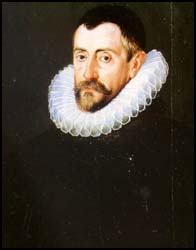
Francis Walsingham (c. 1530 - 1590) was born in London to a well-off, well-connected family and educated at King's College, Cambridge and abroad, and was admitted to the bar at Gray's Inn in 1553. Walsingham leaned Protestant; he left England for Switzerland and Italy when the virulently Catholic Mary Tudor took the throne. He continued his legal studies at Basel and Padua, and did not return to England until 1558, after Mary had died and her Protestant sister Elizabeth I succeeded her. In 1559 he was elected to Elizabeth's first parliament.
By 1569, Walsingham was working with William Cecil to search out and counteract plots against Queen Elizabeth, and he helped to foil the Ridolfi Plot designed to depose Elizabeth and replace her with her Catholic cousin, Mary, Queen of Scots.
In 1570 Walsingham was appointed ambassador to France, where in 1572 he witnessed the horrendous weeks-long St. Bartholomew's Day Massacre, in which thousands of French Huegenots (Protestants) were slaughtered. This experience marked Walsingham deeply, and in the future, whenever the opportunity arose, he showed no mercy to Catholics. He supported the torture of Catholic priests and the extraction of confessions from suspected conspirators by use of torture. He also supported giving land grants in Ireland to English settlers, who he believed would work the land more productively than the Irish had been doing. This policy fostered Irish resentment, needless to say, and the eventual result was centuries of horrific English-Irish warfare, a.k.a. "The Troubles."
Walsingham returned to England in 1573, having earned the Queen's trust by the loyalty and talent he had shown during his years in France. In December of that year, Walsingham was appointed to the Royal Privy Council, and became the Queen's Principal Secretary (an office later known as Secretary of State). In that role, he became an indispensable advisor to the Queen, second only to William Cecil, the Lord Treasurer. Walsingham was in charge of all of Elizabeth's correspondence and decided the agendas of council meetings. He was a big supporter of British trade and exploration, including Francis Drake's circumnavigation of the globe (1578-81). Perhaps most importantly, he became known as Elizabeth's "spymaster;" he employed a master cryptographer, as well as a fleet of "intelligencers" throughout Europe and North Africa that enabled him to foil many and varied plots against the Queen's life. Walsingham didn't invent spying, but he's the one who raised it to an art form.
Perhaps the most remarkable thing about Walsingham's lifelong faithfulness to Queen Elizabeth was the fact that the two of them didn't like each other very much, and they both knew it. His surviving letters (not to her, of course) contain observations such as "I would to God her Majesty would be content to refer these things to them that can best judge of them [i.e., him], as other princes do," and that there was not a councilor in her service "who would not wish himself rather in the furthest part of Ethiopia than to enjoy the fairest palace in England." But neither of them ever let their personal animosities get in the way of their professional relationship, and they worked together to their mutual benefit for over 20 years.
In 1582-83, Walsingham uncovered another plot to kill Elizabeth and replace her with Mary, Queen of Scots. The British ringleader was executed and the Spanish ambassador, who had been deeply involved, was expelled from England. By 1585 Mary, Queen of Scots had been imprisoned, and was tricked into believing that she ha a single means of secret communication with the outside world (letters hidden inside a beer keg). Those letters enabled Walsingham to prove that she had been engaged in yet another plot against the Queen's life. Mary was tried, convicted, and in 1587, despite Elizabeth's reluctance, executed.
MARY QUEEN OF SCOTS (WITH HEAD STILL ATTACHED)
From 1586 on, Walsingham began to receive reports from his spies about Spanish plans to invade England. By keeping himself well-informed on all the preparations, he was able to order counter-preparations, and thus he contributed greatly to the defeat of the Spanish Armada in 1588.
Walsingham's health had been in decline since 1571, and became very bad in the late 1580's. But he continued to work; he attended his last Council meeting two weeks before his death from cancer in 1590. His political legacy is decidedly mixed, but as a spymaster, he was second to none.
Subscribe to:
Posts (Atom)