to bring you this important photo of Leo, my newest family member!
Leo is an approximately 7-year-old cockapoo who was found so neglected, his coat so hopelessly matted, that the shelter had to shave him down to the skin. His hair is still growing back, as you can see, and he still needs to put on some weight, but what a handsome little boy he'll be! He and Finney (partially seen to the right) got along just fine during our meet-and-greet, after an initial warning growl or two. Leo is friendly, gentle and affectionate, and his temperament will remind us every day of our beloved Murphy, whom we lost to cancer in February.
Leo isn't home with us yet because we're going to Washington next weekend to visit our adult son, but we're picking up our new baby on our way back on Sunday. And now we know what to do when he arrives home, thanks to the video posted on Saturday by Giulie Castillo, fellow A to Z blogger and dog rescuer extraordinaire, at Life in Dogs! Thanks, Giulie! Thanks, Animal Alliance of Lambertville, New Jersey! And thanks to whatever higher powers have brought little Leo into our lives!
Monday, April 18, 2016
O IS FOR ORANGE IS THE NEW BLACK
In age-old European tradition, jails were used as holding facilities for people charged with crimes but not yet sentenced. That's still how jails are used in the 21st century, although now prisoners are segregated by gender and by an age of majority. Back then, everyone was just jammed together in one disgusting common area. But nowadays, there are also prisons - places to which people get sentenced as punishment for their crimes. Before the 16th century, that concept didn't exist. Punishment for petty crimes usually consisted of some form of humiliation, like public flogging or being exhibited in the stocks (also called the pillory).
For more serious crimes, the punishment was usually execution in one grisly form or another. I won't go into detail about these methods because some people might inexplicably find it unpleasant to read about, but if you do have a perfectly understandable curiosity about practices such as drawing and quartering, you can just look it all up yourself. Sorry, but I'm here to talk about prisons.
In the 15th and 16th centuries, crime rates soared throughout Europe as populations increased, economies suffered, and rural residents fled to the cities to try to make a living. If they couldn't succeed there in feeding themselves and their families by legal means, many turned to illegal ones. The traditional penal systems started becoming unmanageable, and it was apparent that something was going to have to change.
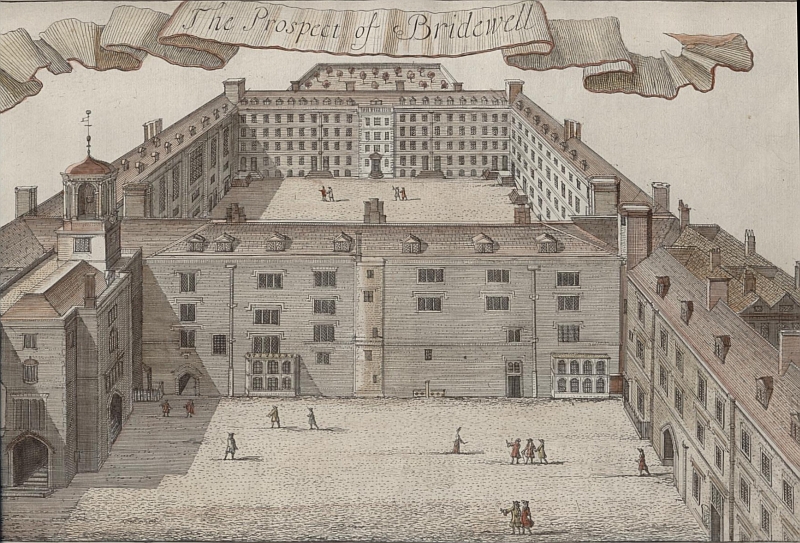
That change started in London in 1553. In that year, Bridewell Palace, originally built for King Henry VIII in 1515, was donated by Edward VI to the city, which revamped it into a prison facility for petty criminals. That category included "vagrants," i.e., homeless people. Instead of being subjected to brief public humiliation, the prisoners - all of them poor - would instead be both punished and (so it was thought) reformed through a period of enforced hard work, for which they would be paid a small wage. More than half of the prisoners were also beaten. And yes, the opening of Bridewell Prison was indeed considered a reform; after all, it gave the benevolent state the opportunity to help the poor to help themselves!
One actually beneficial innovation at Bridewell was providing services to homeless children. Operating as the prison's charitable component, which was called a "hospital," Bridewell provided to its apprentices a rudimentary education and a course of training under masters in useful trades.
But of course, it was the "reformist" system of managing indigent populations through incarceration, and not necessarily the "hospital" idea, that soon spread throughout England and the rest of Europe, along with the name "Bridewells." I'll put in my own two cents here by saying that the system still sounds shockingly familiar to me as a 21st-century American.
And then things got even worse in the prisons when the Black Plague swept through Europe in the mid-1500s. Aware that the terrible sanitation conditions (see my B for Bathrooms post) and cramped living quarters conditions among the poorer classes quickened the spread of the outbreak, the Powers that Be hit upon the novel idea of sending debtors to prison in vast numbers. After all, the more poor people who were locked up, the fewer there were still out on the streets to spread disease, possibly even (OMG) to the upper classes. In the prisons, the reasoning went, the only people they could infect was each other, so... really, how much of a loss could that be?
The Plague eventually died out, carrying with it about a third of Europe's population. But the practice of debtors' prisons persisted into the 19th century, when it ensnared the father of the young Charles Dickens, among countless others.
![]() |
| "Debtors Prison," by William Hogarth |
Saturday, April 16, 2016
N IS FOR NOSE JOBS
There was no shortage of fashionistas in the 16th century,
but cosmetic surgery was unheard of - with one exception. Physicians performed rhinoplasties - otherwise known as nose jobs - although I'm using that term in a misleading way. We're talking about full nasal reconstruction procedures, not small tweaks. Men of that era tended to have a nasty habit of lopping each others' noses off during duels and swordfights. In fact, that's what happened to Tycho Brahe (1546-1601), the renowned Danish astronomer, who lost most of his nose in a duel and for the rest of his life wore a metal (some say silver) prosthesis over it. And diseases like cancerous tumors and syphilis did their fair share of nasal damage too.
But the history of cutting off someone's nose to punish or humiliate them goes back much farther than the medieval era. An article by plastic surgeon Larry Nichter, M.D., provides the following information:
Examples abound in Asian and European literature. In the ninth
century the Danes slit the noses of Irishmen who could not pay
the annual levied tax of one ounce of gold. Sixtus Quintus of
Rome (1521–1590) ordered nasal amputation of thieves and
other rogues. In 1769–1770 Pritivi Narayan, the Ghoorka King
of India, ordered the amputation of nose and lips of all 865 male
inhabitants in the recently captured city of Kirtipoor, Nepal. Only
musicians who played wind instruments were excluded. Adding
insult to injury, he changed the city’s name to Naskatapoor, which
means “city without noses.”15 In recent times, too, the Dacoits of
Northern India plundered a village and punished resistance by
amputating the noses of their enemies.
Nichter also says that in India, mutilation of the nose was practiced "on women suspected of infidelity, on sexual offenders, and as a prime means of 'mortal revenge.'" Because nasal mutilation was not uncommon in that country, it's thought that the practice of nasal reconstruction originated in India. The first detailed description of nasal replacement is found in a classical Indian text written in about 600 B.C. The method employed was removal of a flap of skin from the patient's cheek, attaching it to the bridge of the nose to maintain a blood supply, sewing it in place over the nose area, and binding it all together with bandages until healing was complete. At some later point, the "Indian method" of nasal reconstruction came to involve the use of a flap of skin from the middle of the patient's forehead, rather than from his cheek.
Gradually, Indian medical knowledge spread to the West. In 15th-century Italy, the Branca family of Sicily - whose members were NOT physicians - developed a new and innovative technique for nasal reconstruction using a flap of tissue taken from the upper arm. This knowledge was apparently transmitted to an Italian surgeon, Gaspare Tagliacozzi (1545-1599), a professor at the University of Bologna, who went on to popularize the procedure as the "Italian method," and to discuss it in detail in his 1597 treatise, De Curlorum Chirurgia per Insitionem, the first text in any language to discuss plastic surgery exclusively.
What made the Italian method unique was that it involved only partially removing the skin flap from the arm. One end would remain attached so as to continue the blood flow, and the free end would be shaped into a nose and grafted onto the patient's face. How? Like this:
The arm would be held immobilized in that position for weeks while the graft firmly attached itself, after which the flap would be cut from the arm and the new nose would be molded into shape. The bottom line, I would say, was that nobody in his or her right mind would undergo this kind of torturous procedure just to remove a bump or two. The intent was to give noses to the noseless. In Tagliacozzi's words:
We restore, rebuild, and make whole those parts which nature hath given, but
which fortune has taken away. Not so much that it may delight the eye, but that
it might buoy up the spirit, and help the mind of the afflicted.
Healing the wounded body and the wounded spirit at the same time. It sounds like good medicine to me.
but cosmetic surgery was unheard of - with one exception. Physicians performed rhinoplasties - otherwise known as nose jobs - although I'm using that term in a misleading way. We're talking about full nasal reconstruction procedures, not small tweaks. Men of that era tended to have a nasty habit of lopping each others' noses off during duels and swordfights. In fact, that's what happened to Tycho Brahe (1546-1601), the renowned Danish astronomer, who lost most of his nose in a duel and for the rest of his life wore a metal (some say silver) prosthesis over it. And diseases like cancerous tumors and syphilis did their fair share of nasal damage too.
But the history of cutting off someone's nose to punish or humiliate them goes back much farther than the medieval era. An article by plastic surgeon Larry Nichter, M.D., provides the following information:
Examples abound in Asian and European literature. In the ninth
century the Danes slit the noses of Irishmen who could not pay
the annual levied tax of one ounce of gold. Sixtus Quintus of
Rome (1521–1590) ordered nasal amputation of thieves and
other rogues. In 1769–1770 Pritivi Narayan, the Ghoorka King
of India, ordered the amputation of nose and lips of all 865 male
inhabitants in the recently captured city of Kirtipoor, Nepal. Only
musicians who played wind instruments were excluded. Adding
insult to injury, he changed the city’s name to Naskatapoor, which
means “city without noses.”15 In recent times, too, the Dacoits of
Northern India plundered a village and punished resistance by
amputating the noses of their enemies.
Nichter also says that in India, mutilation of the nose was practiced "on women suspected of infidelity, on sexual offenders, and as a prime means of 'mortal revenge.'" Because nasal mutilation was not uncommon in that country, it's thought that the practice of nasal reconstruction originated in India. The first detailed description of nasal replacement is found in a classical Indian text written in about 600 B.C. The method employed was removal of a flap of skin from the patient's cheek, attaching it to the bridge of the nose to maintain a blood supply, sewing it in place over the nose area, and binding it all together with bandages until healing was complete. At some later point, the "Indian method" of nasal reconstruction came to involve the use of a flap of skin from the middle of the patient's forehead, rather than from his cheek.
Gradually, Indian medical knowledge spread to the West. In 15th-century Italy, the Branca family of Sicily - whose members were NOT physicians - developed a new and innovative technique for nasal reconstruction using a flap of tissue taken from the upper arm. This knowledge was apparently transmitted to an Italian surgeon, Gaspare Tagliacozzi (1545-1599), a professor at the University of Bologna, who went on to popularize the procedure as the "Italian method," and to discuss it in detail in his 1597 treatise, De Curlorum Chirurgia per Insitionem, the first text in any language to discuss plastic surgery exclusively.
What made the Italian method unique was that it involved only partially removing the skin flap from the arm. One end would remain attached so as to continue the blood flow, and the free end would be shaped into a nose and grafted onto the patient's face. How? Like this:
We restore, rebuild, and make whole those parts which nature hath given, but
which fortune has taken away. Not so much that it may delight the eye, but that
it might buoy up the spirit, and help the mind of the afflicted.
Healing the wounded body and the wounded spirit at the same time. It sounds like good medicine to me.
Thursday, April 14, 2016
L IS FOR LASER TAG
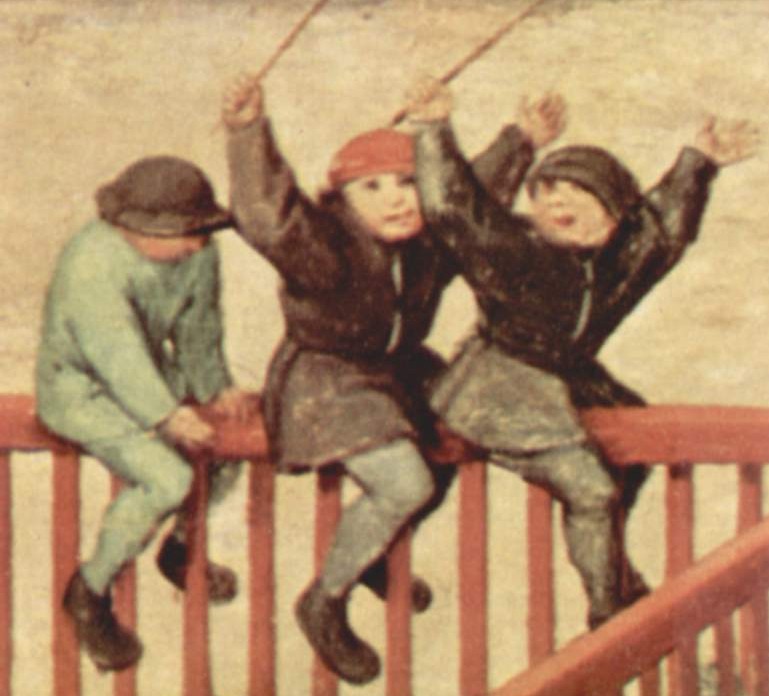
I will grudgingly admit that you can't play laser tag without laser, and no, laser had not been discovered in the 16th century. But there were games resembling tag, and one of them seems to have been popular among adults - the laser tag of its day, so to speak.
There was a children's game called "hide-fox and all after" which is widely considered to have been identical with hide-and-seek. There was also a rustic game, popular with all ages, known as "base," "prison base," or prison bars." And here I will quote at length from an article describing various games which are mentioned in Shakespeare's plays:
The success of this pastime depended upon the agility of the candidates, and their skill in running. Early in the reign of Edward III ([which lasted from 1327-1377] it is spoken of as a childish amusement, and was prohibited to be played in the avenues of the palace at Westminster during the session of Parliament, because of the interruption it occasioned to the members and others in passing to and fro as their business required. It was also played by men, and especially in Cheshire and other adjoining counties, where it seems to have been in high repute among all classes. Strutt [Joseph Strutt, 18th-century antiquarian and historian] thus describes the game: "The performance of this pastime requires two parties of equal number, each of them having a base or home to them-selves, at the distance of about twenty or thirty yards. The players then on either side, taking hold of hands, extend themselves in length, and opposite to each other, as far as they conveniently can, always remembering that one of them must touch the base. When any one of them quits the hand of his fellow and runs into the field, which is called giving the chase, he is immediately followed by one of his opponents. He is again followed by a second from the former side, and he by a second opponent, and so on alternately until as many are out as choose to run, every one pursuing the man he first followed, and no other; and if he overtake him near enough to touch him, his party claims one toward their game, and both return home. They then run forth again and again in like manner until the number is completed that decides the victory. This number is optional, and rarely exceeds twenty.
Got all that? Sounds like some form of group partner-tag, with only one person that each pursuer can tag. The game sounds okay, but what I really love about this quote is the mental image of kids (and possibly adults) running around like lunatics in the halls of Parliament, tripping everyone in their path. Could this be the missing ingredient that might actually make the U.S. Congress functional?
p.s. Both of these illustrations come from paintings by Pieter Bruegel the Elder, about whom you read in my "I" post. But if you didn't read my I post yet, it's not too late!
Wednesday, April 13, 2016
K IS FOR KINDLE
It's not plagiarism if you steal from yourself, am I right? I've previously written about someone who did for 16th-century readers much of what the Kindle has done for 21st-century readers: made books more portable and thus, more accessible. So without further ado, I'm going to quote part of a post I did for last year's A to Z Challenge about Aldus Manutius (1449-1515), an Italian humanist who, among other things, is considered the father of standardized punctuation. Although there are still some people who chafe at punctuation rules, no one can dispute that at least one of his printing innovations profoundly changed the way people read books.
Manutius was a publisher and printer who invented italic type, developed some elements of modern punctuation, and perhaps most importantly, introduced the idea of printing inexpensive volumes of books bound in vellum in "octavo" size - much smaller and more portable than the then-standard size [my 2016 note: up to that point, books were usually printed either in folio size - four pages to a sheet of paper - or quarto size - eight pages to a sheet. Octavo size was appreciably smaller - sixteen pages to a sheet] - that were distributed and read much as paperback books are in modern times. Manutius, and the Aldine Press which he founded, had no less of an admirer than Erasmus, who worked at Manutius's press for a while during his stint in Italy, and had this to say:
However one may sing the praises of those who by their virtue either defend
or increase the glory of their country, their actions only affect worldly pros-
perity, and within narrow limits. But the man who sets fallen learning on its
feet (and this is almost more difficult than to originate it in the first place) is
building up a sacred and immortal thing, and serving not one province alone
but all peoples and all generations. Once this was the task of princes, and it
was the greatest glory of Ptolemy. But his library was contained between the
narrow walls of its own house, and Aldus is building up a library which has
no other limits than the world itself.
Manutius founded the Aldine Press, and came up with the logo of a dolphin wrapped around an anchor, inspired by an image on ancient Roman coins. The logo was such a success that it was immediately pirated by French and Italian publishers, and is still used by Doubleday, a Random House division.
Tuesday, April 12, 2016
J IS FOR JENNY CRAIG
I'll be the first to admit that there were some pretty bizarre forms of medical treatment in the 16th century (just wait until you get to my post for R). But although we of the 21st century might not agree with our 16th century peers about the causes of obesity, most of the recommended remedies would strike us as quite familiar.
In early human history, it was virtually impossible for anyone to be overweight. Having to hunt for one's food required a tremendous amount of physical activity, and food itself often came in the form of large animals fully capable of killing and eating you first.
But eventually, based on the urgent need of ensuring an adequate food supply, humans learned both to farm crops and to domesticate food animals, and the activity of getting your next meal became much less fraught with peril. In fact, people got so good at producing food for themselves that eventually most societies had a comfortable abundance (at least for those who could afford it). Simultaneously, lifestyles were becoming more sedentary, and by Roman times, physicians were treating excess weight as a public health problem. What treatments did they suggest? For the most part, exercise and a healthy diet.
Since the time of Hippocrates (460-370 B.C.), through the 16th century, and for at least 100 years after it, most people believed that good health was maintained by a proper balancing of the four humors in the body: blood, phlegm, yellow bile and black bile. Obesity, like many other physical ailments, resulted from an imbalance in the system, and the goal was to figure out ways to rebalance.
The Roman physician Galen (A.D. 131-201?), whose theories governed medical practice up to and throughout the Middle Ages, described his treatment for obesity as follows:
I have made any sufficiently stout patient moderately thin in a short time,
by compelling him to do rapid running, then wiping off his perspiration
with very soft or very rough muslin, and then massaging him maximally
with restoratives, and after such massage leading him to the bath after
which I give him nourishment immediately but bid him rest for a while
or do nothing to which he was accustomed, then lead him to a second
bath and then give him abundant food of little nourishment so as to
fill him up but distribute little of it to the entire body.
Similarly, Avicenna (A.D. 980-1037), a highly influential physician of the Arab world, wrote:
The regimen which will reduce obesity. Produce a rapid descent of the
food from the stomach and intestines, in order to prevent completion
of absorption by the mesentery. Take food which is bulky but feebly
nutritious. Take the bath before food, often. Hard exercise...
The early 16th century marked the beginning of the so-called Age of Science, during which people began to use hypothesis and experiment as methods to discovering solutions. Antonio di Paolo Benivieni (1443-1502) was the author of a pathology textbook published posthumously in 1507, in which he provided the first known pathological descriptions (case studies) of obese individuals, as well as discussions of treatments.
Luigi Cornaro (1467-1566) was an Italian layman who published a short book, Discourses on a Sober Life, in 1558 describing his own struggles to conquer obesity and his eventual success. He made no secret of what he believed to be the cause of his excess weight; his book began, "O wretched, miserable Italy! Does not thou plainly see that gluttony deprives us of more soul years than either war or the plague itself could have done?" Cornaro came from a wealthy Venetian family and had freely indulged himself in food and drink until about the age of 40, when his health problems began to catch up with him. He consulted with his doctor, who advised him to eat only wholesome foods, and only in small quantities. Cornaro immediately followed this advice and lost all of his excess weight, and his health problems all disappeared. He became a zealot for healthy living, published his book at age 80, and lived to see the fourth edition published when he was 99.
But, as we know in the 21st century and as physicians probably knew in the 16th, prescribing diet and exercise to counteract obesity doesn't always work.
Monday, April 11, 2016
I IS FOR INSTAGRAM
It's true that cameras weren't going to be invented until the mid-1800s. But the 1500's did mark a period during which some artists started to take a different approach toward depicting people.
In the 1400's, most people who were having their portraits painted looked as if they had just come straight from the taxidermist.
Of course, this didn't apply to all 15th-century portraits,
especially if they were painted by Albrecht Durer.
But, let's face it, a lot of other 15th-century portraits looked positively posthumous.
But then we arrive at the 16th century. Check out this El Greco portrait.
To me, this woman looks ready to swoosh off the page and into the room. Or how about this one, a self-portrait by Artemisia Gentileschi?
I can hear the lute music, can't you? Or this guy, by Andrea del Sarto:
He's looking at me with extremely mixed feelings, as if to say: who are you and what exactly are you doing here?
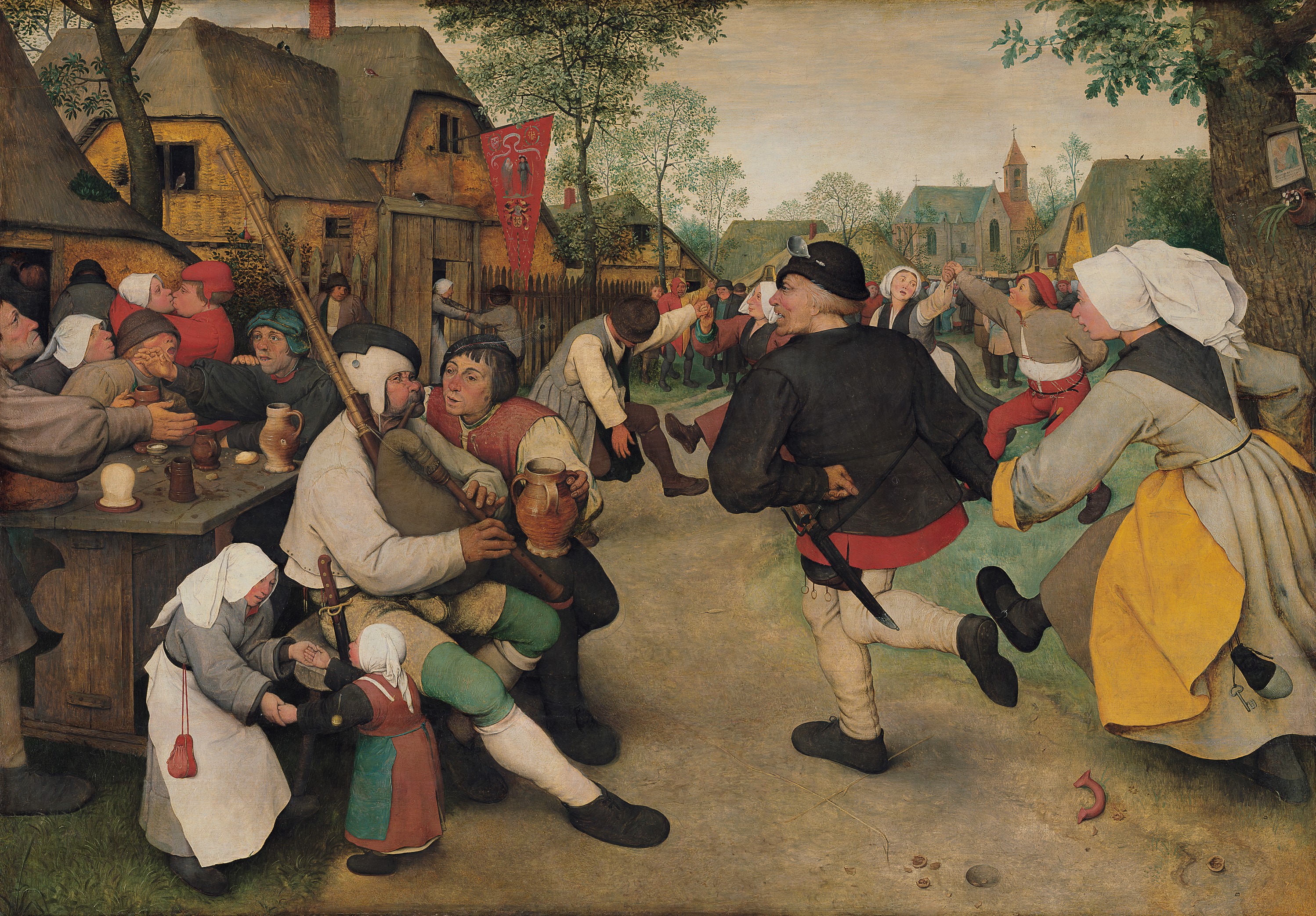
But it wasn't just portraiture that changed. Pieter Bruegel the Elder (1525-1569) came up with the revolutionary idea of not just painting wealthy patrons and religious subjects, but actually painting peasants as they went about their daily business. He would dress as a peasant himself so he could travel incognito and mingle among his hoped-for subjects, and some of his results were the equivalent of candid snapshots of a social class and a lifestyle which other middle or upper class Europeans believed weren't worthy of observation.
Children's Games (1560)
The Peasant Wedding (1567)
Click! Unlike those 15th-century nobles who spent fortunes getting their portraits painted, only to come out looking like waxworks, these peasants still live and breathe over 500 years later.
Subscribe to:
Posts (Atom)