Thursday, April 14, 2016

L IS FOR LASER TAG


     I will grudgingly admit that you can't play laser tag without laser, and no, laser had not been discovered in the 16th century.  But there were games resembling tag, and one of them seems to have been popular among adults - the laser tag of its day, so to speak.
     There was a children's game called "hide-fox and all after" which is widely considered to have been identical with hide-and-seek.  There was also a rustic game, popular with all ages, known as "base," "prison base," or prison bars."  And here I will quote at length from an article describing various games which are mentioned in Shakespeare's plays:

The success of this pastime depended upon the agility of the candidates, and their skill in running. Early in the reign of Edward III ([which lasted from 1327-1377] it is spoken of as a childish amusement, and was prohibited to be played in the avenues of the palace at Westminster during the session of Parliament, because of the interruption it occasioned to the members and others in passing to and fro as their business required.  It was also played by men, and especially in Cheshire and other adjoining counties, where it seems to have been in high repute among all classes.  Strutt [Joseph Strutt, 18th-century antiquarian and historian] thus describes the game: "The performance of this pastime requires two parties of equal number, each of them having a base or home to them-selves, at the distance of about twenty or thirty yards.  The players then on either side, taking hold of hands, extend themselves in length, and opposite to each other, as far as they conveniently can, always remembering that one of them must touch the base.  When any one of them quits the hand of his fellow and runs into the field, which is called giving the chase, he is immediately followed by one of his opponents.  He is again followed by a second from the former side, and he by a second opponent, and so on alternately until as many are out as choose to run, every one pursuing the man he first followed, and no other; and if he overtake him near enough to touch him, his party claims one toward their game, and both return home.  They then run forth again and again in like manner until the number is completed that decides the victory.  This number is optional, and rarely exceeds twenty.

Got all that?  Sounds like some form of group partner-tag, with only one person that each pursuer can tag.  The game sounds okay, but what I really love about this quote is the mental image of kids (and possibly adults) running around like lunatics in the halls of Parliament, tripping everyone in their path.  Could this be the missing ingredient that might actually make the U.S. Congress functional?  

 
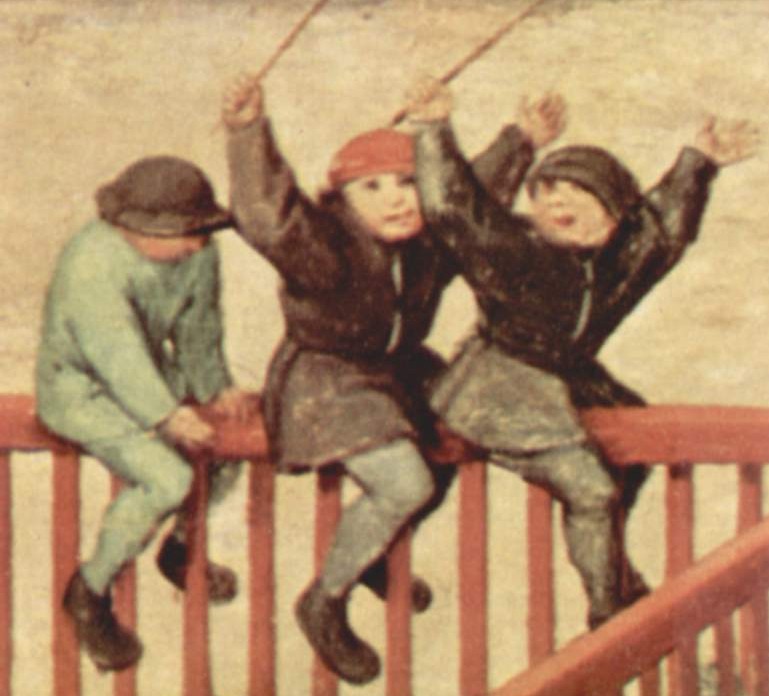
p.s.  Both of these illustrations come from paintings by Pieter Bruegel the Elder, about whom you read in my "I" post.  But if you didn't read my I post yet, it's not too late!

Wednesday, April 13, 2016

K IS FOR KINDLE


     It's not plagiarism if you steal from yourself, am I right?   I've previously written about someone who did for 16th-century readers much of what the Kindle has done for 21st-century readers: made books more portable and thus, more accessible.   So without further ado, I'm going to quote part of a post I did for last year's A to Z Challenge about Aldus Manutius (1449-1515), an Italian humanist who, among other things, is considered the father of standardized punctuation.  Although there are still some people who chafe at punctuation rules, no one can dispute that at least one of his printing innovations profoundly changed the way people read books.

   Manutius was a publisher and printer who invented italic type, developed some elements of modern punctuation, and perhaps most importantly, introduced the idea of printing inexpensive volumes of books bound in vellum in "octavo" size - much smaller and more portable than the then-standard size [my 2016 note: up to that point, books were usually printed either in folio size - four pages to a sheet of paper - or quarto size - eight pages to a sheet.  Octavo size was appreciably smaller - sixteen pages to a sheet] - that were distributed and read much as paperback books are in modern times.  Manutius, and the Aldine Press which he founded, had no less of an admirer than Erasmus, who worked at Manutius's press for a while during his stint in Italy, and had this to say:

             However one may sing the praises of those who by their virtue either defend
             or increase the glory of their country, their actions only affect worldly pros-
             perity, and within narrow limits. But the man who sets fallen learning on its
             feet (and this is almost more difficult than to originate it in the first place) is
             building up a sacred and immortal thing, and serving not one province alone
             but all peoples and all generations. Once this was the task of princes, and it
             was the greatest glory of Ptolemy. But his library was contained between the
             narrow walls of its own house, and Aldus is building up a library which has
             no other limits than the world itself.

     Manutius founded the Aldine Press, and came up with the logo of a dolphin wrapped around an anchor, inspired by an image on ancient Roman coins.  The logo was such a success that it was immediately pirated by French and Italian publishers, and is still used by Doubleday, a Random House division.

Tuesday, April 12, 2016

J IS FOR JENNY CRAIG

     I'll be the first to admit that there were some pretty bizarre forms of medical treatment in the 16th century (just wait until you get to my post for R).  But although we of the 21st century might not agree with our 16th century peers about the causes of obesity, most of the recommended remedies would strike us as quite familiar.
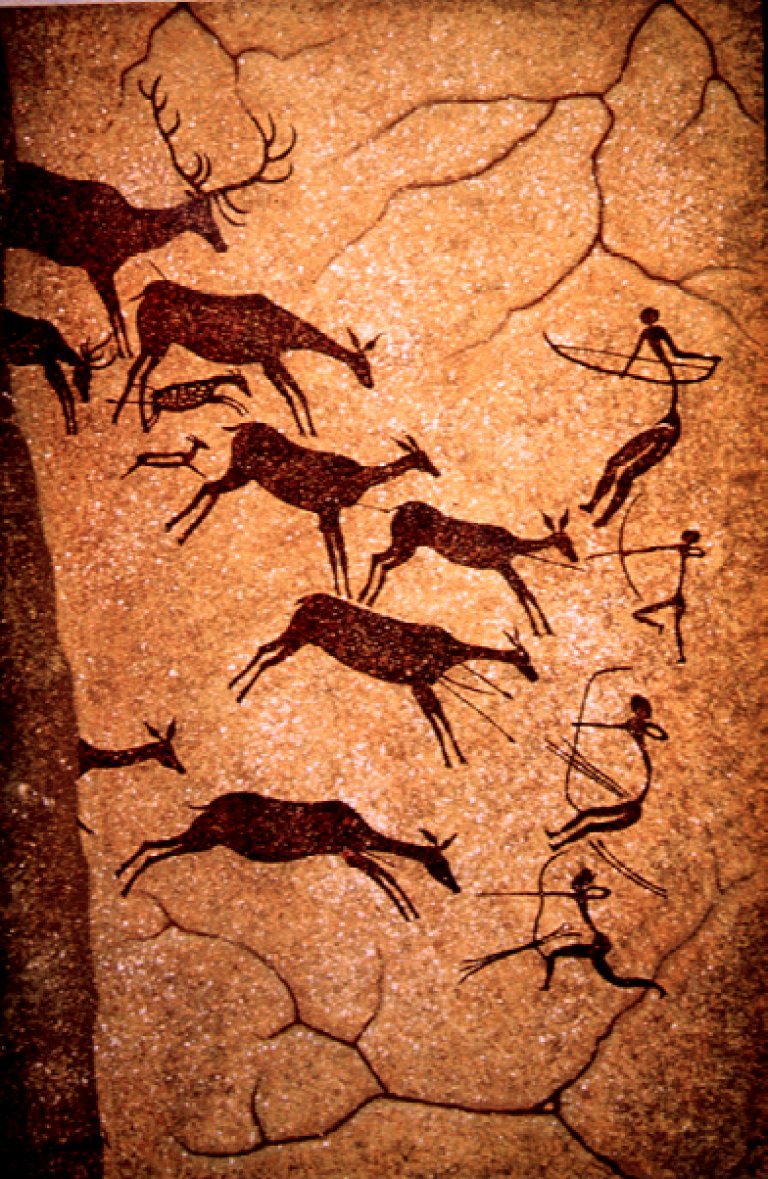
     In early human history, it was virtually impossible for anyone to be overweight.  Having to hunt for one's food required a tremendous amount of physical activity, and food itself often came in the form of large animals fully capable of killing and eating you first. 


     But eventually, based on the urgent need of ensuring an adequate food supply, humans learned both to farm crops and to domesticate food animals, and the activity of getting your next meal became much less fraught with peril.   In fact, people got so good at producing food for themselves that eventually most societies had a comfortable abundance (at least for those who could afford it).  Simultaneously, lifestyles were becoming more sedentary, and by Roman times, physicians were treating excess weight as a public health problem.  What treatments did they suggest?  For the most part, exercise and a healthy diet.
      Since the time of Hippocrates (460-370 B.C.), through the 16th century, and for at least 100 years after it, most people believed that good health was maintained by a proper balancing of the four humors in the body: blood, phlegm, yellow bile and black bile.  Obesity, like many other physical ailments, resulted from an imbalance in the system, and the goal was to figure out ways to rebalance.
     The Roman physician Galen (A.D. 131-201?), whose theories governed medical practice up to and throughout the Middle Ages, described his treatment for obesity as follows:
           
               I have made any sufficiently stout patient moderately thin in a short time,
               by compelling him to do rapid running, then wiping off his perspiration
               with very soft or very rough muslin, and then massaging him maximally
               with restoratives, and after such massage leading him to the bath after
               which I give him nourishment immediately but bid him rest for a while
               or do nothing to which he was accustomed, then lead him to a second
               bath and then give him abundant food of little nourishment so as to
               fill him up but distribute little of it to the entire body.
 
     Similarly, Avicenna (A.D. 980-1037), a highly influential physician of the Arab world, wrote:

               The regimen which will reduce obesity.  Produce a rapid descent of the
                food from the stomach and intestines, in order to prevent completion
                of absorption by the mesentery.  Take food which is bulky but feebly
                nutritious.  Take the bath before food, often.  Hard exercise...
 
     The early 16th century marked the beginning of the so-called Age of Science, during which people began to use hypothesis and experiment as methods to discovering solutions.  Antonio di Paolo Benivieni (1443-1502) was the author of a pathology textbook published posthumously in 1507, in which he provided the first known pathological descriptions (case studies) of obese individuals, as well as discussions of treatments.
     Luigi Cornaro (1467-1566) was an Italian layman who published a short book, Discourses on a Sober Life, in 1558 describing his own struggles to conquer obesity and his eventual success.  He made no secret of what he believed to be the cause of his excess weight; his book began, "O wretched, miserable Italy!  Does not thou plainly see that gluttony deprives us of more soul years than either war or the plague itself could have done?"  Cornaro came from a wealthy Venetian family and had freely indulged himself in food and drink until about the age of 40, when his health problems began to catch up with him.  He consulted with his doctor, who advised him to eat only wholesome foods, and only in small quantities.  Cornaro immediately followed this advice and lost all of his excess weight, and his health problems all disappeared.  He became a zealot for healthy living, published his book at age 80, and lived to see the fourth edition published when he was 99.
      But, as we know in the 21st century and as physicians probably knew in the 16th, prescribing diet and exercise to counteract obesity doesn't always work.


Monday, April 11, 2016

I IS FOR INSTAGRAM


         It's true that cameras weren't going to be invented until the mid-1800s.  But the 1500's did mark a period during which some artists started to take a different approach toward depicting people.
     In the 1400's, most people who were having their portraits painted looked as if they had just come straight from the taxidermist.


 Of course, this didn't apply to all 15th-century portraits,


especially if they were painted by Albrecht Durer.


     But, let's face it, a lot of other 15th-century portraits looked positively posthumous.


     But then we arrive at the 16th century.  Check out this El Greco portrait.


To me, this woman looks ready to swoosh off the page and into the room.  Or how about this one, a self-portrait by Artemisia Gentileschi?


I can hear the lute music, can't you?  Or this guy, by Andrea del Sarto:


He's looking at me with extremely mixed feelings, as if to say: who are you and what exactly are you doing here?  
     But it wasn't just portraiture that changed.  Pieter Bruegel the Elder (1525-1569) came up with the revolutionary idea of not just painting wealthy patrons and religious subjects, but actually painting peasants as they went about their daily business.  He would dress as a peasant himself so he could travel incognito and mingle among his hoped-for subjects, and some of his results were the equivalent of candid snapshots of a social class and a lifestyle which other middle or upper class Europeans believed weren't worthy of observation.

 
                                                    Children's Games (1560)


The Peasant Wedding (1567)


                                                The Peasant Dance (1569)

     Click!   Unlike those 15th-century nobles who spent fortunes getting their portraits painted, only to come out looking like waxworks, these peasants still live and breathe over 500 years later.

Friday, April 8, 2016

G IS FOR GPS

     Absolutely correct!  It's the sun, moon and stars.


      In the 16th century, the biggest problem wasn't finding your way on land, where there were usually distinguishing features (unless you were Hansel and Gretel).  And for another thing, unless you were heading into uncharted territories, there were maps.

                                                (first printed map of Wales, 1573)

(16th-century map of London)

     Besides, even if you were headed into parts unknown, on land you could use an astrolabe - a device first developed in the ancient Muslim world - to determine your latitudinal location through the positions of the heavenly bodies.  But on the high seas, one wave looks pretty much like another, and the pitching and tossing of a ship made astrolabes unreliable.  And as it happened, exploration by sea was the name of the game in 1500's Europe, and so it was urgent that your country find ways to get your ship to the New World before another country got its ships there first.
     Magnetic compasses were in widespread use by then, and so you could always generally determine the direction in which your ship was headed.  Mariner's astrolabes - made of brass and much sturdier and heavier than regular land-base astrolabes - were known of by the time of Columbus's voyages, but were too rudimentary to be very useful until 16th-century Portuguese explorers redesigned and improved them.  The new mariner's astrolabes enabled sailors to determine their latitude by measuring the angle between the horizon and the North Star.  And because the North Star is often obscured by clouds or fog, and is below the viewer's horizon in the southern hemi-sphere, sailors learned to use the sun as an alternative point for measurement.
     
    
     But 16th-century mariners could not calculate longitude, because that required comparing local time with the time at a distant location, as determined by a clock, and 16th-century mechanical timepieces were not accurate enough to afford that kind of precision.   So instead, navigators used a system called "dead reckoning," which essentially consisted of educated guesswork.  Starting at a known position, the navigator would make his best estimate of the heading and speed of the ship and the speed of the ocean currents.  Time was determined by very careful onboard monitoring of hourglasses, and speed was determined by throwing one end of a weighted rope, knotted at regular intervals, overboard, and then counting how many of the knots passed through a sailor's fingers during the running of a one-minute hourglass (which is why nautical miles per hour are still called "knots").
     These methods might not sound like much, but, as they say, the proof is in the pudding.  Before the year 1600, both Ferdinand Magellan (in 1519-22) and Sir Francis Drake (in 1577-80) had circum-navigated the globe.

Crew of Willem Barentsz fighting a polar bear in the Arctic (1596)
 

Thursday, April 7, 2016

F IS FOR FACEPALMS

     Guys.  I hate to break this to you, but you did not invent the facepalm.


Not by a long shot.


Dismay, regret, anguish - they've been with the human race for a long, long time.  It's instinctive in those situations to cover your eyes so you can't see, to cover your face so you can hide in shame.  When Adam and Eve got exiled from the Garden of Eden, don't you think there was some serious facepalming going on?


                                                             Sistine Chapel facepalm


And the moral of the story is:

And there you have it.

Wednesday, April 6, 2016

E IS FOR ELECTRIC SLIDE


     You don't have to be so literal about it!  Maybe there was no electric slide, per se, in the 16th century, but those guys killed it when it came to line dances!
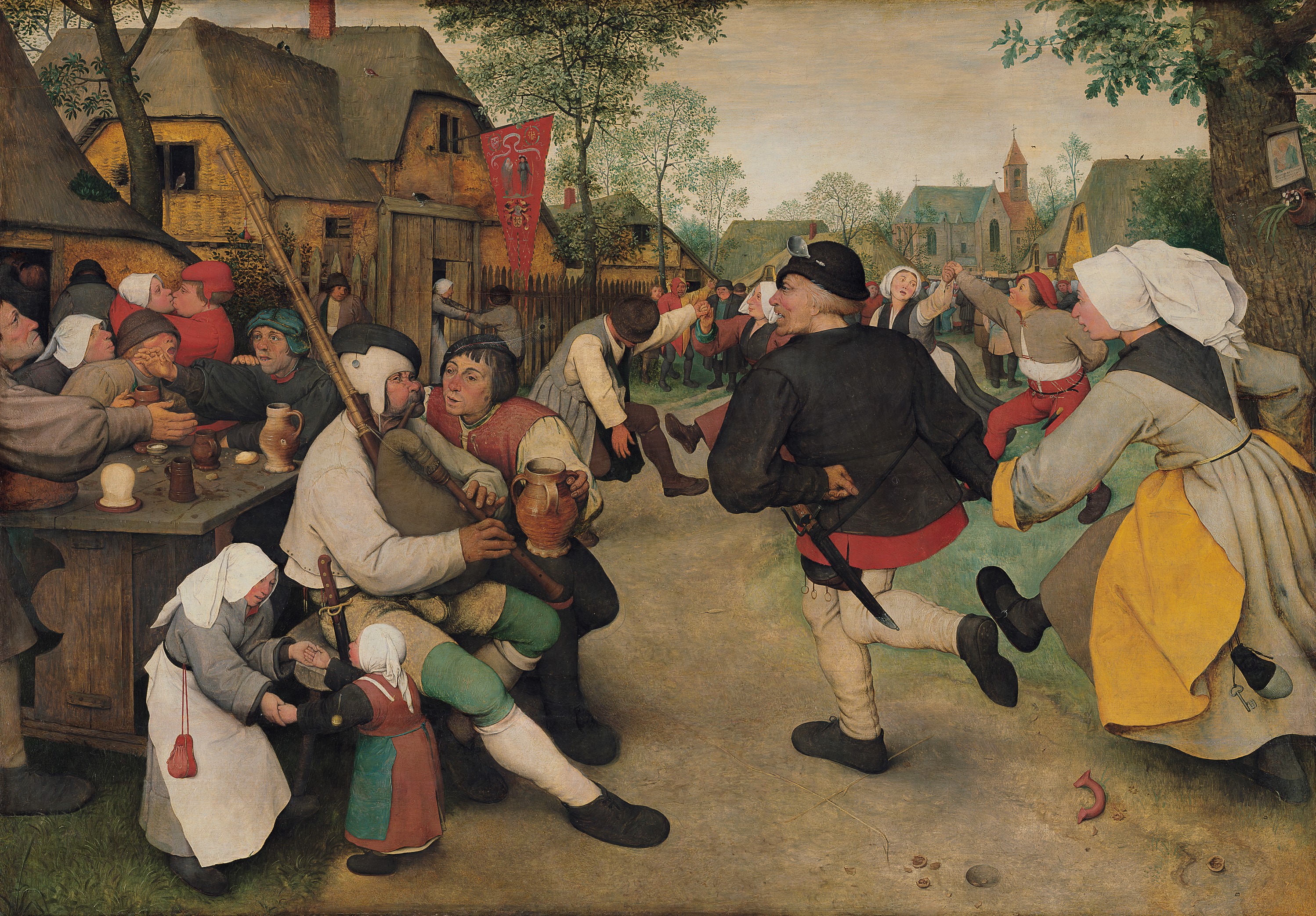
     The peasants had line dances


as well as Morris dances, which sometimes involved costumes and mumming (play-acting).


And the merchant classes had some simple circle dances,


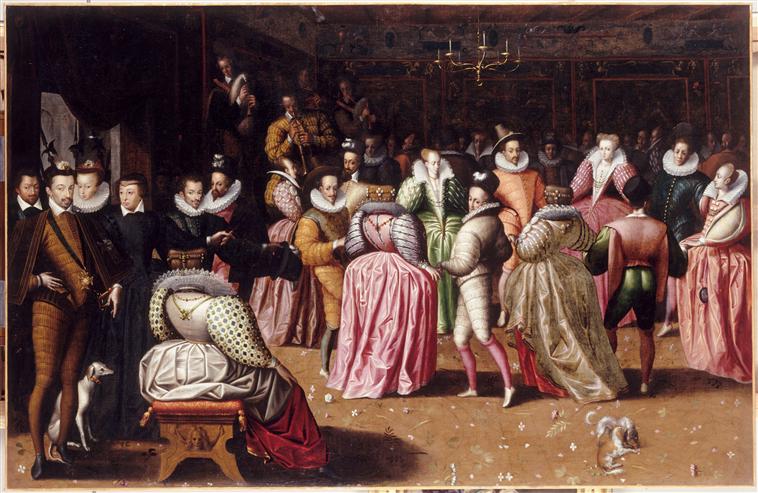
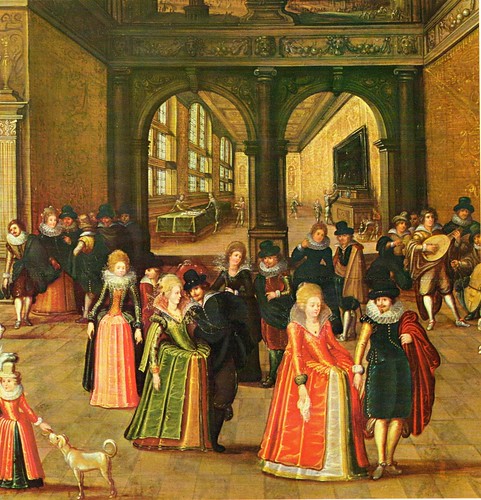
but of course, at royal courts, everything got much more elaborate.


And the royals had line dances too.  The Pavane, for example, was a slow, stately, processional dance for couple, like so:


     and like so.


Yep, here too, with a smaller crowd.


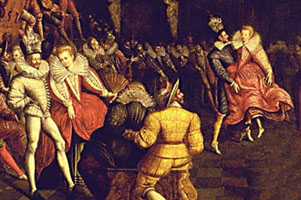
     But listen: you can't just Pavane, Pavane, Pavane all the time, am I right?  Bor-ing.  Sometimes you have to kick up your heels!  And that's just what these 16th-century folks are doing, in a lively dance called la Volta:


     Some people claim that's Queen Elizabeth I herself in the upper right, cutting a rug with her "favorite," Robert Dudley, and showing an indecent expanse of leg.  And OMG, where is her partner's hand???  But I don't buy that, and neither do a lot of people more knowledgeable than me.  Sure, Elizabeth had her wild side (and I bet there were plenty of coughing fits among the courtiers any time someone called her "The Virgin Queen,") but she was careful about her image, and she didn't go around making a spectacle of herself just for fun.  This is just a gathering of some other partying aristocrats, whoever they may be.
     So there were some pretty sprightly dances, considering how many pounds of clothing all the dancers were wearing.  La Branle was a 16th-century French style of chain dance which traditionally kicked off the dancing portion of banquets. The coupled-off dancers moved mainly from side to side either in a circle or a line.  It might not sound that thrilling, but there must be reasons why the name of that dance gave rise to the English word brawl! 
     Take that, Electric Slide!!