Saturday, October 10, 2015

MOONING OVER MARS

     My obsession with space began about ten years ago, when I first had the idea of writing a novel about a girl with an imaginary moon-sister.  The Hom were an advanced race of moon people who spent their lives in a system of underground chambers and tunnels, from where they closely monitored Earth and its inhabitants.  To write about the Hom, I had to read a lot about the moon, and I got hooked.

    
     The problem was that everyone who read my manuscript tried to convince me that the Hom part of the story just didn't belong in, and in fact detracted from, what was otherwise a contemporary realistic YA novel.  For years, I dug my heels in and refused to listen because... the Hom.  Those ten-foot-tall featureless spheres, each one identifiable by its signature color.  Rolling through their tunnels, projecting their own light, unspooling tubes from inside their bodies when arms are needed to perform tasks, or when they want to communicate with other members of their pods.  I know the Hom.  In a way, I am the Hom.
     It's only this year that I finally accepted reality and banished the Hom from the book.  No more Hom.  (Well, not in the book, anyway.  But you can't tell me they're not still out there.)  No more moon-sister.  But my feeling of kinship with the moon hasn't lessened.  Nor has my belief that planetary exploration is absolutely necessary for the human race, because without a doubt there is going to come a time when Earth is going to become overpopulated, or run out of fossil fuels, or we'll find some other way to destroy it (we're already doing a dandy job in that direction).  Or, even without our help, it will experience a natural disaster that will render it either temporarily or permanently uninhabitable, and our descendants are going to need an escape hatch.  A place to go.
     And now Mars has become the Cool Planet.  The next frontier.



And I want to live there. So then the question becomes: why?  I have a nice house right here on Earth, with everything I need right at hand.  Supermarket a mile away, CVS right down the street.  Fresh water flows through pipes directly into my kitchen and bathroom.  I can make the house warm in the winter and cool in the summer without having to know shit about the science involved.  Reliable WIFI.  I even have a generator in the garage in case the power goes out for more than a few hours.  Why would I want to leave?
     And it's not like Mars is hospitable. In fact, pretty much everything about it is inimical to human life.  Liquid water is great and all - it definitely beats NO liquid water - but then you think about transporting a desalinization plant there, and it gets tricky. EVERYTHING is tricky, beginning with mere survival.  But the night after I dragged my husband to see The Martian, I was too excited to sleep.  I couldn't stop thinking about the habitat, the rover, and the sheer Marsness of it all.  (Although, let's face it.  If you were the commander of a Mars crew, waiting anxiously at the end of a tether to catch a  crew member whom you unwittingly abandoned and who's survived alone on the planet for over a year and who is now in uncontrolled bodily flight in your direction - wouldn't you at least put out BOTH hands???  But I digress.)
     Oh, sure, you went to see THE MARTIAN too.  But did you later download NASA's 36-page report entitled "NASA'S JOURNEY TO MARS: Pioneering Next Steps in Space Exploration?"  If you didn't, allow me to recommend it, so that you too can revel in sentences like these: "Current MAV designs require a minimum lander size of just under 20 mt, assuming propellant can be generated from the Martian atmosphere via ISRU."  Those space scientists do love them some acronyms, don't they?
     But I couldn't pinpoint the source of my Martian obsession.  And then I remembered the Swiss Family Robinson.  (Whose name, by the way, wasn't Robinson.  That was for Robinson Crusoe.) How when I was a little girl, all I dreamed about was living like the Swiss Family Robinson, on a previously uninhabited island, having created an adorable treehouse and ingeniously added all the comforts of home, with (conveniently) someone else there to do all the sciencing.
     The images in my head of this idyll were so vivid, but thinking about it over the last few days, I couldn't remember where they came from.  I was pretty sure I'd never read the book, but had there been a movie I saw as a child?
     I looked it up.  The book was originally written in 1812 by a Swiss clergyman with four sons who wanted to teach them the virtues of industry, resourcefulness and self-sufficiency.  So he invented a family with four sons - go figure - that gets shipwrecked on a deserted island, and is fortunately able to rescue barrels and barrels of undamaged supplies from the ship, not to mention all the miraculously unharmed livestock, and they create their own little paradise.  Over the years, the story went the 19th-century equivalent of viral, and was adapted so many times by so many other writers so that it ended up becoming sort of a public-domain fable. 
     And then along came the 1960 Disney film version.


     Seriously, who could not want to live in that treehouse?  Who could not want to have a pet baby elephant in the front yard?  I know I did.  All this, and window curtains too!!


     Looking at those weirdly familiar 55-year-old movie stills, I know for sure that my parents must have taken 5-year-old me to see that movie, and that scenes from it have been forever burned into my brain.  And that is why I now want to go to Mars.  With a lot of scientists.  And a baby elephant in a customized space suit.  And window curtains.
     Obviously, I'm not the only one to have made that connection with space.


     It's actually kind of a no-brainer.  So.  Want to join me on the Red Planet?  But first - how good are you at practical science?  Because I'm a lawyer and a novelist, and I'm pretty sure I'm going to need some help with the tricky parts.

Wednesday, September 30, 2015

SPEAKING OF BANNED BOOKS, I JUST MET KATHERINE PATERSON


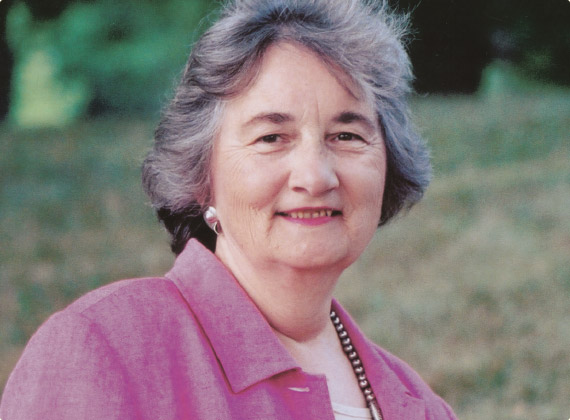
     Yes, that's actually me, sitting next to Katherine Paterson on her couch.  And the connection to Banned Books Week is that two of KP's books, BRIDGE TO TERABITHIA and THE GREAT GILLY HOPKINS, are on the American Library Association's list of the 100 most banned books (past and present) in this country.  KP wears this distinction as a badge of honor.  Full disclosure: I didn't earn the privilege of sitting next to this amazing woman on her couch; I bought it.  I was the highest bidder this spring for the "Tea With Katherine Paterson" prize in an auction sponsored by the Vermont College of Fine Arts, of which she is a board member.  But at least I won fair and square, and didn't have to lie, cheat or steal in order to spend three hours in the company of my writing hero.
     The prize was tea (the meal, not just the beverage) for me and one other person, so I enlisted Michele, my trusty friend and fellow writer, to take a one-night road trip with me from her home on Cape Cod to Montpelier, Vermont, where KP lives.  But KP has only lived in Montpelier (the state capital) for about two years.  Before then she lived with her family in Barre, the next town over, for 29 years - by far the longest she's ever lived in any one place - and Barre is clearly where her heart lies.   Her husband (recently deceased, hence KP's move to smaller living quarters in Montpelier) was a minister at the Barre Presbyterian Church.  The children's room in the Barre Public Library is named after her.
     Barre is a quirky place.  It bills itself as the Granite Capital of the World, and a short walk along the main street will bring you to oddities like a giant granite zipper in the ground


and an outdoor granite chair for your comfort (and ours).


     But Michele and I didn't take that little walking tour until the next day, after we spent the night at the wonderful Maplecroft B&B (if you're ever in Barre, make sure you check it out!)  KP Day was the day before, September 18th.  After our tea (which featured homemade scones) and chat, KP took us on a driving tour of Barre, as she had told us she'd like to do.  She pointed out some of the highlights, like this statue of the poet Robert Burns
 
 
and this World War I memorial to fallen soldiers, known locally (as KP gleefully informed us, and for obvious reasons) as Naked Neil:
 
 
     It was a lovely afternoon.  We got to know KP's adorable companion Pixie
 
 
and to spend some time with the very gracious KP herself.


     And yet it's taken me almost two weeks to put together a post about my pilgrimage.   Here's the thing.  I'm torn between feeling awed and grateful at having met KP (and still not quite believing that I really did), and feeling disappointed that the three of us didn't get to talk about her work.  I guess I was expecting that the conversation would flow naturally in that direction, but it never did, and Michele and I discovered afterward that we shared the distinct impression that KP didn't want the conversation to flow the way Michele and I were hoping it would.  That it would have been rude for us to ask questions about her books and her writing career.  In fact, when at one point Michele was brave enough to ask whether KP was planning to write any more novels, I almost gasped.  What if she's offended by the question?  What if she throws us out after we drove all this way? 
      Of course, she didn't throw us out, and if she was offended, she was too polite to show it.  Her answer was basically that she doesn't know whether she can do it without the support of her team.  Her agent has retired; the only editor with whom she's ever worked, Virginia Buckley, has retired; and her husband and biggest supporter is no longer here to cheer her along.
     But the rest of our questions remained unasked.  As Michele later said, she and I were apparently both just too well brought up.  We were taught to follow the host's lead, and that's what we did, especially because the host was one of the most revered and accomplished writers for young people in the world.  But of course, that's also why we wished we could have asked her more questions. 
     So there you have it.   I wish I had more news to share with you, but instead, all I have is these photos and the memory of a once-in-a-lifetime experience.  And I can pass along KP's exhortation for this week:  Celebrate banned books!!  


Wednesday, September 9, 2015

PLOTTING: WHAT? YOU WERE SERIOUS ABOUT THAT?

                            You don't like this jacket, Your Honor?  I thought you wuz kidding!

     A few weeks ago I had my manuscript critiqued by a very kind and very smart author, and you know what she told me?  That I needed to put more work into plotting!  What the hell?  Just because she asked me what my main character wanted, and what the climax of the story was, and other such annoying questions, and I didn't know the answers to any of them?  SO WHAT?  Didn't she know that because I'm a good writer, and I've created interesting characters, and the book begins at Point A and ends at Point B, I am exempt from the laws of plotting???
     Look.  It's not that I've never heard anyone talk about plotting.  I've attended several million writing conferences and workshops,  I've read one or two million writers' blogs and seen photos of their charts (some color-coded, some not), notebooks, index cards, Post-its, spreadsheets...  I got it, okay?  Some poor souls need to plot out their books.  I, on the other hand, do not.  Because I'm, ya know, gifted, I guess.
     Twenty years of trying to write novels before a tiny glimmer of light finally enters my thick skull.  Yes, I need to know before I write Page One what my main character wants, and pretty soon, she also needs to know what she wants, or nobody will care enough to keep reading about her.  Yes, I need to have the first half of the book lead inexorably toward the midpoint.  Yes, I need to then start gaining speed and tension until I'm barreling toward the climax, after which I can smoke a metaphorical  cigarette and reward myself with the denouement.  YES, YES, YES, OKAY?  I AM NOT SPECIAL.  I AM NOT EXEMPT.  I NEED TO LEARN TO PLOT JUST LIKE EVERYBODY ELSE, OR EVERYTHING I'VE EVER WRITTEN WILL JUST END UP IN A DRAWER ALONG WITH MY HOPES AND DREAMS.
     I was blind, but now I see. 


Which only means that now it's going to be possible for me to make the revisions I need to make.  "Possible" does not rule out "torturous."
     I hear there are people in the world who for some reason don't need to do everything the hard way.  I don't believe it, though, do you? 

Tuesday, August 25, 2015

ABOUT THOSE VACATION PHOTOS...

Vacation was great.


     We were in Vancouver and then Seattle.  I don't take a lot of photos on vacation so you can't see us in Whistler, a ski resort 2 hours north of Vancouver, ziplining between two mountains.  Yeah we did!!  Nor can you see us attending a Saturday night Bard on the Beach production of Shakespeare's Love's Labor Lost, set in the 1920's with all kinds of Jazz Age choreographed musical numbers thrown in.  It was a hoot!  But here are a few Vancouver shots my husband took:

                            (outside our hotel with some serious eye-rolling by my daughter)

                                         (Shannon Waterfall, just off the road to Whistler)

                                                       (some new friends)

                                                                    (ditto)

                                                           (double ditto)

     Nor do I have photos to display of our Underground Seattle Tour (which seemed to focus heavily on the city's history of sewage disposal) or of our Locked Room Challenge (which was cool, except that I discovered to my deep shame that I'm useless at locked room challenges.  Everyone else in my family did really well though).  I did force my daughter to pose for me at the wonderful Elliot Bay Bookstore


and my husband caught this lovely shot of me and my son at the aquarium gift shop:


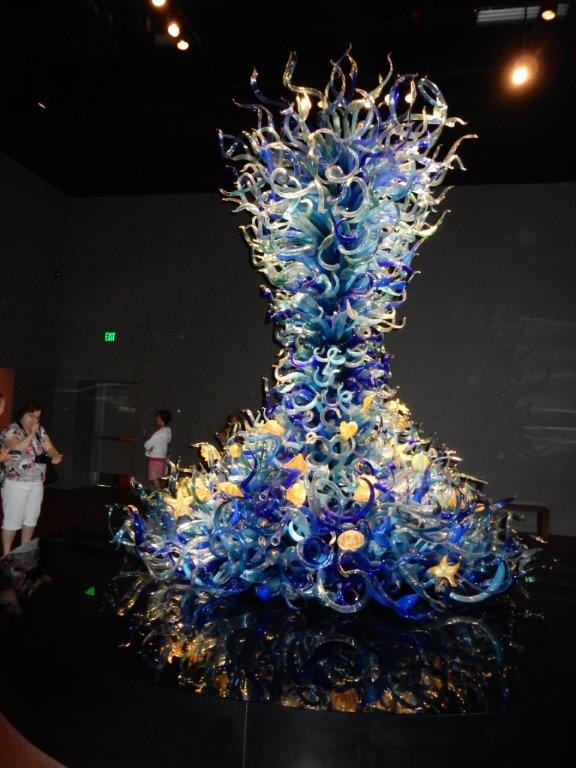
But the only time I really pulled my phone out and started snapping pics is when we got to the Chihuly Garden and Museum, because it was absolutely incredible.  First off, I should note that Dale Chihuly, one of the world's foremost glassmakers and a native of Tacoma, is a genius (I think that's beyond question) but is also completely whacked.  This museum/exhibit space of his in Seattle has a café, where we ate lunch, but before you enter the café you walk past two enormous wall-hung exhibit cases displaying a tiny fraction of his collection of bottle openers.  Two cases of bottle openers also hang in each of the nearby bathrooms.  So you start to get a sense of why it might be called the Collections Café, but you don't really get it until you're seated in the restaurant and you look up to the ceiling and see this:


Those are accordions.   Eighty-two of them on the ceiling, our helpful waiter told us.  Less than a fifth of Chihuly's full accordion collection, which he stores at various warehouses.  But if you thought that Chihuly only collects accordions and bottle openers, you were gravely mistaken.  He has MANY other collections, including but not limited to: shaving brushes; pre-WWII string dispensers; mid-20th-century wooden dollhouse furniture; vintage radios; and a category called chalkware, which is so supremely creepy that I had to take two pictures of the huge display cases:


     Okay, so there you have Dale Chihuly the Lunatic Collector.  But there is also Dale Chihuly, the man who single-handedly revolutionized the art of glassmaking, and on this subject, I will just let the photos speak for themselves.


     If you ask me, we could have done nothing else on vacation but seen the Chihuly exhibits, and it would still have been worth the trip.

Monday, August 17, 2015

STOPPING TIME

Best Things About Returning From a Family Vacation

1. My own home; bed; pillow.
2. Reuniting with the dogs.

Worst Things About Returning From a Family Vacation

1. Cooking!  Washing dishes!
2. Having a zillion tasks that were shelved until after vacation.
3. Thinking I see my son everywhere I go and then remembering it can't be him.

Absolute Worst Thing  About Returning From a Family Vacation

     The very worst thing, bar none, is having to confront the reality that none of us can stop time.  For a week or so, I can live inside the illusion that my husband and kids and I are still a four-person unit, and that status will never change.  Of course, it's already changed.  My son is a grown man with a job waiting for him to start in September and a new apartment he shares with his girlfriend.  My daughter is in college and even though she's still a work in progress, more and more often I see glimmers of the woman she's becoming.  But when the four of us go on vacations together, it's like we enter an unspoken pact to pretend that they're still The Kids and my husband and I are still The Parents.  No one tells The Kids they have to act that way, so I have to think that they derive some measure of comfort from this arrangement too.  Because of course all of us know that time has changed us and will keep changing us even more.  The four of us will drift apart and then, if we're fortunate, back together, but in new configurations.  They'll both start their own families, and those will become primary to them.  My husband and I will retire from our jobs at some point, and we'll have to figure out where our next steps will lead us.  The future is exciting, scary, inevitable.  So once in a while, for a short and finite time, it's restful to stop moving forward into whatever comes next.  It feels good for all of us to climb back into the nest together, and just be the way we used to be, even though we all know it's artificial.  And then our little idyll ends.


     Vacation photos to follow soon.

p.s.  This afternoon I came across a poem by Nilanjana Bose, a gifted poet whom I e-met during the A to Z Challenge, that perfectly fit my elegiac mood, so I thought I'd share it here.

SHELLS 
The laughter’s gone from this heart.
the lamplight’s gone from this home;
the threshold, the corners are dark,
the ones who’d lit it up depart
for cities from where no letters come;
for cities that no one returns from.
 
The water’s as tall as the crops -
the river’s too full of herself,
ear by ear the grain starts to rot,
the young scatter in search of jobs,
the old watch unable to help;
the lamp stands unlit on its shelf.

The fathers can keep their eyes dry
and keep their words clipped and brief;
but they pause far too much, they sigh,
and their lips suddenly pull awry;
the mothers are too bowed to weep
gone to places even beyond grief.

The water stands as high as the rice
the harvest has stopped in its tracks;
the lamp flickers once before it dies -
the light lays its head on the thighs
of the dark and the young men pack
for cities, and they don’t come back.

We’re become the shell of a house.
We’re become the shell of a loving.
See how our garments fall loose.
See how our proud heads are bowed.
Once here the bulbul used to sing,
she’s now fallen quiet, there’s nothing.
 
        *        *        *         *
     My feelings at the moment aren't quite as extreme as those Nila is expressing here - and I'd like to think I'm more than just an empty shell - but her poetry is always lovely, and always worth the read.  You can find more of it on her blog, http://nilabose.blogspot.com

Wednesday, July 29, 2015

BOOK REVIEW: ABOVE THE EAST CHINA SEA

     I do love me some Sarah Bird.  By which I mean that I love her novels, but I also mean that I have a very strong sense that if I were ever to actually meet her, I would want so badly to be her BFF.  Her books glow with wacky humor and deep compassion.  Her sharp intelligence enlivens all of her intricate plotlines and their satisfying conclusions.  She's one of the handful of authors whose names I periodically Google to see if they've published any new novels, and if they have, I scoop them up.  That's how I found out about Bird's ninth novel, ABOVE THE EAST CHINA SEA (Vintage Press, April 2015).


     Unlike her other novels, this one didn't draw me in at first.  Writers are always told to begin a story with a hook, and I have to admit that a first chapter consisting of a conversation in stylized language between a dead fetus and his dead teenaged mother missed the sweet spot for me by a wide margin.  But this was Sarah Bird, so I persevered.  I'm glad I did.
     We don't learn the name of Tamiko, the pregnant 15-year-old, who lived on Okinawa and died during World War II, until much later in the book, but we do learn a lot about her life before the War.  Her two parents exemplify opposite ends of the social spectrum at the time: her mother comes from a long line of pragmatic, rough-mannered Okinawan peasant farmers, while her father's family has long followed white-collar pursuits - mathematics and calligraphy -  and considers itself refined and elegant, superior in every way to those who toil in the fields.  Tamiko is ashamed of her mother, and ashamed that she takes after her physically: dark skin, round face, broad feet.  Her older sister Hatsuko, on the other hand, seems to have inherited more of her father's genes, and is everything Tamiko longs to be: beautiful, graceful, sophisticated.  Of course, Hatsuko was selected last year to be one of the Princess Lily girls - the chosen few from the entire island who will be invited to attend the one and only girls' high school.  Tamiko is up for the selection process this year, but she has almost no hope for her own prospects and is more or less resigned to her fate - a lifetime of farm work - in advance.  But when the war suddenly arrives on Okinawan shores in the form of invading American ships, the old social order is instantly upended.
     Switch gears to the book's other story, also set on Okinawa but 70 years after Tamiko's.  Luz James is a tough-talking, rule-breaking 17-year-old military brat who pulls off looking like she has her shit together, but secretly contemplatesending it all by jumping off one of the island's high black cliffs.  For Luz, Okinawa is just one more in the endless series of her mother's interchangeable short-term postings.  At first her mother pumps her up about the prospect of meeting their Okinawan relatives - Luz's maternal grandmother was from the island - but that idea is shut down totally after her mother receives a mysterious letter she refuses to discuss with Luz.  So now, the only difference between Okinawa and anyplace else, as far as Luz is concerned, is that this is the first time she's started over in a new place as an only child. When Luz's older sister stunned her by enlisting right out of high school and then promptly getting herself killed on her first deployment, Luz lost the only person who made her feel like she mattered.  All she's doing now is going through the motions of hanging out with yet another band of base-kid stoners while trying to decide whether it's even worth the effort.  But that begins to change when Luz finds herself trapped in a cave and follows the sound of whimpering until she comes upon a starving, wounded young Okinawan girl who wordlessly begs Luz for help - not for herself, but for her tiny newborn baby.  And it changes even more when she leads Jake, the handsome Okinawan boy who follows Luz to the cave because he's worried about her, back to where she saw the girl and her baby.  But now, only minutes later, there's nothing there but a pile of bones.
     But what's even crazier is how matter-of-factly Jake reacts when Luz can finally bring herself to tell him about the disappearing girl in the cave.  "This is Okinawa," he tells her.  "This is how it is: We live with the dead and the dead live with us.  It's not spooky or creepy or woo-woo; it's just how it is."  But what Jake fails to mention at that point is how much more true all of this becomes during the three-day festival of Odon, when the line between the living and the dead becomes so thin that it requires almost no effort to slip across it  - in either direction.
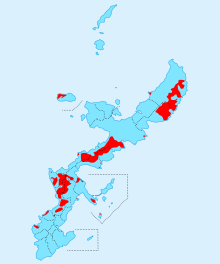
     I don't know about you, but my knowledge of Okinawa has, until now, begun and ended with Mr. Miaggi.  Wax on, wax off.  I didn't know that Japan had used Okinawa as a pawn in World War II, putting it in harm's way and then not even making a pretense of defending it.  I didn't know that, despite the fact that Okinawa had no stake in the outcome of the War, something like a third of its population was killed by the end of it.  And I didn't know that afterward, part of Japan's peace treaty with the Allied forces was its agreement to cede about one-fifth of Okinawa (which was given no say in the matter) to be used for American military operations. 


Or that it didn't matter to the Americans what they were plowing under - fertile fields, ancient burial grounds - in order to build their bases and airstrips.  I didn't know that the tiny island of Okinawa has been shamelessly screwed over by more powerful forces, time after time after time.
     I was bothered by one gaping plot hole.  There's a ton of backstory for all the major players, and a huge emphasis on family, but Luz's absent father barely even gets a mention.  Still, to me this omission is heavily outweighed by the sheer pleasure of reading this lovely novel and following its clues until, at the end, the reader fully understands how and why - as the Okinawans say - "life is the treasure."

Sunday, July 26, 2015

NEVER THOUGHT I'D GET THE CHANCE...

...to meet my #1 Kidlit Writing Hero, but barring something unforeseen, it's going to happen.  I'M GOING TO HAVE TEA AT HER HOUSE, you all!! Okay, first let's see if you can guess who it is.  This person:
     - was born in China between the two World Wars;
     - was a teacher in Japan;
     - has won (among many other awards) two Newbery Medals and two National Book Awards;
     - was recently a U.S. National Ambassador for Children's Literature; and
     - is (I just discovered) active on Facebook!

     It's Katherine Paterson, and here's how this came about.  In June I saw on someone's website that the MFA program of the Vermont College of Fine Arts was going to be hosting an auction.  Just out of curiosity, I looked to see what the prizes were, and saw to my amazement that one of them - the only one, as far as I was concerned - was Tea with Katherine Paterson (who's on the VCFA Board of Trustees) at her house.  I mean, how many world-famous writers do you know who would open up their homes to complete strangers and serve them tea??  So I pledged an absolutely insane amount of money, because talk about a once-in-a-lifetime opportunity!  And I won the auction, because luckily for me, no one else seemed to be willing to spend quite so much of his/her children's inheritance as I was.  Sorry, kids.  Someday maybe you'll understand.


     Katherine Paterson is who I want to be when I grow up.  She's been publishing books since the 1970s, and they've been delighting and inspiring me for twenty years or more.  And I heard her deliver a keynote address years ago at some conference or other, and she was exactly as awesome as I expected her to be, which is an extremely high bar to meet.  She signed books afterward, and when it was my turn to get her autograph and I asked her if I could give her a hug (yes, yes, I'm mortified that I did this, okay?), she didn't bat an eye, just smiled, stood up, came out from behind the desk, and hugged me back.
     Paterson has written picture books, a memoir, some essays and other nonfiction, and 16 novels for young people covering an enormous variety of subjects, both historical and contemporary.  The common thread between almost all of the novels is that her protagonists are outsiders and sometimes outcasts.  They're displaced persons, uncomfortable in their surroundings and, often, in their own skins.  Paterson understands them all so deeply that she makes the reader love them even though they don't (yet) know how to love themselves.  Paterson's background is intensely Christian (her parents were missionaries, her husband was a minister, she has an advanced degree in Christian education).  She doesn't ever use her books to shove her faith at you, but what she does do, over and over, is beautifully, credibly illustrate both the pain of isolation and the power of redemption.  Her books have brought solace to kids all over the world, and are very close to my heart.
     And in September I'm going to meet this woman and spend a few hours in her company and bask in her glow.  And then I'm going to come back home and write about every last detail.  So stay tuned.  And follow her on Facebook!  Because, as if all her other accomplishments weren't enough, apparently she's tech-savvy too!

p.s.  No, I'm sorry, you can't have tea with Katherine Paterson, because (as I might have mentioned)  I WON THAT, but maybe if you're lucky (and also cool with hijacking your family's financial security), you can have lunch with A.S. King: https://www.facebook.com/as.king.author/photos/a.286927082468.144637.45802717468/10153025337017469/?type=1&theater.  I guess writers eating meals with their slavering fans is a thing now! Go for it!