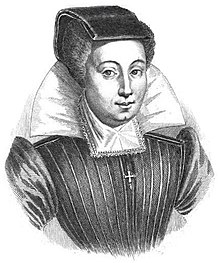
 Louise Bourgeois was born into a wealthy French family in 1563. At age 21, she married her neighbor, the master surgeon Martin Boursier, and they settled outside of Paris. (Boursier, by the way, had been a longtime student of an amazing man named Ambroise Pare ... and check back here on "P" day to learn more about him.) Five years later, while her husband was away in the army, Bourgeois and her three children were forced to flee from Henri IV, who had attacked the city of Paris during the Religious Wars, and to leave almost all their possessions behind. This left Bourgeois' family in a difficult financial situation. In order to help make ends meet, she began to study, and then practice, midwifery. For five years, she chose to practice among the poor, and in 1598 she passed the official licensing examination and became a registered midwife.
She must have very quickly developed an outstanding reputation, because only three years later, in 1601, Bourgeois was chosen to be the royal midwife to Queen Maria de Medicis, wife of that same Henri IV (apparently Bourgeois was willing to let bygones be bygones), and between then and 1610 she successfully delivered all of the Queen's six children. In the meantime, she managed to write and publish a book entitled (in English translation) Various Observations on Sterility, Miscarriage, Ability to Conceive, Childbirth, Female Illnesses, and Infants. So, clearly, she wasn't just in the business of delivering babies; she was a full-service ob/gyn. In the book, she described herself as "the first woman practicing my art to take up the pen." First published in 1609, this book was updated and republished multiple times over the next 40 years, was translated from the French into four other European languages, and it became the classic text on the subjects it covered.
Bourgeois continued to write and publish, as well as to work as a sought-after midwife to noblewomen, until 1627, when she served as midwife to Marie de Bourbon Montpensier, the Duchess of Orleans, who died of fever shortly after giving birth. The (male) physicians who performed Montpensier's autopsy determined that Bourgeois had been negligent, and her professional reputation suffered as a result.
Bourgeois did not let this setback put a stop to her career. She had a lifetime's worth of practical knowledge to impart to other women. Think about it: consider all the complications that can still arise in pregnancy and childbirth, and subtract 500 years' worth of scientific knowledge. This was not a profession for the faint of heart. Already 67 years old, when anyone else might have considered retirement, Bourgeois continued writing and publishing books until just before her death in 1636. Her last book, the Book of Secrets of Louise Bourgeois Boursier, published in 1635, was a compilation of recipes to treat female medical ailments such as skin eruptions and painful menstruation.
As an educated woman, married to a surgeon, practicing midwifery, Bourgeois aroused the distrust both of midwives from lower social classes (for being too book-smart) and of male medical practitioners (for not knowing her place). To quote from Collette H. Winn in ENCYCLOPEDIA OF WOMEN IN THE RENAISSANCE: "In a time of growing suspicion over women's capacities to handle child delivery, Louise Boursier understood the need for formal training and collaboration with male physicians and surgeons. She saw herself as the founder of a new generation of midwives, more knowledgeable and better trained. In her efforts to educate those who would follow her, she published Instruction a ma Fille (Notes for my Daughter), the first treatise in French on the art of midwifery. She recorded her theories on maternity care and her experiences in Parisian society in her Recit Veritable (True Account). This important work provides a unique source of information about midwifery practices in the early modern period as well as insights into the challenges women faced as they entered the professional world."
In other words: five hundred years before Sheryl Sandberg, Bourgeois was one of the first known proponents of leaning in!
